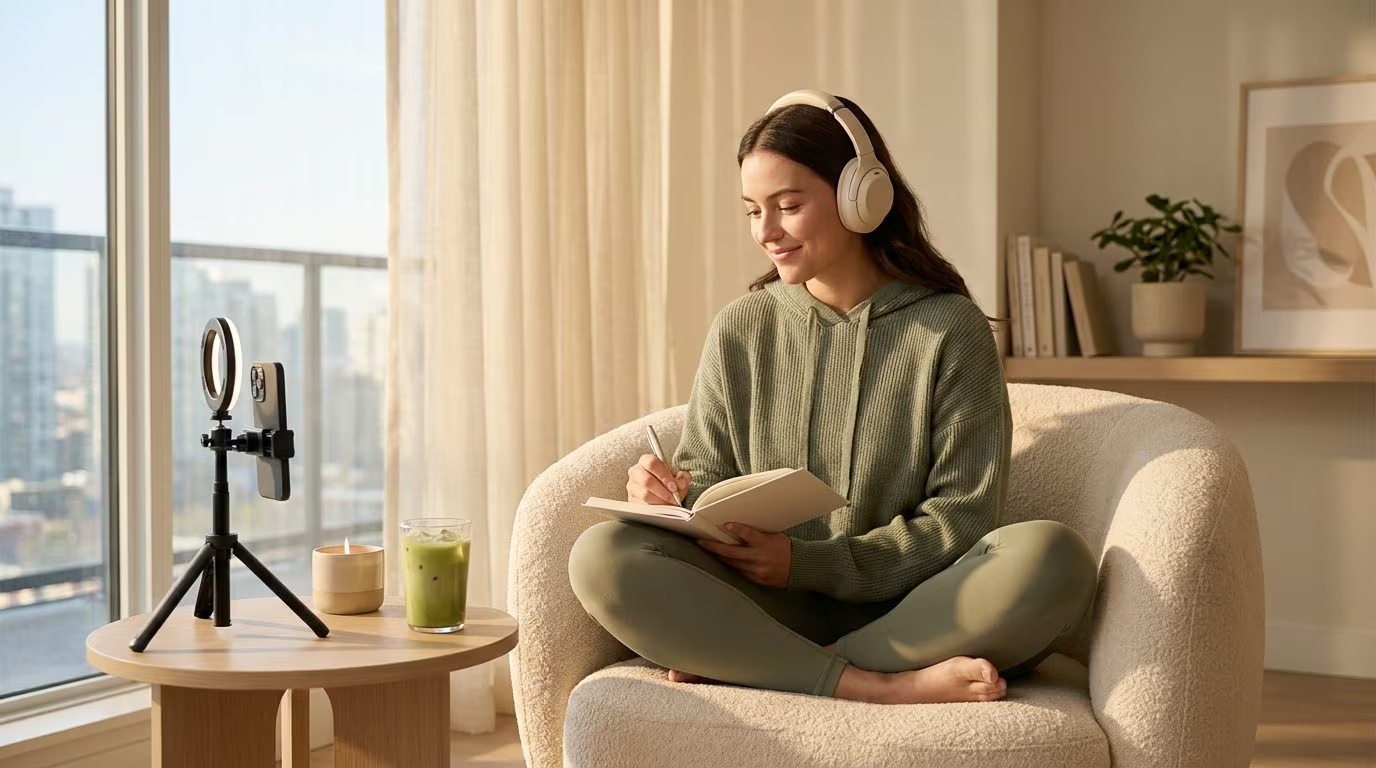
In recent years, a constellation of practices and narratives that revolve around the idea of “maximize yourself” (self-optimization) through the intentional reduction of social distractions, with creators and influencers chronicling and glorifying a life without partners and friends. In this context, the phenomenon that can be defined emerges “just maxxing”: a form of aestheticization of isolation in which loneliness is no longer just a condition, but an active project of personal improvement.
From Elrich Beck’s “structural individualization” to the analyzes of Zigmunt Bauman, this article explores the phenomenon as an extreme expression of neoliberal modernityin which the individual simultaneously becomes a project, an enterprise and a measure of his own value.
Loneliness as a historically variable form of social regulation
Sociological and anthropological literature shows that the loneliness it is not a stable category, but one socio-historical construction. In pre-modern contexts, isolation was predominantly associated with marginality or exclusion, with ascetic or religious life practices, or with rituals in which suspension of social life constituted a change in statussuch as entry into adulthood for young people.
In the latter case, solitude itself operated as one technique of discontinuity in the life of an individualaimed at redefining social status.
In contemporary modernity, we can observe a radical change in the perception and use of solitude. This device, in fact, undergoes a process of functional secularizationthat is, the ritual or ascetic function is taken away and a new one is assigned to him: isolation seems to lose its transcendental value, but is reinstated as tool for achieving and regulating attention, productivity or self-control.
From this perspective, we can read the emerging phenomenon that is becoming popular on TikTok, Youtube and Instagram, in which contents celebrating loneliness as conscious and desirable choice. In these videos people spend Saturday evenings alone, go entire days without having social interactions, training and studying alone.
It’s right inside this universe of re-signification of loneliness that the term “solo maxxing” emerged: used to describe the choice to dedicate time and energy almost exclusively to personal improvement, limiting relationships, outings and activities considered unproductive.
Structural individualization and construction of the self
To understand the success of maxxing alone is helpful look at some of the major changes that have characterized contemporary societies.
According to the sociologist Elrich Beck (1992), we live in an age of increasing individualization, called by Beck and Gernsheim (2002) “structural individualization”, in which once relatively predictable life paths (study, work, marriage, family) have become increasingly flexible and less determined by typical social expectations. Individuals find themselves thus a having to independently build one’s own identity and pathtaking on a responsibility which in the past was shared with institutions and communities.
Similarly, Anthony Giddensin Modernity and Self-Identity (1991), describes modernity as a context in which the if becomes a real “project“. It is no longer enough to live your life: you have to plan it, improve it, monitor it and make it consistent with the goals you have set for yourself.
It is precisely within this context that the “just maxxing” takes on meaning. The choice to reduce social interactions at least it is interpreted as a way to recover time, energy and concentration to invest in oneself.
When being alone becomes aesthetic
One of the most interesting aspects of “just maxxing” is that it doesn’t just promote loneliness, but the transforms into a real aesthetic. Videos of dawn wake-ups, solo workouts, late-night study sessions, walks with headphones and well-planned rigorous solo routines proliferate on social media.
It is therefore not simply shown someone who is alone, but someone who uses solitude in “virtuous” and productive way.
The sociologist Goffman offers an interesting interpretation since, in his study entitled The presentation of oneself in every day (1959), argued that in social life individuals tend to “stage” versions of oneself in front of others. In the case of “solo maxxing”, the staged performance is precisely about self-sufficiency: that is, the ability to be disciplined, concentrated and independent from others, which becomes a trait to be exhibited and enhanced.

Paradoxically, therefore, isolation is not experienced away from the gaze of others, but through it. There solitude becomes a content to be shareda test of personal strength and a form of social recognition.
In this sense, “solo maxxing” is not simply about being alone, but about turning loneliness into a symbol of success and self-control.
Structural paradox: isolation as a form of mediated sociality
“Just maxxing” therefore highlights a paradox typical of hyper-individualized societies: the reduction of direct interaction does not imply a reduction of sociality, but produces a different form of sociality, more indirect and mediated.
Even when daily interactions are reduced, loneliness, through digital content and platforms, is continuously observed, talked about and compared.
In this sense, the analyzes of sociologist Zigmunt Bauman (2000) help to clarify the paradox: in contemporary societies social ties are becoming more and more “liquids”Meaning what unstable and flexiblebut no less influential. Even isolation, apparently an escape from ties, remains within this fluid logic of connections and continuous comparisons.
The result is that “just maxxing” does not eliminate the social dimension, but reconfigures it. There loneliness it never is completely private: it becomes a form of experience that acquires value precisely because it is recognized, imitated and discussed within a collective space. In this paradox we can clearly see: in the attempt to maximize the “isolated self”the social dimension continues to be inevitably present.
