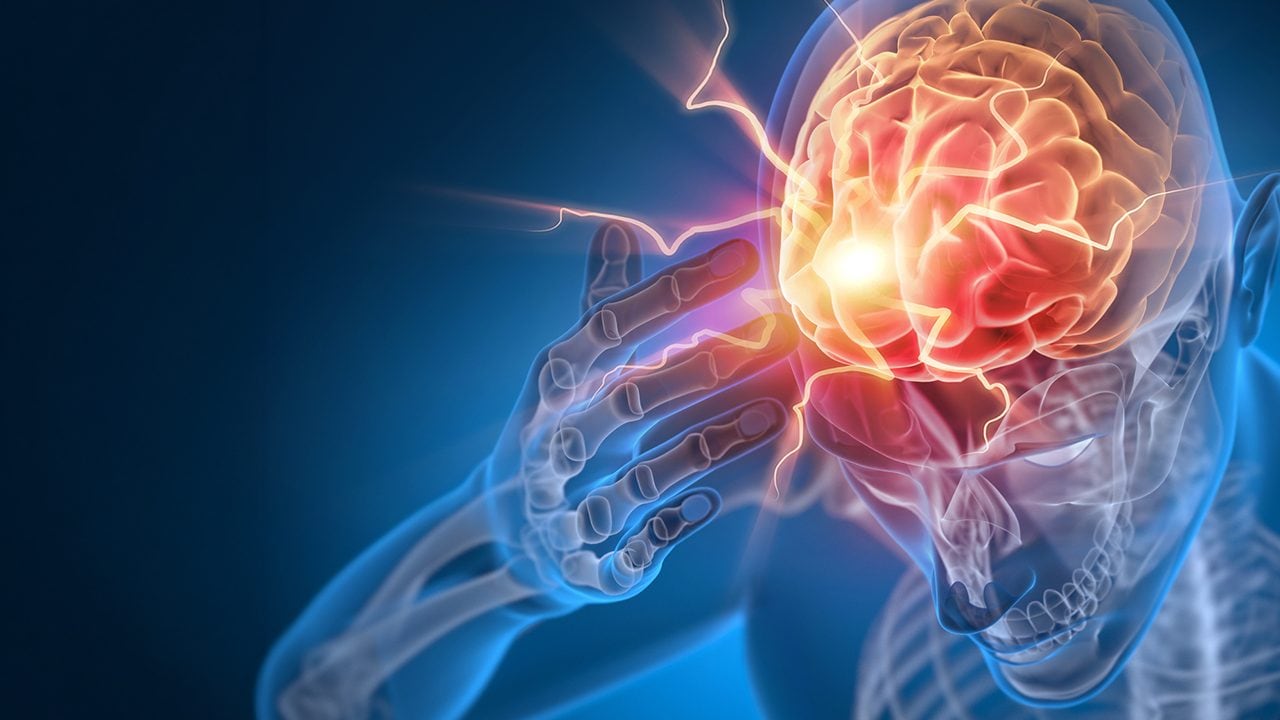
Pain and pleasure have always been considered opposite experiences but in reality the boundary between the two is blurred. In fact, modern neuroscience tells us that in the brain the separation between the two is much less clear than we think: they share the same circuits, the same neurotransmitters and influence each other directly. Pleasure can reduce pain, chronic pain can turn off the ability to feel pleasure, and the brain uses a kind of continuous balance between the two to guide our behaviors.
Pain and pleasure: two sides of the same coin
Pain and pleasure. For millennia philosophers, poets and religious people have described them as absolute opposites, the two extremes of human experience. Jeremy Bentham, an eighteenth-century English philosopher, stated that all human life is governed by these two “sovereigns”: fleeing pain and seeking pleasure. Yet modern neuroscience tells us a much more intriguing story: in the brain, pain and pleasure are not distant enemies, but neighbors who share the same circuits, the same neurotransmitters and, in certain cases, influence each other in surprising ways. Pleasure is a temporary reward, often associated with dopamine, while pain is a response to negative stimuli.
The brain as arbiter of the two sensations
Imagine an athlete who, in the midst of a decisive race, does not feel the pain caused by a sprain. Or think of the pungent pleasure of chili pepper or an ice cream bath. Why does the brain, in certain circumstances, “turn off” pain or even transform it into a positive sensation?
The answer lies in what researchers call Motivation-Decision Model, a model proposed by neuroscientist H. Fields. The underlying idea is as simple as it is elegant: the brain is constantly busy deciding what is most important for survival. If a more pressing reward or threat is in play, the pain may be temporarily suppressed. In evolutionary terms, it makes sense: an animal fleeing a predator can’t afford to stop because of a scraped knee.
This pain suppression mechanism is mediated by a sophisticated descending pain modulation system that starts from the brainstem and communicates with the prefrontal cortex, hypothalamus and amygdala. And the main chemical protagonists of this system are two: the endogenous opioids and the dopamine.
The role of endogenous opioids and dopamine
Our brain produces substances, called endogenous opioids (such as endorphins) and dopamine which are released during both painful and pleasant experiences. In particular, a structure called nucleus accumbensa kind of “pleasure center” in the brain, plays a key role in both types of experience.
- Endogenous opioids (endorphins): they modulate the emotional component of pain, how much it hurts, and amplify the pleasantness of experiences. They don’t eliminate the painful signal, but they make it more tolerable. They are released both during pain and during pleasant experiences (food, music, sex).
- Dopamine: it is not the neurotransmitter of pleasure, but of the motivation to seek it. In pain, it has analgesic effects and stimulates the release of opioids.
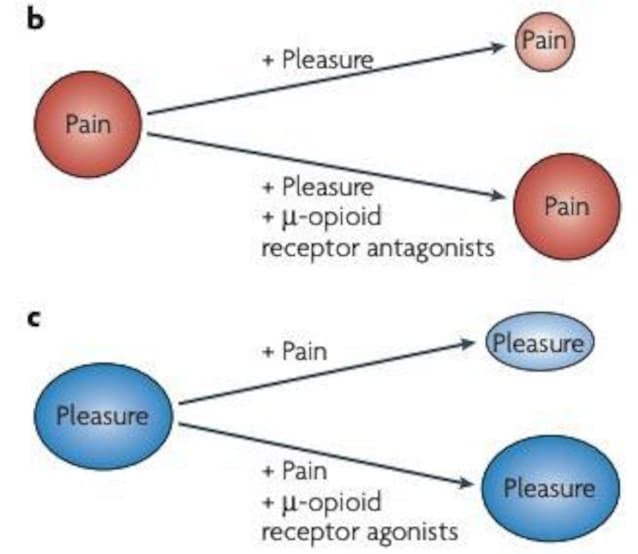
Pain and pleasure: same brain areas, two opposite experiences
Perhaps the most surprising evidence concerns neuroanatomy. When the researchers mapped the brain areas activated by painful and pleasant experiences, they found a striking overlap. The anterior cingulate cortex, the insula, the orbitofrontal cortex, the amygdala, the nucleus accumbens, the thalamus, the midbrain: all these structures are active both during pleasure and pain, albeit with different patterns.
Particularly interesting is the case of the ventral pallidum and the nucleus accumbens: both contain small areas, called “pleasure hot spots”, in which opioid stimulation increases the pleasantness of a sweet taste. But the same structures also contain populations of neurons that respond to pain. And the location of these two types of neurons, in the pallidum, is adjacent: the “pain neurons” are located lateral to the pleasure neurons. An anatomical proximity that suggests continuous functional interactions between the two systems.
