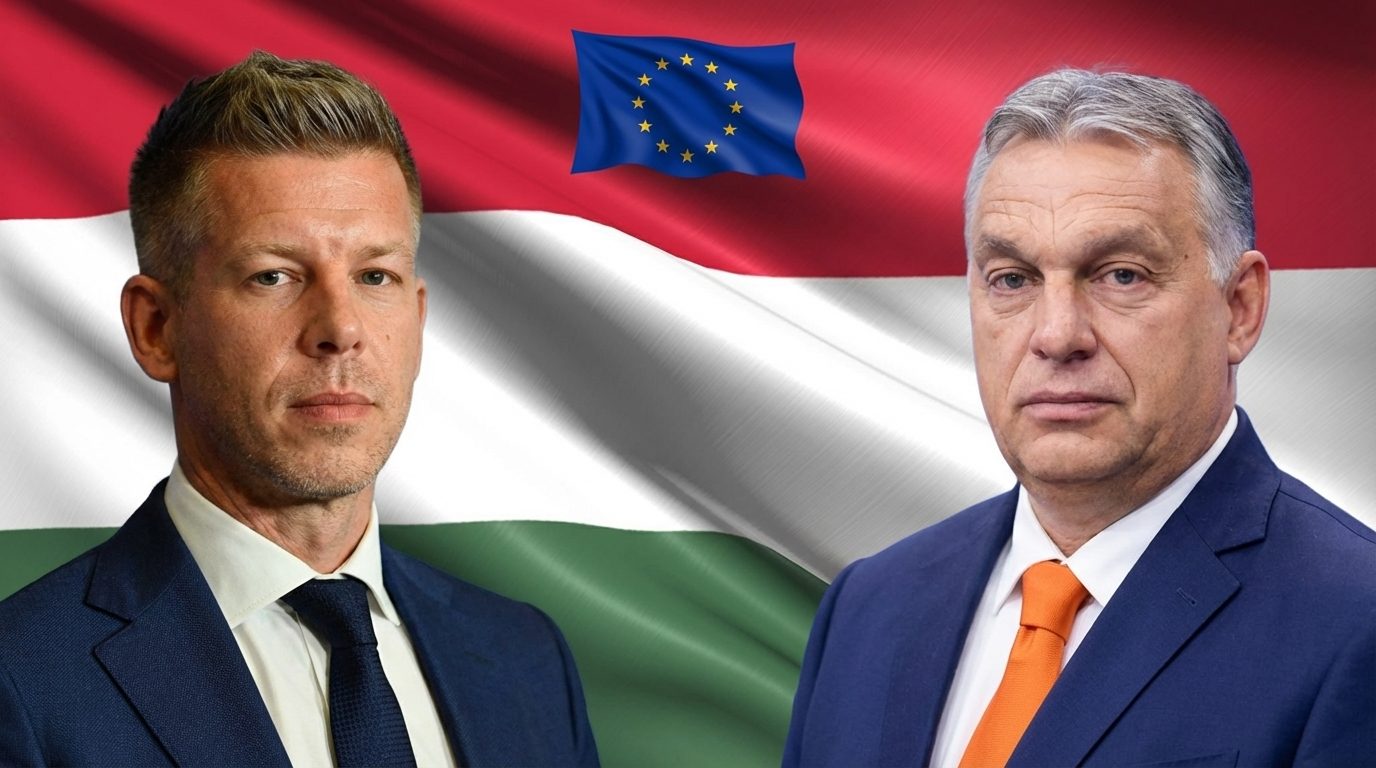
The Hungarian Prime Minister Viktor Orban and his party Fidesz they lost the elections, defeated by opposition party Tiszaled by Peter Magyar. This is a historic result – not only for Budapest but also for the internal dynamics of the European Union – which puts an end to 16 years of government under the leadership of Orban, during which the prime minister managed to greatly centralize power, coming to control the media, the judicial system and various state bodies.
The victory of the centrist party was overwhelming, even exceeding expectations: Tisza obtained 138 seats out of 199 (with over 53% of the vote), while Fidesz stopped at 55 seats, with 37% of the votes. The third party that entered Parliament was the far right Mi Hazankwhich obtained only 6 seats. In practice, this means that Magyar will be able to count on a 2/3 majority in Parliament, which is necessary for amend the Constitution and intervene on the so-called “cardinal laws”, which regulate the functioning of state institutions and bodies.
Orban’s defeat represents a hard blow also for the Trump’s United States (with Vice President JD Vance having personally traveled to Hungary to support the Prime Minister) and for the Putin’s Russiawith Orban representing the only Russian ally within the EU.
What made the vote even more significant was therecord turnout, with well The 77.8% of eligible voters went to the polls: it’s about thehighest turnout since the end of communism in 1989.
The news was immediately welcomed by the leaders ofEuropean Unionwith which i relationships they had become more and more thesis also due to the pro-Russian positions of the Hungarian government: now, however, it is not certain that Orban’s foreign policy line will be completely overturned by Magyar (who, in the past, was a member of the now former prime minister’s party).
Who is in Peter Magyar and what led to his victory
Born in Budapest on March 16, 1981, Peter Magyar comes from a family of the Hungarian Christian Democratic establishment: from a political point of view, he has long been a member of Orban’s party, Fidesz (without ever obtaining positions of great responsibility) and remains, in fact, a conservative exponent with several analysts dubbing him a “baby Orban”.
There political turning point of Magyar arrived in 2024 when, after abandoning his previous public positions, he founded the Tisza party to stand in the European elections of that year, obtaining approximately 30% of the votes.
But above all, they were the ones who made the difference in the 2026 political elections two elements of internal politics: the fight against corruption and the revival of the economy. In fact, during its electoral campaign, Magyar’s party presented itself as a third political way, leveraging the stop to state corruption, the need for internal reforms to relaunch the Hungarian economy and, above all, the refusal to ally with the old oppositioneffectively managing to create the image of a new party capable of gathering the consensus of a very diverse electoratefrom progressives to conservatives disappointed by Orban.
It is precisely theeconomyin fact, to have made it Orban’s system is vulnerable: to be clear, despite the fact that between 2005 and 2025 the Hungarian real GDP grew by 40%, in 2023 the Hungarian economy entered into recession (-0.8% of GDP), with inflation at an average of 17% per year, the highest figure in the entire EU. Then, in 2024, real growth returned to positive but remained weak (+0.7%) and, after two years of limited growth, GDP is expected to grow by only 2% in 2026 and 2027, with inflation fluctuating around 4-4.5%.
What changes for the EU with Orban’s defeat
But, so, what could change for the European Union with Orban’s defeat? Over the past 16 years, the Prime Minister had become the symbol par excellence of what he himself had defined as a “illiberal democracy”whose policies were often at odds with the founding values of the European Union, including respect for fundamental human rights.
Strengthened by the parliamentary majority obtained in 2010, Orban had rewrote the Constitution in 2011 and changed hundreds of laws, forced hundreds of judges into retirement, rewritten electoral rules, taken control of approximately80% of the media national and placing the main guarantee institutions, from the Constitutional Court to the National Prosecutor’s Office, under the control of loyalists. Precisely for these reasons, in 2022 the European Parliament he had defined the Hungarian regime as a “hybrid regime of electoral autocracy”, with the European Commission having suspended billions of euros of funds intended for the country due to violations of the Rule of law.
At this point, the first effect of this defeat could concern the support for Ukraine: for years the Hungarian prime minister was the only EU leader to systematically oppose military aid to Kiev, to maintain close relations with Vladimir Putin ea block a 90 billion euro European loan destined for Ukraine. With Magyar in power, analysts expect a greater European cohesion on the Ukrainian front and, above all, the release of these funds intended for Kiev.
The second effect, perhaps the most important for the Hungarian economy, concerns i frozen European funds. If the new government actually implements the anti-corruption reforms promised during the election campaign, Brussels could release the billions of euros currently suspended, giving the Hungarian economy the possibility of a concrete economic revival. More specifically, among these funds there would also be a grant package of approx 10 billion euros – for which state intervention is required by the end of August – as well as rearmament loans equal to 16 billion euros.
It is not certain that Hungary’s foreign policy will be overturned
Although the European Union celebrated Orban’s defeat in Hungary, it is not certain that the political line adopted by Magyar will overturn the legacy of the last 16 years: in fact, several question marks on the figure of Peter Magyar and the political line he will adopt in the coming months.
The first concerns his ideological position: Magyar is neither a progressive nor a liberal, but a center-right conservative, who he built his political rise by leveraging the need for a “functioning Hungary”, avoiding taking clear sides on the most ideologically divisive issues.
Secondly, his foreign policy line is not yet entirely clear. Although Magyar is considered more pro-European and less close to Russia than Orbán, the future prime minister never provided specific details on his position regarding the conflict in Ukraine, the relationship with Russia or economic cooperation with China. His electoral program, as we have seen, focused above all on internal priorities such as anti-corruption, healthcare, education and economics, leaving the international political line still partially in the shade.
It remains to be seen how much and how quickly Magyar will be able to dismantle the institutional apparatus built by Orban in 16 years of power. Despite the two-thirds majority, in fact, many key state bodies (from the Constitutional Court to the Prosecutor’s Office up to the authority that regulates the media) are occupied by figures nominated by the Fidesz partywho will remain in office for years to come.
In short, despite the end of the Orban era, it is not certain that there will be a total upheaval of the political line in Hungary, at least for the first post-election period.
