
We told you how much we earn in Italy, providing you with a photograph of the average salary and the gaps between workers depending on geographical area, study path, sector, age, gender, company size and so on. We also told you how in Italy salaries are not absolutely the lowest in Europe, but how they have a lower purchasing power and how they have not increased sufficiently compared to the growth in the cost of living and prices: this has meant that i real wages (i.e. calculated based on the cost of living) and ours purchasing power they even are lower yourself in recent years.
You wrote to us asking: but if in recent years the average Italian salary had increased in step with prices, how much should it amount to today? To understand this we must first explain with official data how much Italians earn today and how much prices have increased in recent years.
How much you earn in Italy today and how much you earned in 2010
As we had already analyzed, the average net salary in Italy is around 23 thousand euros per yearwith variations that depend on various factors: from qualifications to the gender of the workers, from the geographical area to the size of the company. Important: with average salary it is not understood that everyone in Italy earns this amount on averagebut that by adding all the salaries – from the highest, which are paid to a few, to the lowest, received by many – and dividing the total by the number of workers, that is the value obtained.
Many workersUnfortunately, they earn much lower salaries than the statistical average. On a monthly basis, therefore, the net average (i.e. the amount that arrives in workers’ pockets on average after paying taxes and contributions) is approximately 1770 euros – with a slightly higher average for public sector employees.
Taking a leap into the past 15 years, in 2010, the average net monthly salary of an employee in Italy was approximately 1,286 euros per month (ISTAT data), 16,718 euros net per year, calculating on 13 monthly payments. The cost of living, however, was lower and from 2010 to today it has grown much faster than salaries.
How much have prices increased?
To understand how much salaries should be increased, we need to look at how much the prices of goods and services have increased in Italy in recent years. As official data we can use theNational Consumer Price Index (NIC) published byISTATwhich measures inflation in Italy. Below is the average per year in our country since 2010, calculated on a standard basket of goods and services for all Italian families.
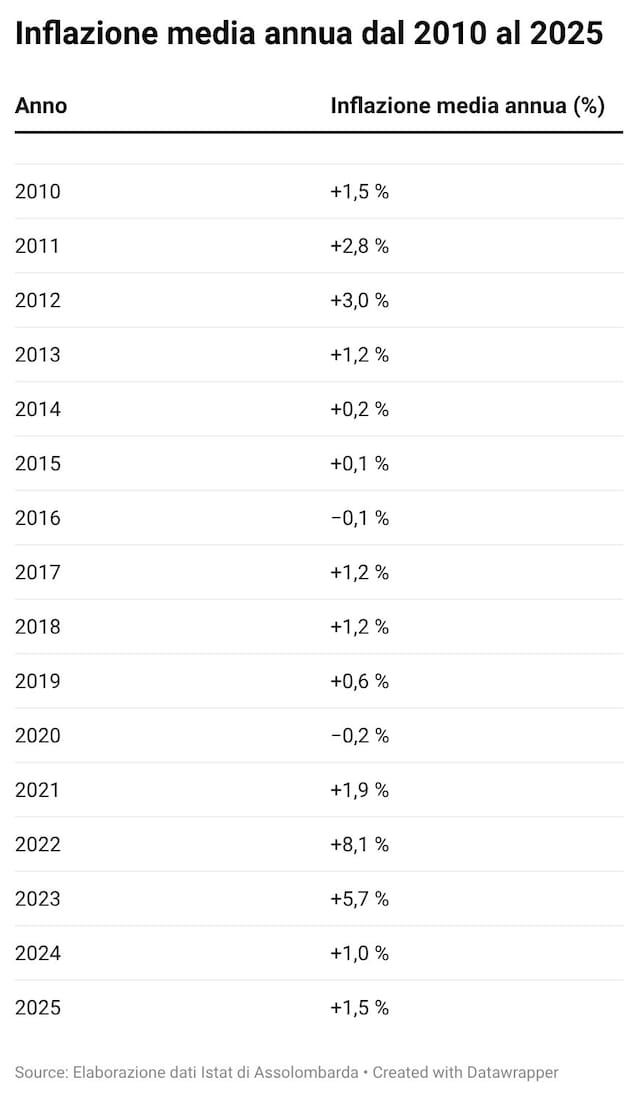
The cumulative price increase from 2010 to 2025
How we calculate the cumulative increase in prices from 2010 to today? Not with the sum of the percentages year by year, but with a “compound” sum: the compound effect (or compound capitalization) is the principle whereby a percentage increase applied several times does not simply add up, but “multiplies” over time. When something grows by a certain percentage every year, the following year the percentage no longer applies to the original value, but to the already increased value.
Let’s give an example: if in 2021 prices increased by 1.9% and in 2022 by 8.1% (ISTAT data, collected in the table above), we will not have to add these two figures (which would give us 10%), but rather we will have to do the sum in a compound way. 1.019 × 1.081 ≈ +10.15 % cumulative.
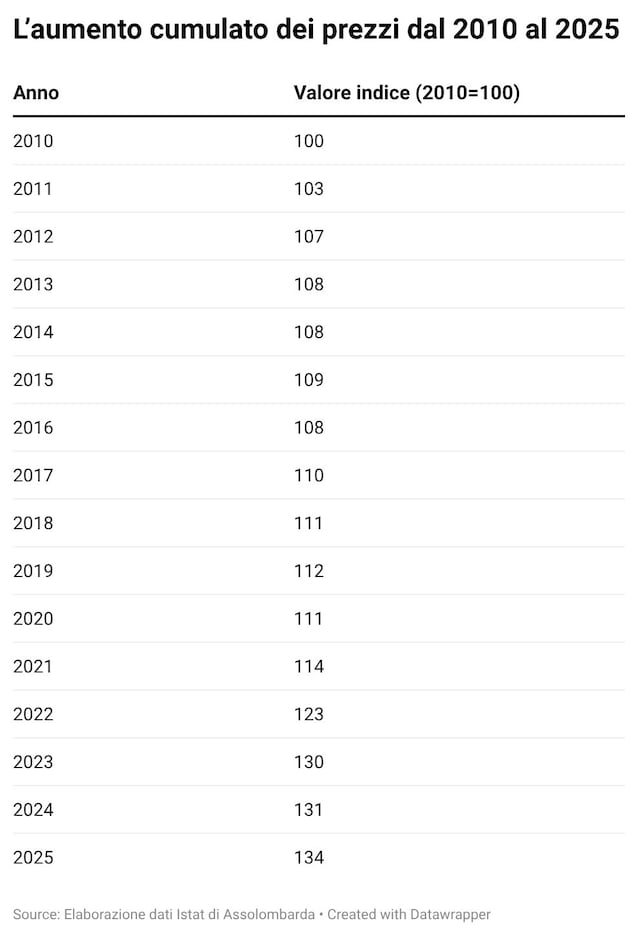
Always using the ISTAT index and applying this method over the entire period between 2010 and 2025, we can “add up” the effects year after year. If we set the 2010 price level at 100, applying official inflation year by year we arrive at a value of 133.97 in 2025. This number means that, on average, a basket of goods and services that cost 100 euros in 2010 costs around 134 in 2025. In other words, from 2010 to 2025 prices in Italy increased overall by approximately +33.97%: this is the official cumulative effect of Italian inflation in the same period.
So what is the relationship between inflation and salaries?
Starting from the average value of 28,243 euros gross per year and approximately 19,800 – 20,500 euros net per year, let’s try to calculate a salary “adjustment”. so that it maintains the same purchasing power in proportion to the increase in prices. All calculations are always based on official ISTAT data and on consolidated estimates of average salaries (as mentioned, individual situations can vary greatly based on sector, territory and type of contract).
28,243 euros x 1.3397 = 37,847 euros gross per year (at parity of purchasing power)
21,150 euros x 1.3397 = 28,334 euros net per year (at parity of purchasing power)
Still following these calculations, this is approximately 2,179 euros net per month. This is a theoretical measure, which we can summarize as follows: if in 2010 an average salary was around 28 thousand euros gross per year, to buy the same goods and services today that salary would have to have risen to almost 38 thousand euros – but we earn around 32 thousand, with a difference therefore of around 6 thousand euros gross per year. Here, due to a wage growth that is too slow compared to the rise in prices, we have lost purchasing power.
In terms of purchasing power, the average Italian salary today is worth around 16% less than in 2010. This, we clarify, does not mean that salaries have never increased, but that they have not grown enough to keep pace with the cost of living. And it is also for this reason that, even without becoming “impoverished” on paper, many people today find it more difficult to make ends meet.
