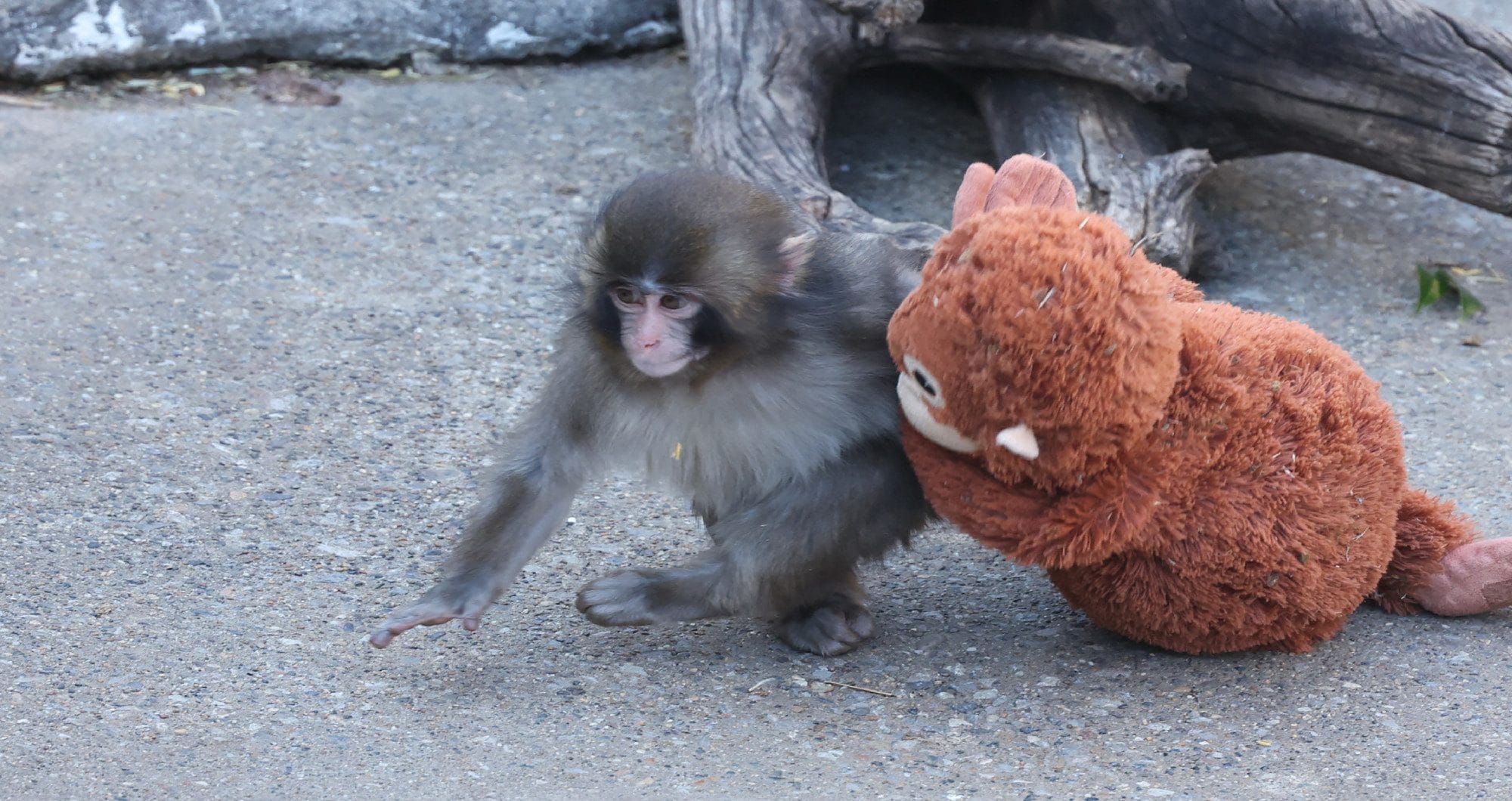
The story of the. has been making the rounds on the web for days Punch macaque babyrejected by his mother in the Ichikawa Zoo in Japan, who developed a deep and – for us – very tender attachment to a monkey plush provided by zoo staff. An inanimate object which however became something much more for her: a presence, an emotional support, almost a relationship. A story that is striking for its tenderness, but which actually opens a window onto something much deeper: the need to belong, one of the fundamental pillars of social life, not only of monkeys, but also of ours.
The story of the macaque Punch and his stuffed animal
It all started from a video that went viral, shot inside one zoological structure of Ichikawa (in the metropolitan area of Tokyo), in which it is seen a baby macaque just 6 months old, called Punchwithin a controlled environment together with other individuals of the same species. In the first months of life, however, Punch comes rejected and abandoned by his mother. An event which, in nature, is not so rare if linked to various conditions: chronic stress, difficulties related to childbirth, artificially composed social groups, primiparous mothers, deficiencies in maternal learning in previous generations or even human interference in the early stages of building the mother-puppy bond. Rather than looking for “blame”, it is important to understand what happens to the little one when this bond is lost.
In the case of Japanese macaques, physical contact it is central from the first weeks of life: the relationship with the mother passes through a constant proximity, grooming (mutual cleansing) and observational learning within a structured social group. Punch, not having access to these fundamental experiences, gradually begins to be marginalized also from the rest of the group. Interactions are reduced, social contact is interrupted and the puppy remains increasingly isolateduntil he was actually removed and excluded completely.
At that point the zookeepers intervened and introduced a stuffed monkeyas a form of enrichment and comfort. It is precisely here that the scene that has excited millions of people takes place: Punch starts keeping the stuffed animal with him all the timeembraces it, holds it and uses it as a point of reference in moments of loneliness. With the support of operators and experts, the puppy is gradually starting a journey of reintegration into the group. A story that, therefore, seems to be heading towards a happy ending.
Because the case of the baby monkey in Japan also speaks to us
Punch’s story enlightens us on two fundamental aspects, which concern not only macaques but also us human beings: attachment and the need to belong.
Punch hasn’t developed such an intense relationship with the stuffed animal because he thinks it’s real, but because an adaptive response is activated to a relational lack. When we are denied such an important relationship, our emotional system does not shut down. It fits. Look for replacements. He holds on (in this case literally) to what he can. And this, let’s be honest, sounds familiar to us.
The need to belong to a group is considered a primary needlike eating and sleeping. From an evolutionary point of view it is perfectly logical: being in a group increased the probability of survival; it guaranteed security, cooperation and reproduction; also, be excluded meant being exposed to greater dangers, having fewer resources and protection.
For many social species, in fact, including ours, being isolated means entering a condition of high stress. It’s not just an emotional issue: it raises the level of cortisol (the stress hormone) and activates brain circuits similar to those of physical pain. They can emerge compensatory behaviors, like the attachment to objects we saw in action with Punch.
This is why our brain evolved to reward social connection and suffer isolation. We see it continuously in our daily lives too: we fight to be accepted, to be part of a group, to not be left out.
Alongside this aspect, there is that ofattachment. On the other hand, the British psychologist John Bowlby understood it decades ago: the bond with a reference figure is a biological necessity. According to the psychologist, it serves a fundamental function: to provide a secure base. What does this mean concretely?
- Knowing that someone is available;
- Feeling protected in times of stress;
- Have a place from which to explore the world.
In other words, attachment is not just about “being less alone”. It is useful for build who we aretogether with our sense of self-esteem, the ability to regulate emotions, to trust others and even to outline our identity.
That’s why we shouldn’t be surprised when it seems so difficult to leave a partner even if the relationship doesn’t work, or when, in order not to be alone, we maintain bonds that make us suffer, or even when we create virtual bonds that seem to fill a void. It may not be adaptive or functional, but at least understandable.
It’s not just insecurity or weakness. It’s also biology. The brain fears exclusion more than it loves freedom.
Harry Harlow’s experiments
The story of Punch immediately brings to mind the experiments of psychologist Harry Harlow. In 1958, Harlow had already observed something very similar: in his famous experiment on rhesus macaquesseparated some puppies from their biological mother and offered them two “surrogate mothers”: a wire structure that provided milk, and a soft “mother” covered in cloth, without nourishment.
The result was surprising: the little ones spent up to 17-18 hours a day clinging to the cloth “mother”, looking for her especially in stressful conditions, while they approached the metal structure for less than an overall hour a day (therefore only for the time necessary to feed themselves). Today these studies are fortunately considered unacceptable, but at the time they demonstrated how much attachment depends not only on nourishment, but on contact, comfort and emotional security.
