
We had already told you about the fears of many people, also widespread in our country, of losing your job due to AI and how many studies have estimated that its introduction will have a much more disruptive and rapid impact than any other technological revolution that has occurred to date – not necessarily destructive, but certainly transformative.
In the past few days Anthropic – the company that developed AI Claude – has published new research, in which it is measured with new criteria the risk of replacement of human workers by AI: This is what is called “observed exposure,” which combines the theoretical capabilities of large language models (LLMs) with real-world usage data. From these data emerges the idea that the theoretical capabilities of AI and its actual use are still distant and that the most vulnerable professional figures include above all young people between 22 and 25 years old. But let’s see in detail what emerges from the study.
The theoretical impact of AI on work vs real risks: data from Anthropic
In recent days you will have seen an image circulating on Instagram (the one below), from the studio designed by economists Maxim Massenkoff and Peter McCrory published a few days ago by Anthropic, which measures the impact that AI is actually having on the job market. This report, entitled “Labor market impacts of AI: A new measure and early evidence”is one of the first attempts to measure the real impact of AI on the labor market, through the combination of the potential capabilities of linguistic models and the real usage data of the Claude platform.
The measurement metric was used as“observed exposure” (observed exposure), which quantifies the tasks of a given profession already performed in real contexts by AI, through the analysis of millions of professional interactions. The measurement levels are full automation, where the AI performs a task autonomously (which obviously weighs more in the metric) and augmentative use where it “only” supports human work. The image below shows the distinction between theoretical predictions of what a technology could do and how professionals actually use it at work.
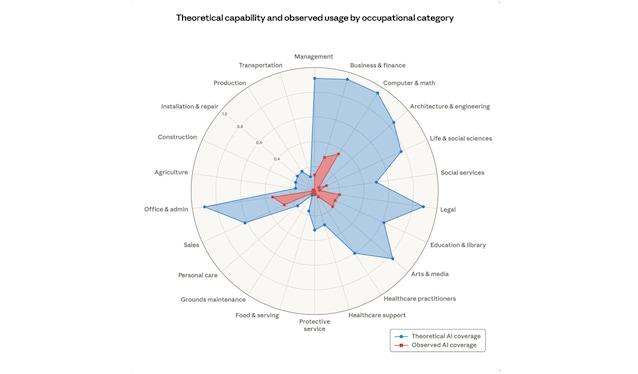
As you can see, in the graph above there are in fact two colored lines: that one blue represents theprofessional area that AI could theoretically cover. That red corresponds instead toactual use that is made of it. For example, in the industry Business & Finance Theoretical estimates indicate that AI could replace us in 70-75% of cases, but that in reality today Claude is used to carry out only 10-15% of tasks. In the industry Computers & Mathematics they would be able to replace humans in 94% of cases, but for the moment only 33% of tasks are covered. In office and administrative roles the capacity is 90%, compared to the actual 10-15%, and so on.
The most exposed professions and the results of the study
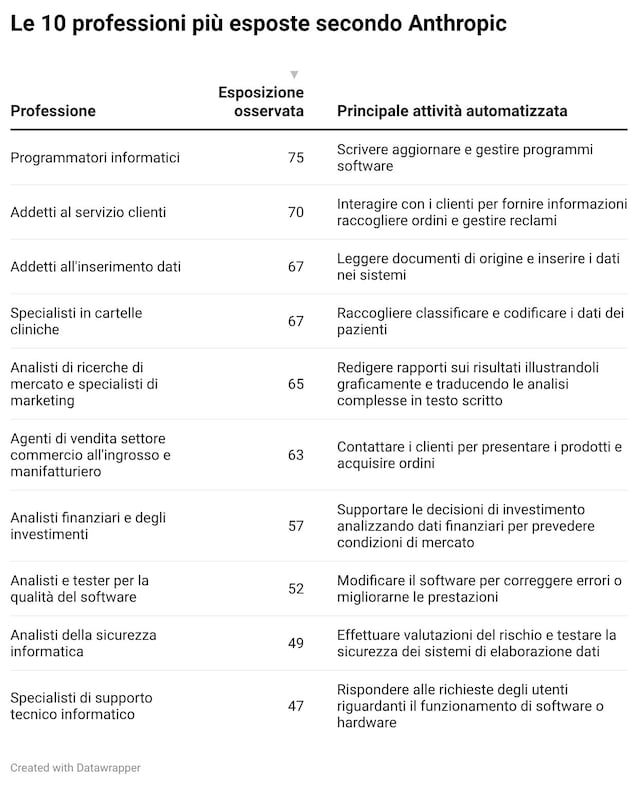
The professions for which he was observed the highest exposure level they are computer programmer (74.5%), customer service operator (70.1%), data entry worker (67.1%), medical records specialist (66.7%) and market research analyst (64.8%). At the bottom of the ranking, with zero exposure, there are cooks, mechanics, lifeguards and bartenders.
Among the most important findings of the study, there is the idea that AI is still far from reaching its theoretical capabilities: the actual coverage would in fact remain, say the two economists, “a fraction of what would be technically possible”.
The data shows that for the moment theAI is not erasing entire professional categoriesbut it is contributing to and changing many of them. The workers most exposed to replacement would be the older ones, those of the female sex (+16%), those with higher average hourly wages (+47%) and with higher qualifications: people with a master’s degree or doctorate represent 17.4% of the most exposed group, compared to 4.5% of the least exposed group. A figure that aligns with what has already emerged from previous research.
One piece of data that emerges from the report and which confirms other research is that relating to young people between 22 and 25 years oldi: the rate of new hires in the most exposed occupations has decreased by around 14% compared to 2022, while in the less exposed occupations it seems to remain stable. A dynamic therefore emerges that several economists are starting to highlight: AI has the tendency to replace not only some senior figures, but also the activities typically entrusted to entry roles – preparation of reports, preliminary data analysis, document synthesis, operational support.
The result for now is therefore not the disappearance of professions, but one contraction in demand in junior positionsthat is, those through which new generations can access the world of work, gain experience and begin to build their careers.
The dangers of AI in the near future: Dario Amodei’s predictions
In recent days it has also been published a long essay by Dario AmodeiCEO of Anthropic, who speaks of the current one as the fastest technological revolution to date and a challenge for civilization, because they can be used as extraordinary instruments of control or war by autocracies and regimes. Amodei compares this period to the adolescence of AI. “I believe we are entering a rite of passage, both turbulent and inevitable, that will test who we are as a species. Humanity is about to be handed almost unimaginable power, and it is deeply uncertain whether our social, political and technological systems possess the maturity necessary to manage it,” writes Amodei, with a different perspective than that of October 2024, when he spoke of how AI could change the world for the better.
Among the factors that worry Amodei most is work. The CEO predicts that approx 50% of entry-level tertiary sector jobs will be eliminated within the next 1-5 yearswith an unprecedented concentration of wealth in the hands of those who already possess it, and a further impoverishment of the weakest groups. To explain this process, Amodei makes a comparison with the Industrial Revolution, in which machines replaced the manual labor of farmers, allowing growing productivity in a first phase. “Even when 90% of the work was done by machines, humans could simply do 10 times more of the 10% they were still doing, producing 10 times more output with the same amount of work.” In a second phase there was the decline of agricultural work carried out by humans, who thus moved on to other jobs, such as those of factory workers, moving from the countryside to the city.
A problem identified by Amodei is the cognitive breadth of AIever closer to the general cognitive profile of human beings: this «means that it will also be good at new jobs that would normally be created in response to the automation of old ones. In other words, AI is not a replacement for specific human jobs, but a general replacement for human labor.” Amodei also predicts that those workers with lower intellectual abilities will be more likely to be left out of the world of work. «It is not clear where these people will go or what they will do – says Amodei –, and I fear that they could form a “subclass” of unemployed or people with very low wages».
But the main problem, in the case of AI, is its own speed of progresswhose pace will be increasingly difficult for humans to keep up with: «The pace of progress in AI is much faster than previous technological revolutions. (…) It is difficult for people to adapt to this pace of change, both in the ways in which a particular job works and in the need to move to new jobs. Even legendary programmers increasingly describe themselves as “late.” The pace may even continue to accelerate as AI models for programming increasingly accelerate the work of developing AI themselves.”
For Amodei, the short-term transition will be much more painful than past technologies, because humans and labor markets are too slow to adapt and reach a new equilibrium.
