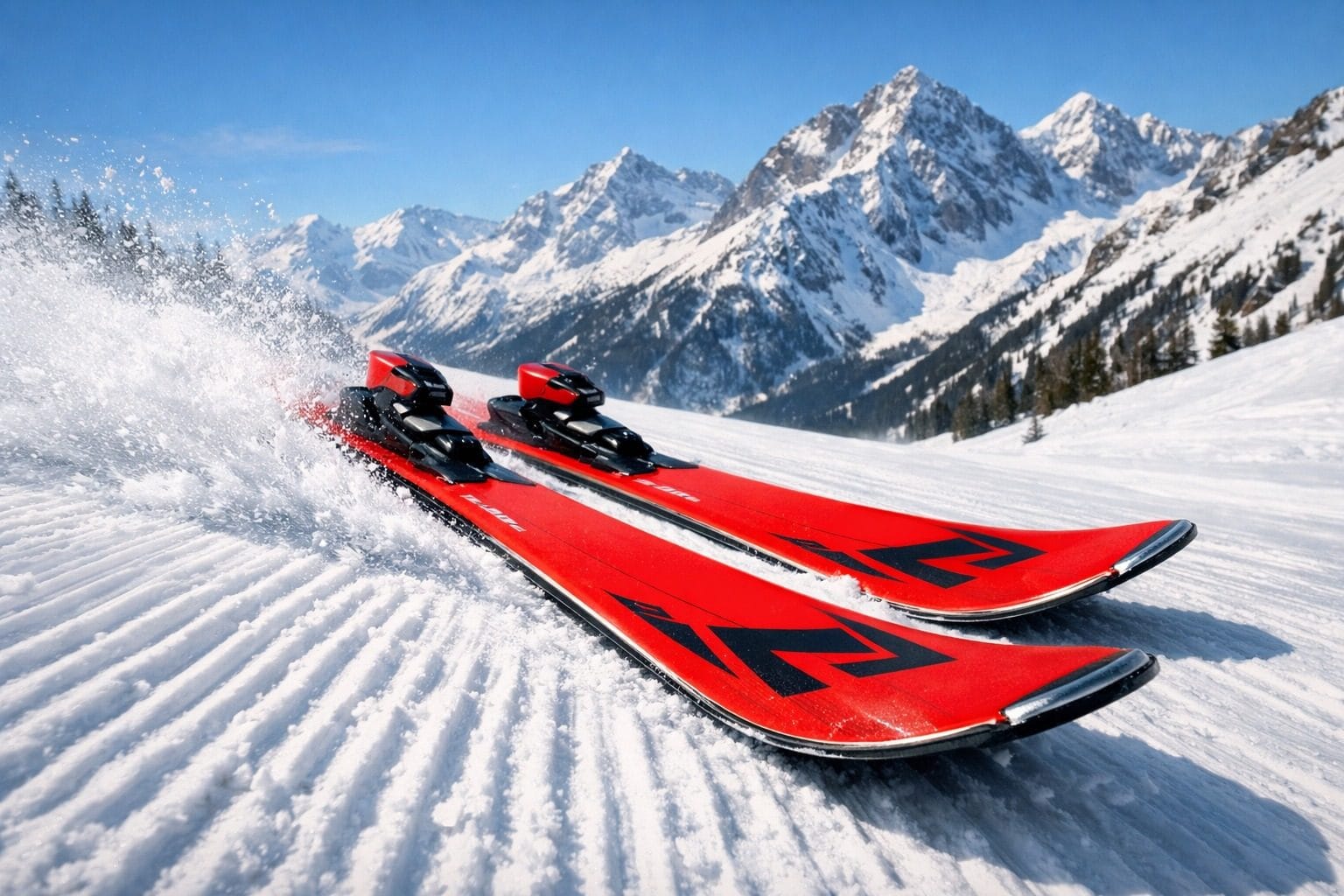
Have you ever wondered what really lies beneath the surface of yours skiing? It is not a single component, but a complex “sandwich” of materials where the wood meet carbon fibers And metallic alloys to create a perfect mix of resistance and flexibility. It is precisely this invisible architecture that allows a thin axle to absorb extreme vibrations and remain stable even at high speeds. But how does this structure transform a simple movement into a precise trajectory? The secret lies in the balance between the materials of the ski and its hourglass shapea design designed to bite through ice and float on fresh snow. From the secrets of internal construction to the most innovative geometries, we discover how engineering influences every descent.
How a ski is made: what are all its parts
If we could cut a modern ski in half, we would be surprised by the number of different layers that make it up. The most advanced construction technique is the “sandwich construction“: a layered superposition of different materials, glued and pressed together to form an extremely resistant single block. The heart of the ski is usually made of laminated wood. Wood is not an outdated material; on the contrary, it is irreplaceable because it offers natural and responsive reactivity ability to absorb vibrations that synthetic materials struggle to replicate. Manufacturers choose the type of wood based on performance: the ash and the beech are stiff woods, ideal for high-speed stability, while the poplar it is much lighter, perfect for ski touring.
Above and below this wooden heart are placed layers of reinforcement. One of the most important is the Titanala particular high-performance aluminum alloy that gives the ski exceptional torsional rigidity. In addition to metals, we find composite fibres: la glass fiber serves to give a more progressive and controllable flex, while the carbon fiber is used to make the ski lighter and “nervous”, ideal for an immediate response to the skier’s commands.
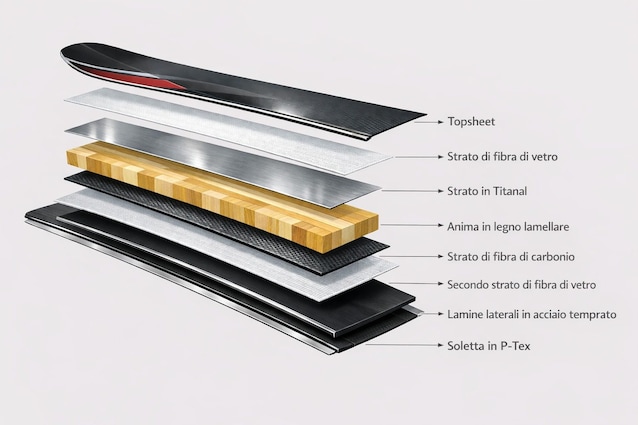
In direct contact with the snow we instead find the insolemade in P-Tex polyethylene and designed to hold the wax: the heat makes it more receptive, allowing the lubricant to penetrate and reduce friction on the snow. On the sides, the laminae made of hardened steel they ensure grip and control even on ice.
What is hidden behind the shape of the skis?
To understand why a modern ski has that strange “hourglass” shape, we need to talk about sidecut. If we look at a ski from above, we will notice that it is wider at the tip and tail and narrower in the middle. This geometry is the secret of carving: when we tilt the ski on its side and apply pressure, the tool deforms following the line of its sidecut and describes a natural arc on the snow, making the easier cornering and it more stable ski. The radius of this arc is called the sidecut radius: for example a ski slalom has a short radius (about 12 meters) for tight turns, while a ski from free descent it can exceed 40 meters to ensure stability at very high speeds.
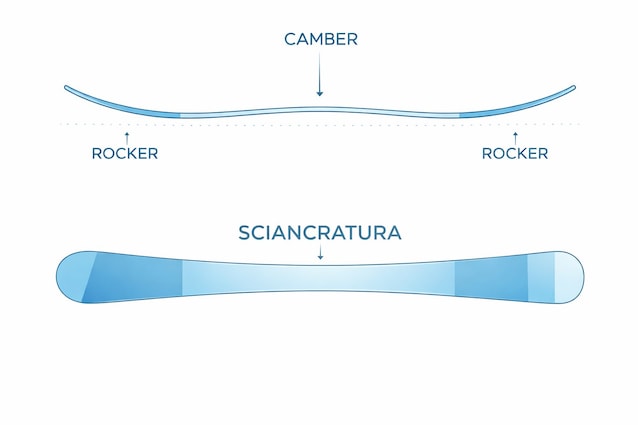
In addition to the sidecut, the lateral profile counts. The traditional profile is the Camber: when the ski is on the ground, the central part remains raised. This design acts like a spring, storing energy and distributing weight across the tips and tails for stable, continuous edge hold. It is precisely the combination of longitudinal flex and torsional rigidity that determines how precise or forgiving a ski is when turning.
In recent decades, the Rockersor an early rise of the tip or tail. The Rocker reduces the length of the edge in contact with the snow, making the ski more manageable and easier to turn, especially in fresh snow where it helps the tool to “float” instead of sinking. However, when the ski is tilted and loaded, more of the edge comes back into contact with the snow, restoring grip and stability.
The difference between the various disciplines
The top layer, the topsheetis often underestimated, but it has a protective role fundamental: it defends the internal structure from humidity, impacts and UV rays. Under the topsheet, in a reinforced area, the attackswhich must transmit forces to the ski without compromising its natural flexion. At the same time, the attacks perform a function of safety crucial: in the event of a fall, the release mechanism reduces the risk of injuries to the knees and lower limbs.
The construction differences also explain why there are skis designed for very different uses: those from the track favor precision and grip, i freeriding they focus on width and rocker for flotation, while the skis for ski mountaineering they sacrifice some stability to keep weight to a minimum.
From simple wooden planks to ultra-high-performance tools: the next time you put on your skis, you’ll know that there’s much more under your boots than meets the eye.
