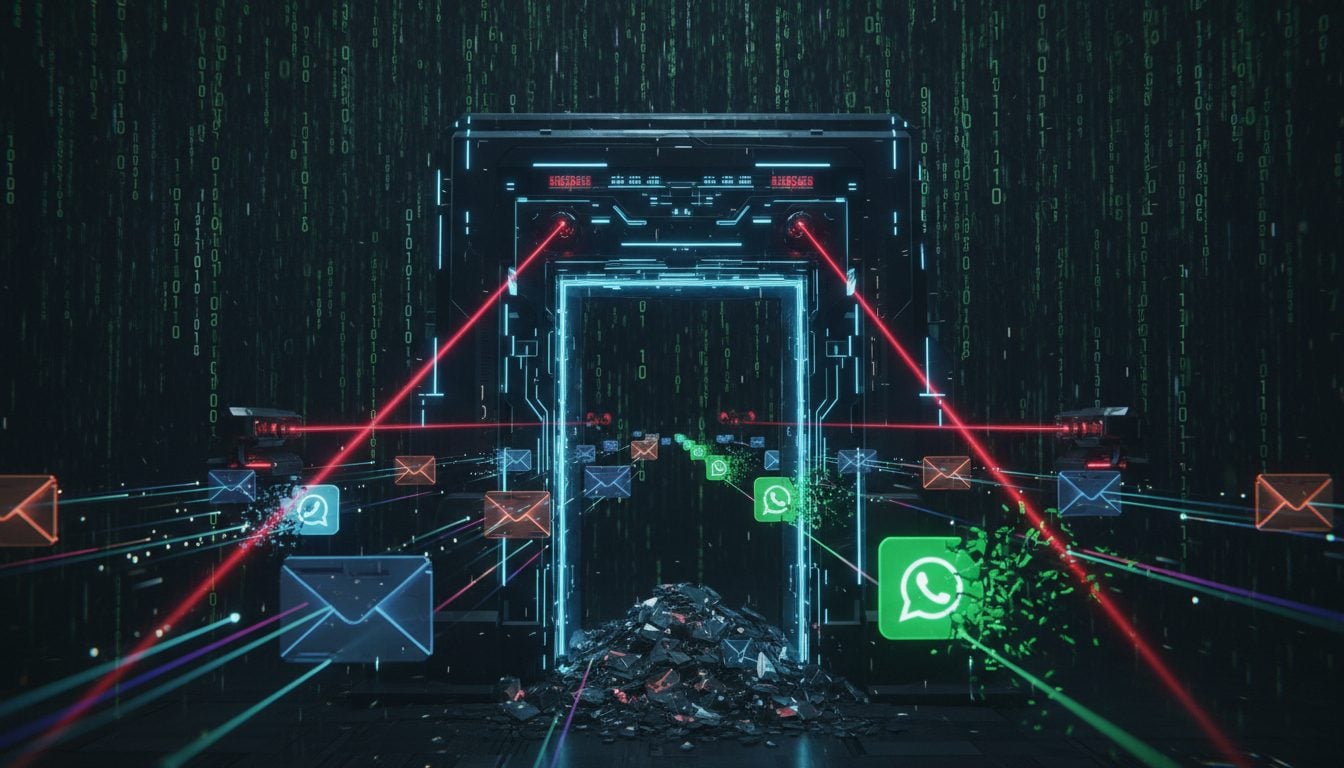
Halfthe company that develops WhatsApprecently reported a intentional slowdown and attempts to block the service in Russia by the authorities. Among the objectives of this operation would be the desire to force a mass migration of users towards “Max”a state-controlled super-app. Analyzing the situation from a purely technical point of view, we find ourselves faced with a phenomenon that goes far beyond politics: it is the construction of a fragmented Internet, the so-called “Splinternet”. In this article we will analyze how it is technically possible for a government to “turn off” an app for millions of people, which data packet filtering technologies are used and what countermeasures are adopted by users, including the use of VPN (Virtual Private Network), that is to say encrypted tunnels which allow you to circumvent geographical barriers, and alternative decentralized protocols, such as those used by BitChatwhich they exploit peer-to-peer networks to make communications uncensorable.
Why does WhatsApp no longer work in Russia?
Meta reported anomalies in data traffic coming from Russia, interpreting them as a deliberate attempt to degrade the service to the point of making it unusable. According to the company’s statements, the Kremlin’s goal is to push citizens towards the national digital ecosystem, especially the app Maxdeveloped locally and heavily promoted by state media. From an infrastructure point of view, Moscow justifies these actions by citing the refusal of Western platforms to localize serversthat is, to store user data physically on Russian soil, as required by national data security laws.
Kremlin spokesman Dmitry Peskovconfirmed that the functioning of WhatsApp depends exclusively on Meta’s willingness to adapt to these regulations, suggesting that the domestic alternative Max is perfectly capable of replacing foreign services. At the BBCPeskov stated that the decision was made «due to (Meta’s) reluctance to comply with the norms and the letter of Russian law» adding that Meta could solve the matter «respecting (the law) and entering into dialogue (with the authorities)».
Cybersecurity experts and digital activists, however, have strong doubts about the security of these state apps, suspecting the lack of end-to-end encryption (a technology that makes messages readable only to the sender and recipient) and the presence of backdoors for government surveillance.
How an app like WhatsApp is blocked
But, technically, how an application is blocked on a national scale? Governments don’t simply flip a switch, of course. Regulatory authorities, such as the Roskomnadzor in Russia or the managers of the Great Firewall in China, they use sophisticated methods. The first level is the DNS block (Domain Name System), which prevents devices from translating “whatsapp.com” in the numeric IP address needed to connect to the platform.
The most invasive and effective method remains, probably, the PPEor Deep Packet Inspection. Imagine Internet traffic like a series of postal envelopes: normally, providers only read the destination address. With DPI, the government network infrastructure ideally opens the digital envelopes in real time, analyzes the “payload” (the content of the data) and, if it recognizes the digital “signature” of protocols such as those of WhatsApp or Telegram, discards the packet, interrupting the communication. This explains why, in many cases, apps don’t stop working suddenly, but suffer extreme slowdowns (or throttling), making it impossible to send files or make voice calls.
This strategy is not exclusive to Russia, let’s be clear. We observed similar dynamics in Türkiyewhere throttling is activated during internal crises to limit the spread of videos, or in Iranwhere access to the Play Store and messaging services is cut off at the root. Also the Nepal recently blocked TikTok citing security concerns, while the China over the years it has perfected a system that completely isolates its citizens from the global Internet.
Users’ strategies for bypassing blocks
Users’ response to these blocks is a constant chase between cops and robbers. The main defense tool is the VPN. A VPN does nothing more than create a secure “tunnel” within the public internet connection: the data is encrypted and sent to a server located in another country. In the eyes of the government’s DPI system, the traffic appears as a mass of indecipherable data headed to a generic server overseas, making selective blocking difficult (but not impossible).
As governments learn to recognize and block even standard VPN protocols, a new technological frontier is emerging: VPN decentralized networks. Solutions like Bitchat or other blockchain-based platforms or local mesh networks operate differently. Instead of going through a central server (which can be blocked or shut down), messages travel directly from device to device (peer-to-peer), often bouncing between the nodes of the network. This makes the infrastructure much more resilient to centralized censorship, as there is no single “address” to block.
These solutions do not always solve the problems completely. If we take the specific case of Bitchat, in fact, we must consider the limited range with which you can send and receive communicationswhich is on the order of a few hundred meters (in optimal conditions), as it uses Bluetooth to “bounce” encrypted messages from one device to another.
