
Few know that in Egyptamong the dunes of the desertthere is one of the sites paleontological most important in the world, or “Wadi al Hitan“(In Arabic the”Valle delle Balene“), where the fossilized bones of ancient marine giants, whale ancestors. Its importance lies in the fact that it has allowed scholars to know the History of evolution of the ancestors of the cetaceans, a rare case in which an earthly species are adapted to live in the water.
Wadi al Hitan’s website, heritage UNESCO Since 2005, he has been in Egyptian western desertin the Governorate of El Faiyum, about 150 km south -west from the capital Cairo. The Valle delle Balene is known for the presence of hundreds of fossils of Archaeocetian extinct sub -art of cetaceans developed between the Eocene and the oligocene, or Between 50 and 20 million years ago about. In addition to the remains of these animals, paleontologists have found those of numerous Other aquatic species. In fact, this area was not an arid desert, but a tropical seawith shallow bottoms, which saw a large development of aquatic life.

Wadi al Hitan fossils, inside rocky layers trained about 30 million years agothey preserved in an excellent way, and this allowed scholars to recognize some in the archaecetes skeletons anatomical characteristics who underline the evolutionary transition between terrestrial and aquatic animals. The sandstone formations, eroded by the wind and sand, have revealed the remains of Basilosaurus isisone of the species bigger of Archeoceti Note, and above all of Dorudon atrox. Both species belonged to the family of Basilosaurids.

The first species, Basilosaurus isiscould reach the 15-18 meters in lengthwhile the size of Dorudon atrox they wandered around the 5 meters. Of this last species in particular, many fossils of youth specimens (some predated just from Basilosaurus isis), going to report how probably, for Dorudon atrox The area where Wadi is located at Hitan today was one habitual area to give birth and breed puppies.

These species of basilosaurids possessed unique anatomical characteristicswhich have allowed paleontologists to recognize some traits in them shared with their terrestrial ancestors, then disappeared in the following Evolution of cetaceans. Is Basilosaurus isis That Dorudon atrox in fact they presented a mixture of characteristics archaic And innovative. Among the archaic sections, maintained in common with terrestrial ancestors (the oldest known ancestors of the cetaceans, Pakicetus And Indohyuslived between Pakistan and India approximately 50 million years agoprobably led a lifestyle amphibian), there were the Conformation of the skullequipped with a heterodon dentition (or with different types of teeth, specialized In different roles in chewing, like ours), the presence of rear limbs still present although not developed and not connected to the spine due to the small size of the pelvis, and the presence of nostrils Instead of vents. Among the innovative features, on the other hand, in common with modern cetaceans, there was the Conformation of the tailadapted to aquatic life, and the front limbsbegan to become real fins.
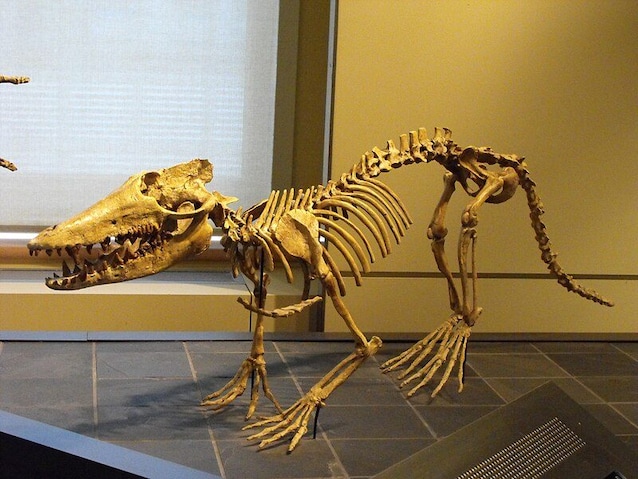
All these elements on the evolution of the cetaceans, which took place in the coastal waters of the Tetidthe ancient ocean that separated Africa from Asia at the time, came to light thanks to the paleontological study of the remains found in the valley of the whales, which began starting from the discovery of the first fossils in 1902. Today Wadi al Hitan is openalthough it is in an area of the Egyptian desert that is not very achievable. Due to his registration in the UNESCO heritage, the site has equipped itself with a tourist route able to allow visitors to see the best preserved skeletons found in the valley. This proved to be also necessary for protect The fossils, which in the past have been raised and damaged by collectors.
https://www.youtube.com/watch?v=q553lpbwavm
Sources
King, c.; Underwood, C.; Steurbaut, E. (2014). Eocene Strastigraphy of the Wadi al-Hitan World Heritage Site and Adjacent Areas (Fayum, Egypt). Strastigraphy 11 (3-4): 185-235
Mahdy, a.; El-Kheir, G. Abu; Gohar, Abdullah S.; El-Sourhier, Maher I. (4 March 2021). “Palaoebiological Assessment of Some Basilosauridarchaeocetes (Mammalia, Cetacea) and its Affinity with recent dedontocetes: New Insights from Wadi El-Hitan, Fayoum, Egypt”. Historical Biology. 33 (3): 313–322
Gingerich, Pd; Domning, DP; Blane, ce; Uhen, MD (1994). “Late Eocene Sea Cows (Mammalia, Sirenia) from Wadi al Hitan in the Fayum Basin, Egypt”. Contributions from the museum of paleontology. 29 (2). University of Michigan: 41–67
Uhen, Mark D (2002). Basilosaurids. In: Perrin, William R; WiSirsig, Bernd; Thewissen, Jg M. Encyclopedia of Marine Mammals. Academic Press. pp. 78–81
