
There Chamber of Deputies rejected the bill presented by the opposition to introduce the short working week also in Italy. More specifically, the text of the bill provided for the gradual reduction of weekly working hours from 40 to 32, for the same salary and divisible into 4 days or in 5 days (with reduced daily hours).
The Peninsula, therefore, is not added to the list of European countries that are testing the short working week to evaluate the results – including Belgium, Iceland, Spain and the United Kingdom – even if some Italian private companies However, they have started an experiment over the last few years. But what is the situation at European level?
As confirmed by the latest EUROSTAT data (published in 2025 and relating to 2024), the EU citizens they work in average 36 hours a weekwith minimums of 32.1 hours in the Netherlands and peaks of well 39.8 hours in Greece. Clearly, the statistics take into account both hours worked for full-time and non-full-time contracts part time.
The new EUROSTAT data, which will be released by May 2026, will however have to take some things into account novelty regulations, first of all the extension of the working day Greeceapproved in October 2025, which introduced the possibility of extending the working day up to 13 hours a day (but only for a maximum of 37 days per year).
The average working week in Europe: the map of the countries
According to what reported by EUROSTAT, the EU average of weekly working hours is 36: the data includes workers aged between 20 and 64 who carry out their main activity, as full-time or even part-time work. In this ranking, Italy positions itself in line with the average of the 27 member states, with 36.1 hours per week of work.
This is a number of hours down compared to 2014when the European average was around 37 hours per week: over the course of this decade, in fact, several countries have adopted policies towards reducing the number of hours.
Going into more detail, there are however notable differences between EU member states, as is clearly visible in the map below: in 2024 (latest data available) the longest working weeks were recorded in Greece (39.8 hours), Bulgaria (39.0), Poland (38.9) e Romania (38.8). In contrast, the Netherlands had the shortest working week (32.1 hours), followed by Denmark, Germany And Austria (33.9 each).
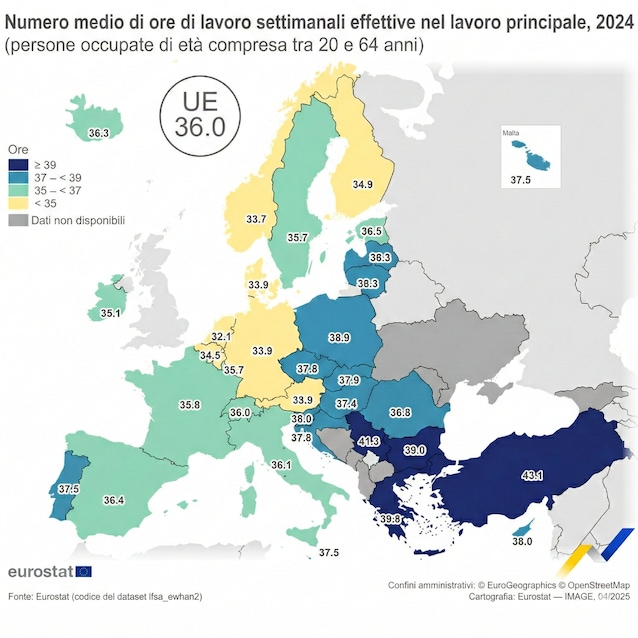
From the point of view of economic activities, however, the sectors for which the longest working week was recorded were agriculture, forestry and fishing (with an average of well 41.2 hours of work per week), themining (38.8 hours) andbuilding (38.7 hours). In contrast, the shortest working weeks were recorded for employers of family activities (26.7 hours), for education (31.9 hours) and for arts, entertainment and recreation (32.9 hours).
Short working week in Europe: where they are testing it
But, so, what are the European countries who are actually testing the short work week? The first to start the experimentation was Belgiumwhich in 2022 approved a law that allows workers to condense the working week into 4 days, or to leave it unchanged at 5. In practice, therefore, it is not a real short week, at most tablet: the total working hours remain 38 weekly, but employees are given the freedom to choose how to divide the number of hours per day.
Even theIceland (which is not part of the EU, but is working to present its candidacy) has taken this direction and today between 80% and 90% of its employees work for around 36 hours per week. Likewise, Spain, Portugal and the United Kingdom they are trying to gradually introduce this social change, even with government support, but so far no national legislation has been passedwhile the number of private companies that are experimenting with reducing the working week is increasing (as in the case of Italy).
Finally, don’t forget the France where the working week has been for over 25 years set at 35 hoursbased on a reform introduced in 2000 by the then socialist government. In recent years, however, some members of the French government have reiterated the need to raise the threshold of weekly hours, thanks to the growing public debt and the need for greater productivity at a national level.
