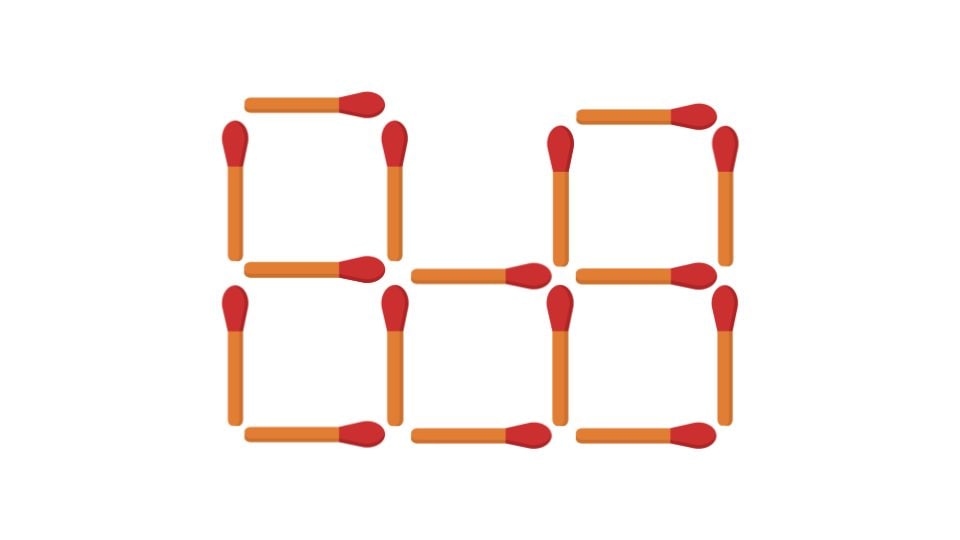
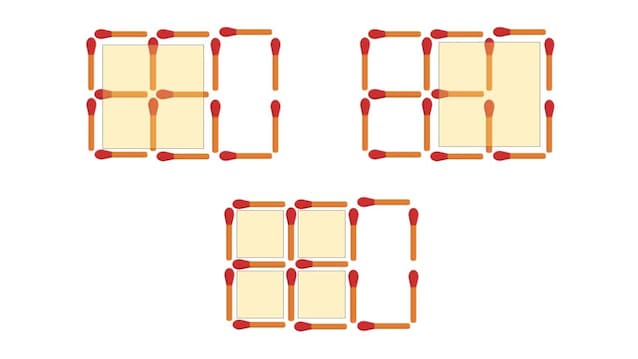
In this riddle there are 16 matches willing to form five squaresas in the figure. Our goal is to get it exactly right six squares moving a single match.
There are, however, two rules:
- each match must be part of at least one square. We cannot, therefore, simply eliminate a match or leave it isolated;
- every match must be entirely part of a square. In other words, we can’t place one halfway between two squares.
If we can move only one match, which one should we choose and how should we move it? For this riddle they are even there three solutions different. Let’s see them together.
The answers to the 16 matches puzzle: which one to move
To understand how to solve it, let’s see what would happen if we decided to move one of the matches on the edge.
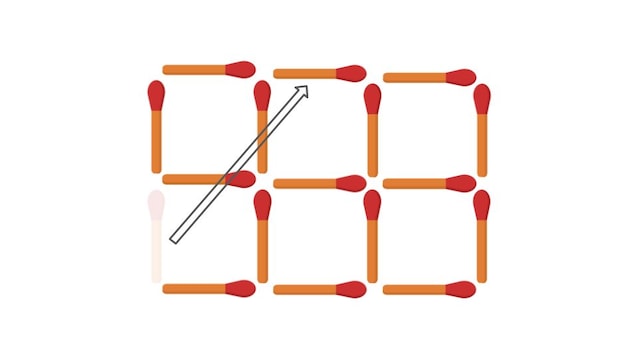
If we moved, for example, one of the matches to the bottom left to complete the upper edge, we would actually be able to have six squares: five small ones and one large one, made up of two matches on each side. The match at the bottom left, however, would remain outside any square, going against the rules!
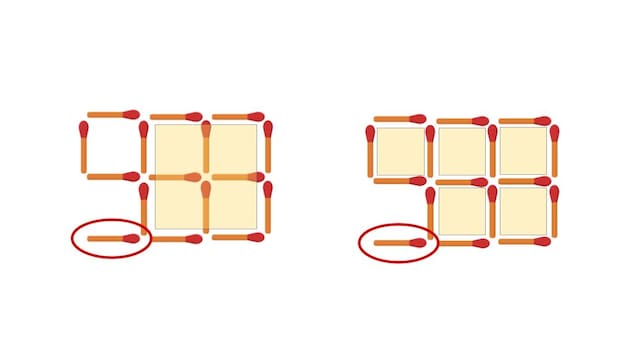
To find the solution, therefore, we must be able to “complete” the upper edge without leaving other holes on the edge. Let’s see how.
The first solution
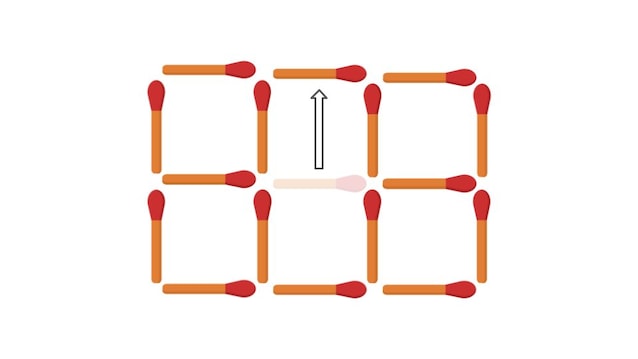
The first possibility is to withdraw the central match of the grill and move it upwards. In this way, we will close the external perimeter creating exactly 6 squares:
- 4 little ones arranged at the corners;
- 2 large (with the side made of two matches) partially overlapping.
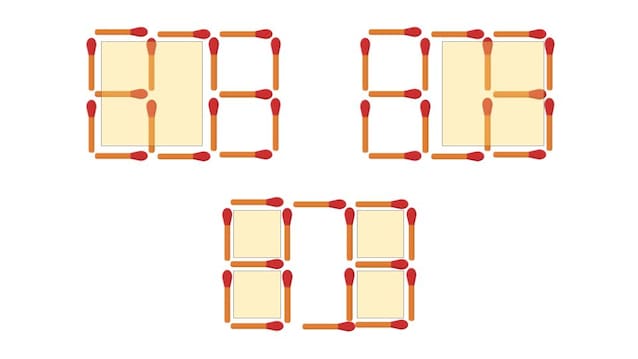
In this situation all the matches are part of a square and therefore our solution is valid.
The second solution
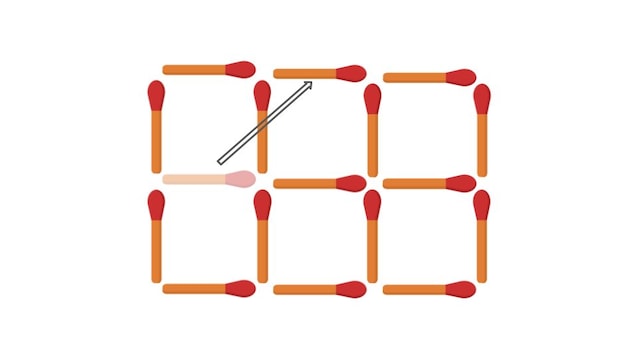
Also for the second solution let’s go and get one of the matches central line. In particular, let’s take the left match and we move it to “close” the empty place left on the top edge again.
Again, we get exactly 6 squares:
- 4 little oneson the right side of the figure;
- 2 largeoverlapping, composed of two matches on each side.
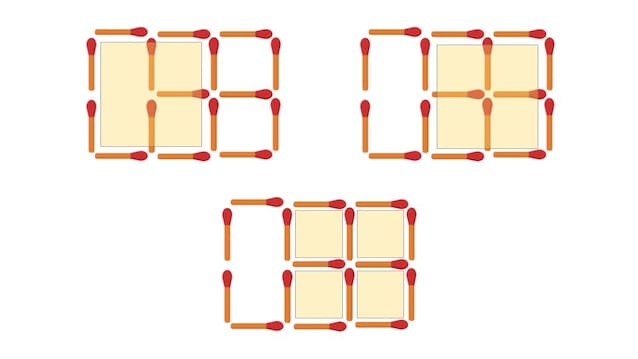
No match has remained isolated and all matches are part of at least one square: the solution is valid.
The third solution
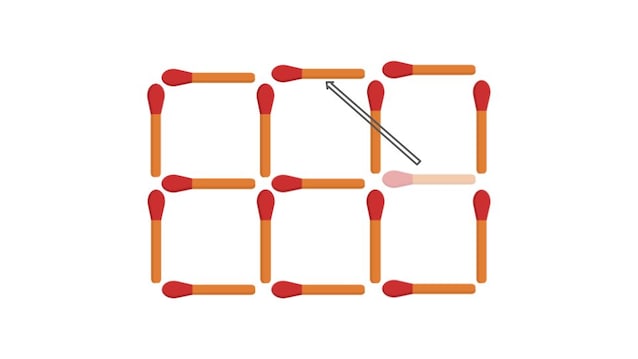
The third possibility is similar to the second… indeed, it is precisely the second “mirrored”! Taking, in fact, the match a right from the central line and using it to fill the hole in the top edge we get 6 squares again:
- 4 little onesthis time on the left side of the figure;
- 2 largeoverlapping, composed of two matches on each side.
Also in this case we respect all the rules and the solution is actually valid.
As we have seen, to solve this puzzle we must get out of the most immediate scheme and stop looking only at the “obvious” squares. The solution appears when we use the lateral thinking and we begin to consider figures of different sizes and reorganize what is in front of us, instead of adding something.
