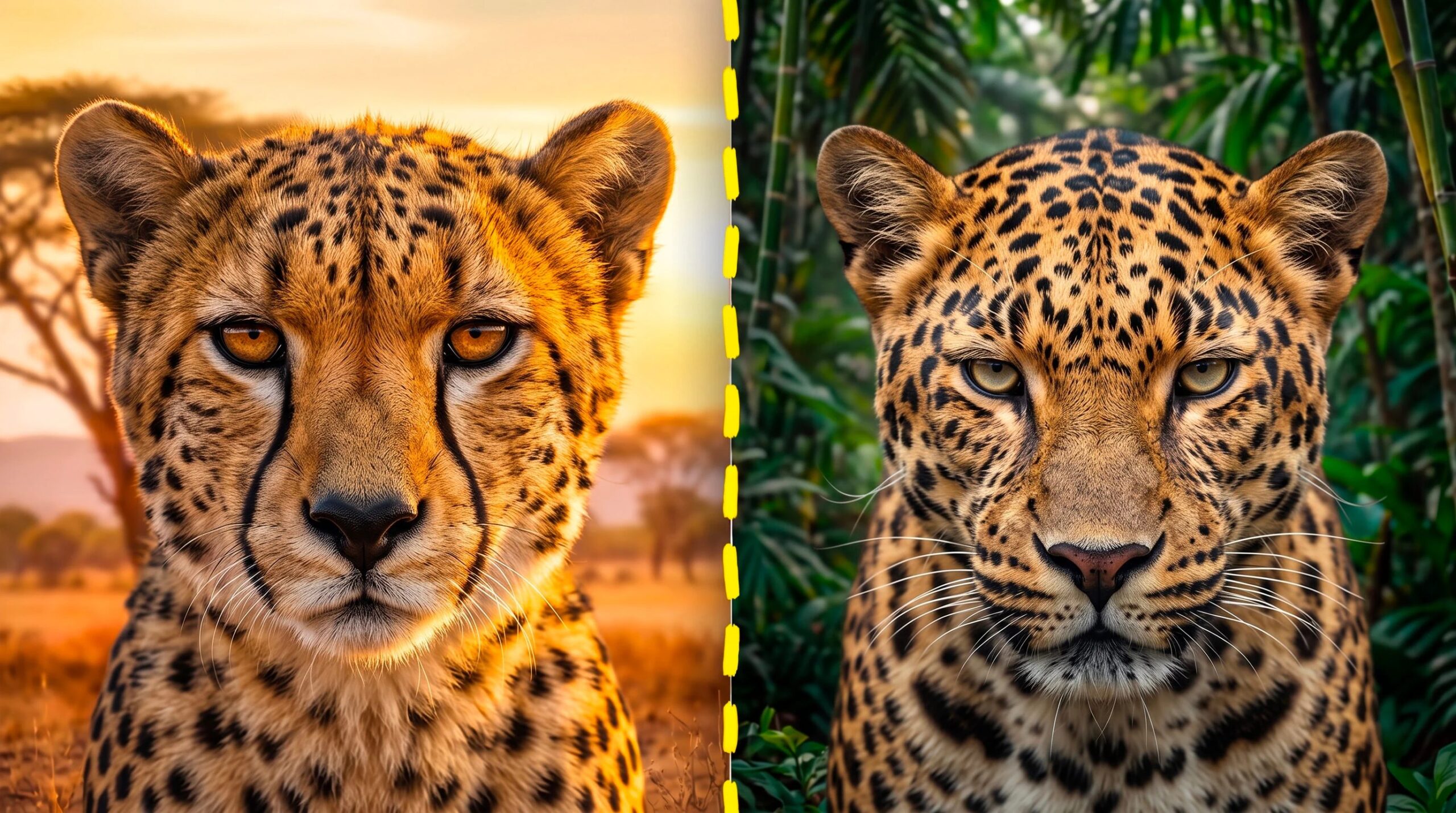
Fast versus stealthy, lean versus rugged, polka dots versus rosettes. Cheetah (Acinonyx jubatus) and leopard (Panthera pardus), spotted cats of Africa, may seem similar from afar, but they actually hide profound realities both physical and ethological differences. The first is thefastest land animal in the worldcapable of touching the 100 km/h during its daytime hunting trips, with a thinner body, black streaks on the face and “polka dot” spots; the other is a massive and powerful nocturnal predator, famous for its ability to drag prey up trees, with larger, rosette-shaped spots.
The differences between the two felines
The visual comparison between cheetah and leopard: how to recognize them by their coat and muzzle
Cheetah and leopard are not as close relatives as you might think. They both belong to the dei family felidsbut they are on two branches of the family tree separated by approx 10-11 million years of evolution. The leopard is part of the genus Pantheraalong with lions, tigers and jaguars. The cheetah, however, is the only living species of the genus Acinonyx and belongs to the subfamily Felinaethat of the “little cats”.
However, to the eye they remain similar with some characteristics that distinguish them.
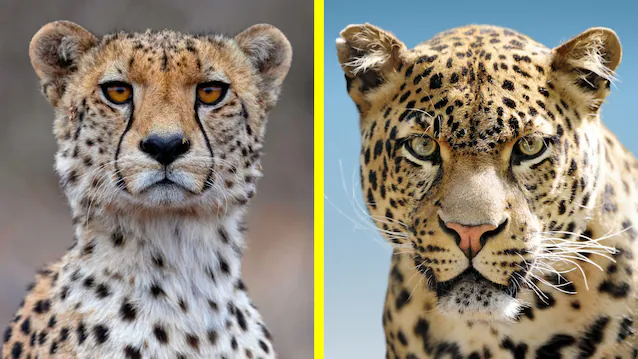
The “tear streaks” on the face
The cheetah wears on his face two black linesinformally called “tear lines,” which run from the inner corner of the eyes to the corners of the mouth. It’s the quickest trait to recognize, because no other big cat has it. Their function it is not confirmed by studies or field experimentsbut the most accredited hypothesis is that reduce glare from sunlight helping the cheetah to focus on prey during high-speed chases in the sunniest hours. The only research, published on Biology Letterswas conducted on another animal with similar stripes, the peregrine falcon.
The leopard, however, has a muzzle without streaks.
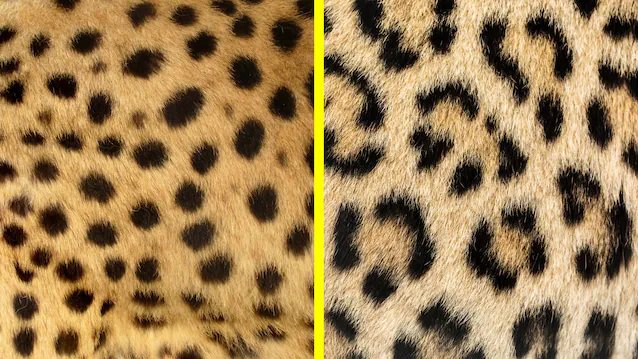
The “polka dot” fur or with complex rosettes
On the body, the cheetah’s coat is studded with full, round and black spotsdistributed relatively uniformly. This design, however, adapts well to the open spaces of the short grass of the savannah, where the animal hunts relying more on speed than on ambush camouflage.
The leopard has its coat covered by rosettes: black spots in the shape of irregular rings around a center slightly darker than the background color, but without dots inside. This structure, as explained by a study published in Proceedings of the Royal Society Bhelps to break up the profile of the body between the lights and shadows of the bush, the woods or the rocks, making it almost invisible when approaching the prey. In the rainforests of Southeast Asia there are even leopards almost completely black (the so-called “black panthers“): it is not a different species, but a melanistic variant of the same one Panthera pardus.
Anatomy and physique: the agile athlete versus the muscular fighter
If the face is the fastest way to recognize them, the build tells two different hunting strategies.
The cheetah weighs on average 39-65kghas long legs, a narrow, deep chest, a small, flattened head, and a long, muscular tail that functions like a rudder, moving from side to side to balance the body in sharp turns at full speed.
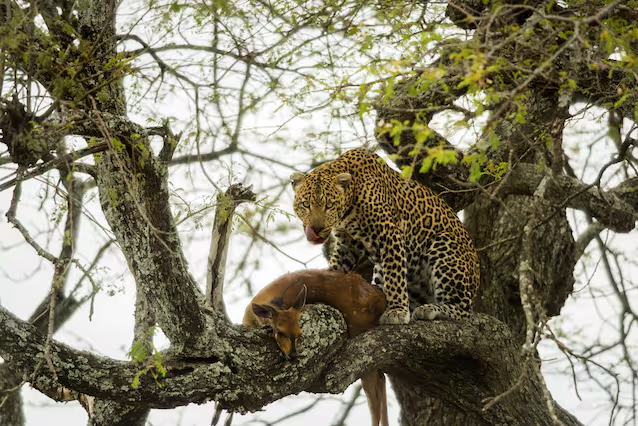
Male leopards weigh between 37 and 90 kgfemales among 28 and 60 kgwith a more robust and muscular physique, especially on the rear. This allows it to climb a tree, dragging prey even heavier than itself into its mouth. The leopard is also one of the few big cats a willing to swimwhile the cheetah avoids water.
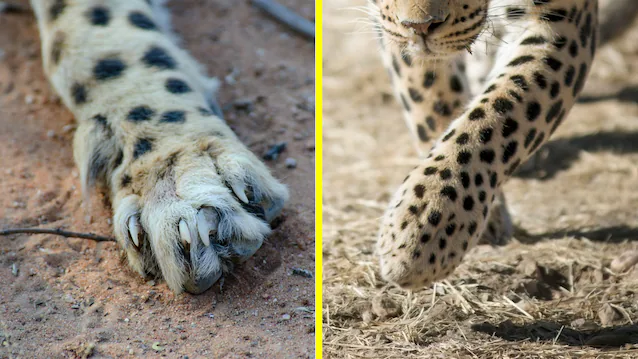
The claws: semi-retractable for gripping or retractable for climbing
The cheetah has claws semi-retractable (the only retractable claw is located on the first toe), which always remain partially exposed, useful for digging into the ground to ensure traction during acceleration and sudden braking as well as for hooking prey. It is no coincidence that the name of the genus, Acinonyxderives from Greek and literally means “motionless claw“.
The leopard, like almost all other felines, has claws fully retractable but always ready to cling to the bark during a climb or to sink into a prey during the attack.
Ethology, speed and hunting: daytime shooting or nighttime ambush
The cheetah is, among African predators, one of the few to hunt mainly during the dayparticularly in the cooler hours of dawn and dusk. The cheetah approaches stealthily then takes off in a short chase. He must then devour the meal as quickly as possible: a study conducted in Serengeti (Tanzania), where researchers have observed hundreds of real catches, estimates that the cheetah loses between11% and 12.9% of their prey (gazelles, kobs and impalas), stolen lions And hyenasbigger and more massive, before I can even finish eating
The cheetah is estimated to reach i 110-120 km/hnumbers that make it the fastest land animal in the world. A study published in Nature in 2013, in which researchers equipped five wild cheetahs in Botswana with GPS collars during 367 real-life hunts, the maximum speed recorded was 93 km/h. While in the IUCN Red List a maximum speed of 103 km/h. The “official” record belongs to a captive cheetah (Sarah, from the Cincinnati Zoo) who covered 100 meters in just 5.95 secondstouching i 98 km/ha record recognized by Guinness World Records.
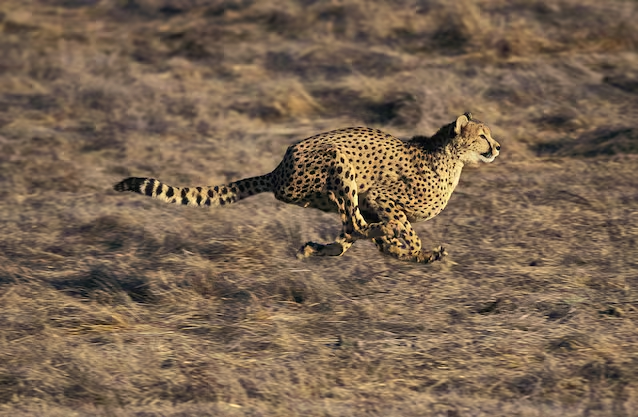
The leopard is above all nocturnal or twilightan ambush hunter who focuses on stealth: he approaches his prey up to a few meters away before taking a leap. In its diet we find from dung beetles to antelopes, passing through monkeys and fish.
Habitat and distribution: where they live and their conservation status
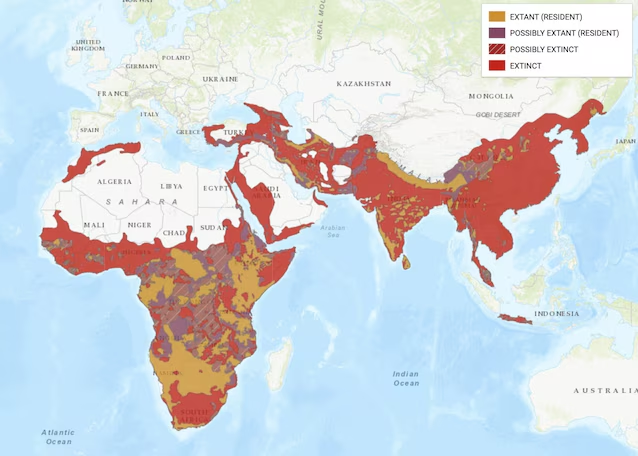
The leopard is, by range, one of the big cats most widespread in the world: occupies much of sub-Saharan Africa, areas of the Middle East, the Caucasus, central and southern Asia, up to the Russian Far East, Java and Sri Lanka. It is also incredibly adaptable, capable of living in rainforests as well as deserts or on the outskirts of Asian megacities.
The cheetah has a very wide range narrower and more fragmented: busy today less than 10% of the territory it once inhabited, concentrated mainly in the savannas of eastern and southern Africa (Serengeti, Maasai Mara, Kalahari), with small residual populations in north-western Africa.
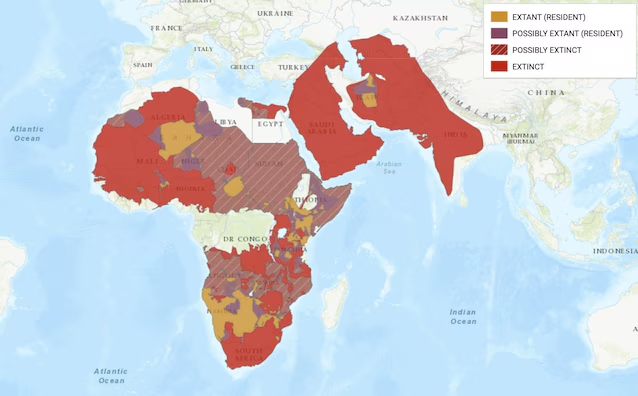
In the savannahs of eastern and southern Africa, the ranges of the cheetah and leopard overlap. The two cats live together in the same reserves and often feed on the same prey (gazelles, impalas).
Both species are classified as Vulnerable (Vulnerable) on the IUCN Red List. These cats are facing a dramatic decline caused by human activity and habitat loss. The leopard has historically lost over the 30% of its population; although globally they still number approximately 261,600 specimenssome regional populations (such as in West Africa) are now in critical dangerwith very few individuals remaining. The cheetah’s situation is more serious: it has recorded a decline in 37% in the last 15 years and there are barely any left 6,500-7,000 specimens fragmented into isolated groups, with a couple of subspecies (including the Asian one in Iran) reduced to a few dozen individuals and on the brink of extinction (Critically Endangered).
Sources
Cheetah Conservation Fund Hudson, PE, Corr, SA, Payne-Davis, RC, Clancy, SN, Lane, E. and Wilson, AM (2011), Functional anatomy of the cheetah (Acinonyx jubatus) forelimb. Journal of Anatomy William L. Allen, Innes C. Cuthill, Nicholas E. Scott-Samuel, Roland Baddeley; Why the leopard got its spots: relating pattern development to ecology in felids. Proc. R. Soc. B Michelle Vrettos, Chevonne Reynolds, Arjun Amar; Malar stripe size and prominence in peregrine falcons vary positively with solar radiation: support for the solar glare hypothesis. Biol. Lett IUCN Red List – Panthera pardus IUCN Red List – Acinonyx jubatus Guinness World Record Convention on International Trade in Endangered Species of Wild Fauna and Flora The South African National Biodiversity Institute (SANBI)
