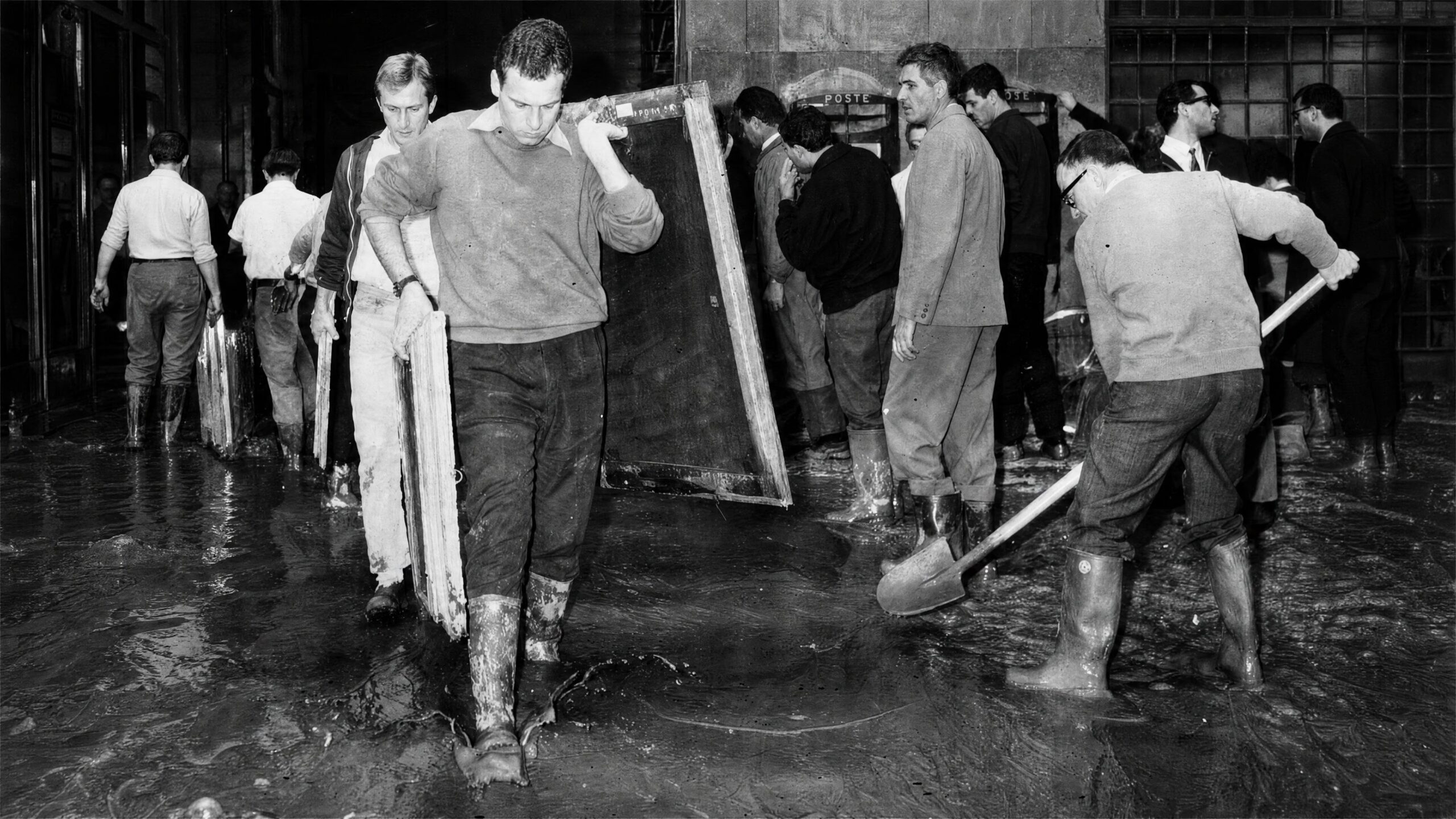
Sixty years ago, the Florence flood of November 4, 1966 mobilized young volunteers from all over Italy and the world, who arrived in the city to lend a hand. A fleet of boys who, armed with buckets and brooms, cleaned up the Tuscan capital and contributed to saving its artistic heritage: this was how the “Mud Angels” were born.
The «mud angels»thousands of young volunteers who came from all over the world to save the masterpieces of art, made history at dawn on November 4, 1966, when the Arno overwhelmed Florence and the flood transformed the cradle of Tuscan art into a swamp of mud and debris.
The city had now become one swamp of mud and debris: the waters of the river, swollen by days of incessant rain, had overwhelmed the city. They invaded the streets, houses, shops, churches. In some areas the river waves even reached 5 meters high and devastated everything.
The masterpieces of art were also overwhelmed with unprecedented force: Cimabue’s Crucifix in Santa Croce (severely damaged), the spectacular works of the Uffizi and thousands of volumes in the central National Library were buried by a greyish mass, and the eyes of the world were glued to the TVs, observing the images of a more unique than rare event. It was precisely then that a phenomenon of solidarity never seen before occurred: to clean the city from the mud and debris, the «mud angels»called this way for the first time by the Florentine journalist Giovanni Grazzini in the Corriere della Sera.
The mud angels who saved Florence from the flood 60 years ago
The angels were thousands of boys and girls from all over Italy And young people who arrived hitchhiking or by train from France, the United Kingdom and other countrieswho poured into the flooded streets, with their boots and buckets in their hands. And off to shovel that blanket of water and mud that suffocated the city.
They were kids of all types (generally very young, between 18 and 25 years old): they ranged from art academy students to workers, from hippies to boy scouts, from kids who arrived from the mountains to those who arrived from seaside resorts.
The angels worked to clean up the streets and houses, but also to recover works of art, books and manuscripts which otherwise would have been lost forever. The feeling was that for all of them that artistic heritage belonged to the entire society, and it was also their responsibility to take charge of it.
Human chains and rescue: how to work in the mud
But how did these guys work for save works of art so fragile without damaging them further?
For example, in the dark and smelly basements of the National Library they organized themselves in interminable human chains: immersed up to their waists in a viscous mixture of water, slime and even heating oil, they passed from hand to hand thousands of soggy scrolls and rare volumes for take them out into the open air before the paper rots.
It was a real one race against time to prevent mold from eating away at the pages and the ink from completely dissolving. At those times, the books were gently dabbed and then sprinkled with sawdust or talcum powder to absorb moisture and buffer the greasy, naphtha-smeared slime from the bindings. Then they were urgently sent to the tobacco dryers scattered between Tuscany and Umbria, to quickly dehydrate the books and avoid the proliferation of fungi.
As for the canvases, hundreds of muddy paintings were transported and urgently hospitalized in the large Boboli Gardens lemon housetransformed into the largest artwork field hospital ever established, heated with controlled oil heaters and fans to manage the gradual evaporation of moisture. But the latter was not the only problem: the mud and naphtha left on the paintings, in fact, threatened to detach the color from the primer. And so, the restorers and volunteers applied layers of to the soaked paintings Japanese paper with reversible water-soluble adhesives to “fix” the paint chips and prevent them from falling off during drying.
In the evening, after all this incredible work, the tireless young people had dinner together and shared a sleeping bag (many of them did this on the floor of the Santa Maria Novella station).
The legacy of a generation
The gesture of solidarity made by the mud angels affected everyone, and goes far beyond the simple emotion.
That army of young people with muddy boots and clothes, in fact, was able to change the relationship between citizens and the artistic heritage, which began to be seen as a common good.
It was the beginning of a civic volunteering phenomenon (and mass) which then recurred several times during Italian disasters. Starting from the Genoa flood of 1970, the expression “mud angels” was used in general to describe the aid of volunteers (especially young ones) to the populations affected by this type of disaster.
