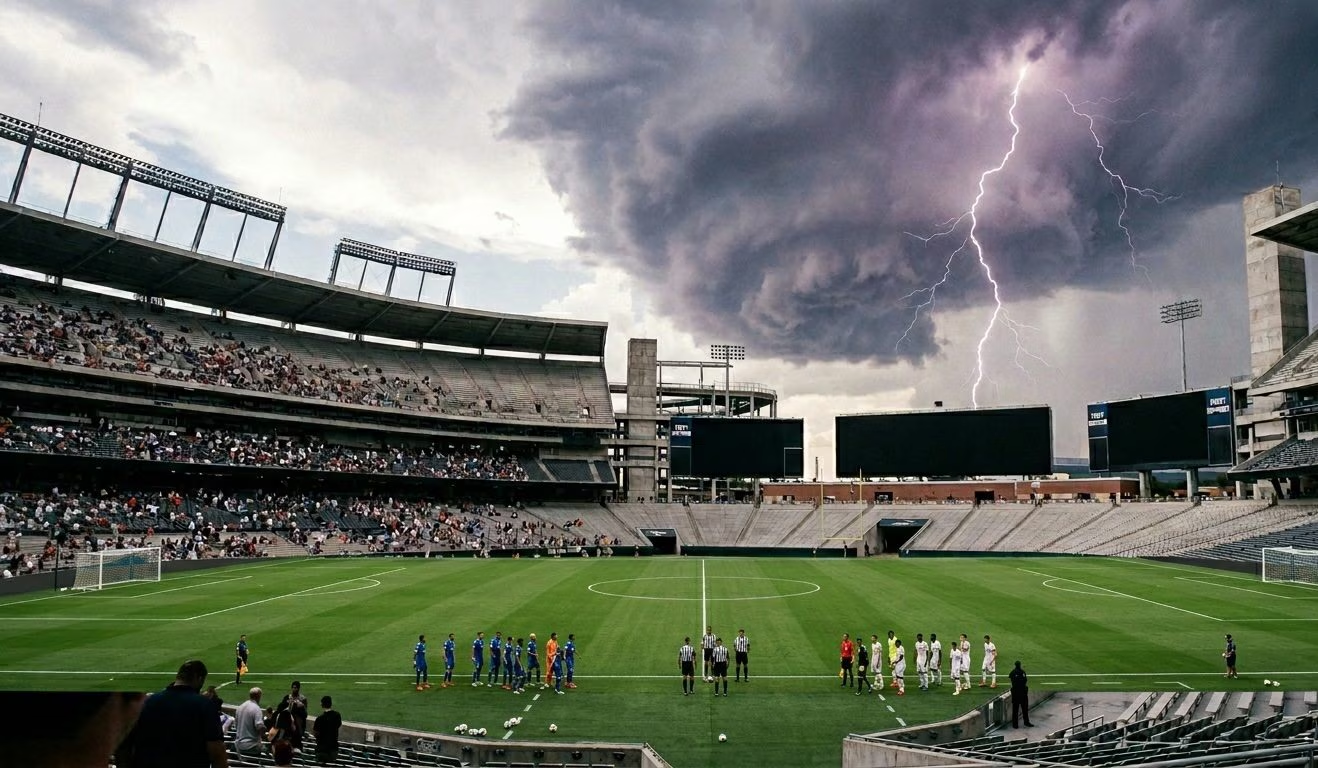
THE Football World Cup 2026 they are the largest in history: 48 teams, 104 games, 16 cities between Mexico, the United States and Canada. Much of the tournament will be played in the United States, which hosts 78 of the 104 matches. And it is precisely in US stadiums that a safety protocol that is little known in Europe but very rigid comes into play: that on storms and, in particular, on lightningalready protagonists last summer at the Club World Cup. This safety standard, based on consolidated scientific guidelines such as “30-30 rule”is preparing to be one of the most surprising elements of the competition. Between the threat of sudden summer storms and the dangers of humid heat tracked by the index WBGTmany matches in American outdoor stadiums risk forced stops of up to hours. We understand how this organizational machine works and why, for us European spectators accustomed to playing in all weathers, it will represent an absolute novelty.
What is the “bad weather protocol” and what does the regulation say
In the United States, outdoor events follow very stringent lightning safety guidelines. The operating rule is simple: if lightning is detected within 8 miles (just under 13 kilometers) from the location of the event, this is suspended immediately. In the case of a football match, the players return to the changing rooms and the spectators are immediately evacuated from the stands towards the covered areas of the stadium following the “Seek Cover Protocol”, the protocol for seeking safe shelter.
At that point a countdown starts 30 minutes. The game can only resume if, during that entire time, no new lightning is detected within the safe radius. This mechanism can increase the time: if while waiting for another lightning strike within 8 miles, the countdown starts from scratch. In the presence of a persistent or slow-moving storm, a game can thus remain stopped for several hours. The protocol has absolute precedence over the game and FIFA also does not set a maximum limit beyond which a match is canceled or postponed. Each case is handled individually, based on stadium conditions, calendar and local safety guidance.
Why lightning is so scary (even without rain)
The key point, and the reason the rules are so strict, is that you don’t need a downpour for the danger to be real. Lightning can also strike over 15 kilometers from the body of the storm, in an area where it is not raining and the sky may seem relatively clear: it is the phenomenon that in English is called bolt from the bluethe “bolt from the blue”. For this reason the protocol is activated at the first detection of an electric discharge, and not when it starts to rain. In the United States, approximately 25 million cloud-to-ground lightning strikes are recorded each year: according to the National Meteorological Service, these strike an average of 300 people per year, of which approximately 30 are fatal. In an open stadium, with tens of thousands of people in large spaces without shelter, the risk is not just theoretical.
The “30-30 rule” and the flash-to-bang calculation
The stadium protocol derives from a safety rule disclosed some time ago by the US authorities, summarized in the slogan “When Thunder Roars, Go Indoors” (“when thunder rumbles, take cover”). Its practical version is the so-called “30-30 rule”.
The first “30” it is used to estimate the distance of the lightning with a method within anyone’s reach, the so-called “lightning-thunder” counting. Light reaches us practically instantly, while sound travels much more slowly, taking about 3 seconds to travel a kilometre. So simply counting the seconds that pass between the lightning and the thunder and dividing by 3 gives you the distance in kilometers. If 30 seconds or less pass between lightning and thunder, the lightning has struck within about 10 kilometers: it is already within the radius where it can be dangerousand it’s time to seek shelter.
The second “30” instead it concerns the return: you must wait at least 30 minutes after the last thunder or lightning before returning outdoors. It is not an exaggerated precaution: many victims are reached because they return outdoors too early, before the storm has really moved away, and this is precisely the reason for the 30 minute wait. In professional facilities, obviously, we don’t rely on counting by eye: the position of the discharges is followed in real time by networks of sensors that detect the electromagnetic pulses emitted by lightning and, by cross-referencing the data from multiple stations, calculate the distance from the stadium. It is this system that tells organizers, moment by moment, if there is electrical activity within the critical 8 miles.
That the problem is real was already demonstrated last summer by the Club World Cup, played in the United States in June-July 2025. During the tournament as many as six matches were interrupted due to weather warningswith suspensions spread across several cities, from Orlando to Cincinnati, passing through Nashville and Charlotte. Similar cases have already been repeated in preparation friendlies: the match between Saudi Arabia and Puerto Rico in Austin, Texas, was stopped for almost two hours. In addition to the safety issue, the coaches reported the sporting impact of these breaks: they break the rhythm of the match and make it difficult to maintain the players’ concentration for such a long wait.
Not just lightning: the heat and the WBGT index
The “severe weather protocol” is designed primarily for thunderstorms, but at the same time, North American stadiums have to deal with another enemy: humid heat. To measure it, in sports we don’t just look at the thermometer, but at a more complete parameter called WBGT (from the English Wet Bulb Globe Temperature), an index that combines air temperature, humidity, heat radiated by the sun and wind, returning a much more realistic estimate of the heat stress perceived by the body.
An analysis of the heat at the 2026 World Cup estimated that approx one game in four is scheduled to take place in cities where heat levels can put pressure on the body’s ability to cool itself, with some matches likely to reach around 28°C WBGT, the threshold above which the footballers’ union (FIFPRO) has recommended the game be postponed. Among the countermeasures foreseen by FIFA are the mandatory three-minute hydration breaks in the middle of each playing half.
What can we expect at the 2026 World Cup in the United States
The good news is that not all stages are exposed equally. Five facilities of the tournament are covered (Atlanta, Dallas, Houston, Los Angeles and Vancouver) and with the roof closed they drastically reduce both the risk of storms and heat. The problem therefore concerns above all the uncovered stadiums, in particular those located in the areas most subject to summer storms, such as Florida or the Texaswhich in the summer period experience very frequent afternoon thunderstorms. In concrete terms, therefore, we can expect some matches to be suspended suddenly, perhaps with little visible rain, and to resume after waits which, in the worst cases, can exceed an hour. For European fans, accustomed to football that is played in all weather conditions and stops almost only due to the pitch being unplayable, it will probably be the most surprising aspect of these World Cups.
