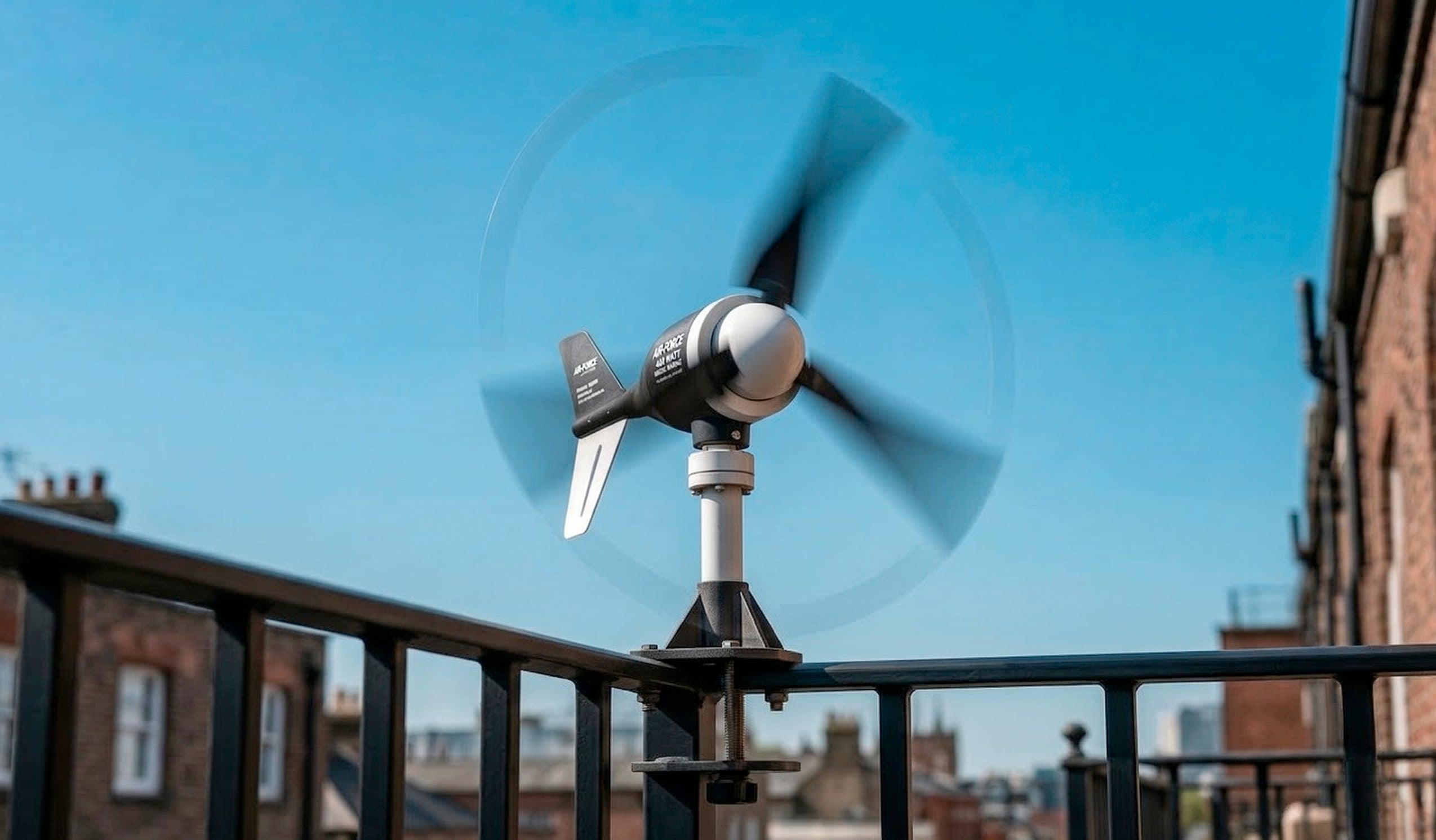
Photovoltaic is now a household appliance: it is installed on the roof, produces predictable energy and requires relatively simple authorizations. THE’domestic wind powerhowever, much remains rarer. Yet the wind is a renewable source like the Sun. So why can’t we put a small turbine on the roof of the house and produce energy? The mini-wind farm, also known by the term Small Wind Turbines (SWT), must face physical, technical and regulatory challenges much more complex than solar.
The speed of the wind
Photovoltaic often works even with seasonal variations and solar radiation remains sufficient to partially or totally power a domestic system. The wind, however, is irregular and difficult to predictespecially in urban environments. To make a turbine work you need at least 5–6 m/s average annual wind. Below 5 m/s production is minimal; between 6 and 7 m/s it becomes sensible; above 7 m/s it grows rapidly thanks to the cubic relationship between wind speed and energy.
The problem is that the wind on city roofs it almost never reaches these speeds. Buildings create turbulence, vortices and flow slowdowns.
The limits of domestic wind power
Small turbines have structural problems more marked than the large ones:
- small rotors with low power/surface ratio;
- greater sensitivity to wind variations;
- lower efficiency at low speeds;
- wear accelerated by turbulence.
Furthermore, the turbines may not reach the performances declared in the catalog because they were tested in ideal and not real conditions.
Photovoltaic is simple: no moving parts, little maintenance, direct current (DC) production easily convertible to alternating current (AC). A domestic turbine, on the other hand, produces variable alternating currentbecause the frequency depends on the wind speed. It is an unstable current, not directly usable at home. To stabilize it you need:
- a rectifier to convert variable alternating current into direct current
- a inverter to convert direct current into stable alternating current at 230 V and 50 Hz
This electronics is more complex and expensive than photovoltaic electronics.
Finally, small turbines rotate faster than large ones and generate more noise and vibrations. This creates problems of social acceptance, especially in residential contexts.
What the legislation says
In Italy, wind power is considered a plant impactful, even if small in size. The Legislative Decree 387/2003 provides for theSingle Authorization, that is, a single authorization that brings together in a single process all the permits necessary to build and manage a renewable source plant. From landscape to acoustic, from construction to safety. Many Regions require this authorization even under a 20 kW system because a turbine modifies the landscape, generates noise and vibrations, requires structural and anti-seismic checks and can represent a risk in the event of the blades detaching.
In restricted urban areas, domestic wind power is often banned regardless and night-time noise limits (around 40 dB) are difficult to meet. Small-sized turbines therefore have potential but today they are held back by physical, technological and regulatory limits.
