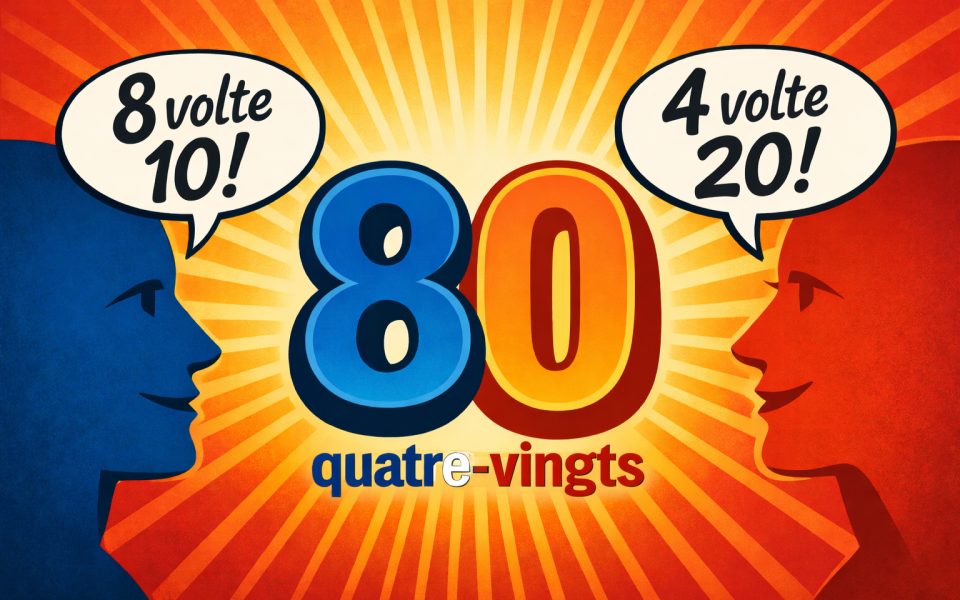
In Franceas in Italy, the decimal number system based on the number 10 is used, however in French the number 80 it is said quatre-vingts, four times twentytaking the number 20 as a basis instead of the number 10. At first glance it may seem strange, but it has its own logic which has to do with the way in which objects are counted: we can do it with only the hands, in base 10 (decimal system) or with hands and feet, in base 20 (vigesimal system). In France, the use of the vigesimal system in counting the number 80 has partially remained, and this is due to ainfluence of the past. In fact it comes from Gallic, the Celtic language spoken when France was called Gaul, which used the vigesimal system. Let’s see how.
All of us, from an early age, have learned to count in base 10: to count up to 10 objects we use the fingersbut when the fingers are not enough we mark the tens in some way, to free the fingers, and continue counting. For example, to count the letters of the Italian alphabet with our hands we proceed as follows:
- we start with the first finger pronouncing “A”, we continue with the second finger, “B”, and we continue until we have finished the fingers with the letter “L”
- we memorize the fact that we have completed a ten and start again with the first finger for the letter “M”. When we get to the letter “V” we have run out of fingers again
- let’s memorize another dozen (so far there are 2), let’s free all the fingers and start again with the first finger with the letter “Z” which is the last letter.
- At this point we have finished and have counted 2 tens and a finger, so let’s say we have counted 21 letters.
The way we count can be reflected in how we call numbers and, from a linguistic point of view, the decimal number system is the most widespread in the world, but there are other ways of counting. For example, we can count in base 20 using both fingers and toesthus having it available 1 score of fingers instead of 1 dozen. Let’s see what changes if we count the letters of the alphabet in this way:
- As before, we begin with the first finger of one hand pronouncing “A”, and continue counting until reaching the “L” we finish the fingers of the hands
- we continue counting using our toes, the first toe will correspond to the letter “M”, the last toe to the “V”.
- At this point we have finished all the toes, which are 20, and let’s memorize 1 score and we end by counting the letter “Z” with a single finger: in all we have counted about twenty and one units, or 20+1=21.
When yes count in base 20as in this case, we are talking about vigesimal system which, from a linguistic point of view, is the second most widespread system in the world after the decimal one. When counting in base 20 we no longer refer to tens, but to twenties and this can be reflected in the way numbers are called in a language. For example if we were to count 80 objects with a vigesimal system we would say that there are 4 scores, four times twentyjust like the quatre-veingts French. This does not mean that in France people currently use their toes to count but only that, in ancient times, there must have been some type of contact with this way of counting in which, in addition to the fingers, the toes are also used.
