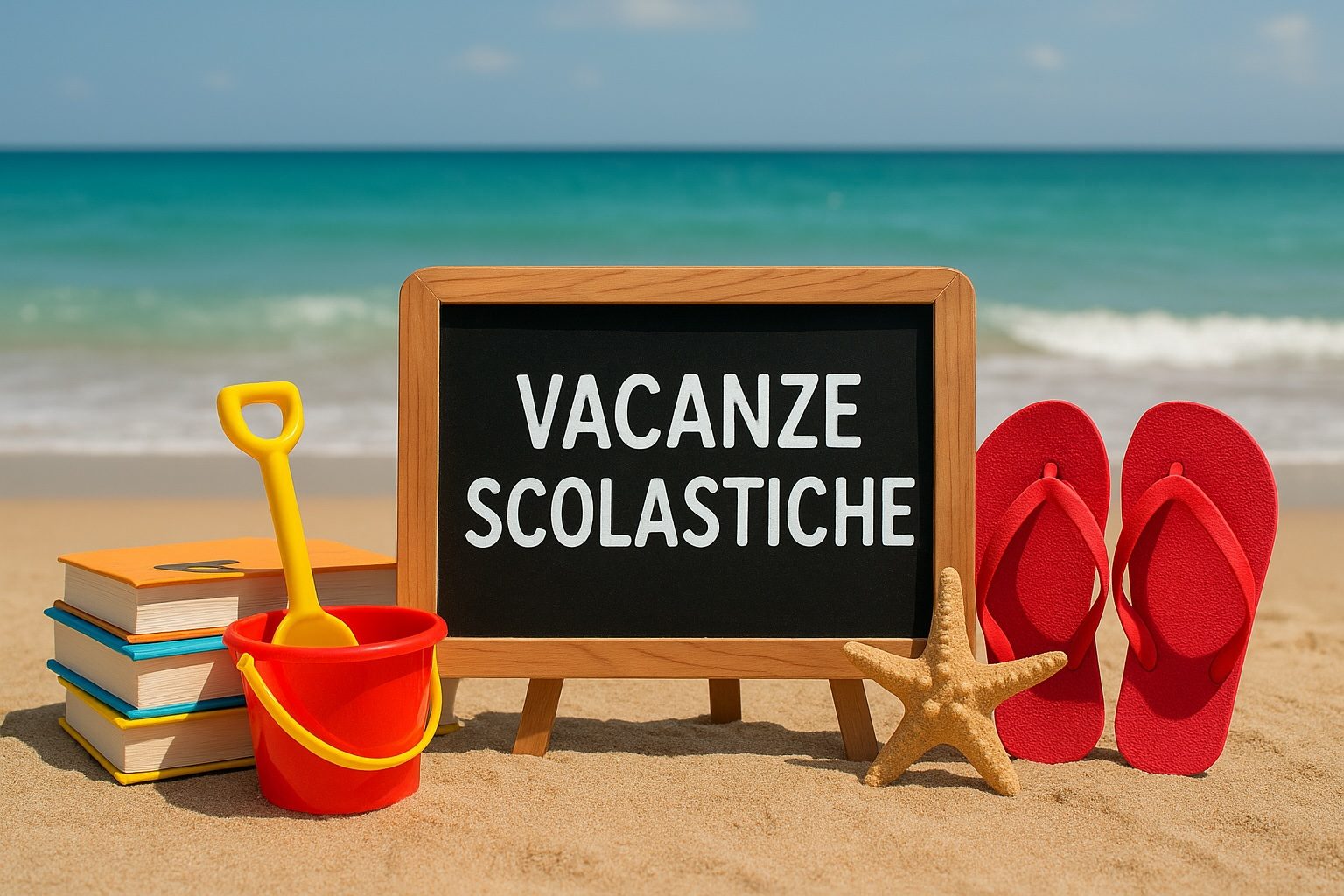
In Italy, the Summer school holidays They are very long: they last three months, and go from June to September. They are the longest in Europe. But why? The duration of these holidays is linked to Cycle of agricultural works: In the past, when most of the population Italian was occupied in agricultureyoung people had to remain at home to help families in the period in which the work in the fields was more intense. When Italy ceased to be a country with an agricultural prevalence The duration of the holidays has been preservedwith some variations, in part for conservatism and in for climatic reasons. Today the holidays last about 13 weeks and therefore there is no shortage of those who propose to change the duration, but until now all the proposals have fallen into the void. The three months of vacation, moreover,, present both advantages and disadvantages for students and for society.
How long the summer holidays for school in Italy last
For students the summer holidays last about three months, equivalent to 13 weeksfrom mid -June to mid -September. This does not mean that for three months schools are closed, because there are exams and administrative and organization activities, but in the summer there is no lesson. Italy is, together with Latvia, the European country in which the holidays are longer. In some cases, such as in Germany and France, holidays they only last 6-8 weeksbut school calendars include different rest periods during the school year. Therefore Italy, despite the long summer holidays, is together with Denmark the country in which the most actual number of school days is made: 200 per year.

Why the summer holidays are so long
The duration of the summer school holidays is linked to Economic and social structure prevalent in the past: Until the 1950s-60s, peasant civilization prevailed in Italy and it was necessary that the boys in school age remained at home in the summer, a period of Maximum activity in the fieldsin particular for the cycle of wheat and for the other collections. Keeping the summer schools open would have meant incentivating school escape, because many families could not give up the contribution of children in agricultural work. Until the 70s, moreover, the school He always started October 1st And only since 1977 the beginning of the year has been anticipated to one day between 10 and 20 September.
The practice of making three -month holidays last was preserved even when Italy has stopped being an agricultural country and because it is Difficult to change rooted traditionsand for climatic reasons: In the summer months the heat makes it more difficult to go to school.
The proposals to change their duration
Several exponents of the ruling class and the intellectual world have proposed to vary the duration of the holidaysorganizing the school calendar in a different way. For example, in 2007 the Minister of Education Giuseppe Fioroni he evaluated the possibility of shortening the two -week holidays, assigning new rest periods during the year, but the idea, however, had not followed. Other attempts to change were advanced in 2013at the time of the Monti government, and in subsequent years. In 2021, due to the loss of lessons caused by the Covid-19 pandemic, not compensated enough by distance teaching, the Draghi government He proposed to keep schools open longer in the summer, but the proposal fell into the void. Recently, an online petition has also been launched to shorten the holidays.

There is also no shortage proposals for the opposite signaccording to which the school should begin in October, as was done until the 70s. Such a thesis has recently been supported, among others, by the former senator Marinella Pacificaccording to which it is necessary to protect students and teachers from the summer months.
The pros and cons of three -month school holidays
The duration of the holidays It has advantages and disadvantages. Among the advantages, the opportunity for students of regenerate and devote yourself to leisure activities. In addition, the three months of holidays allow you to travel and meet new realitieswhich however represents a form of learning. From an economic point of view, the long duration of the school holidays favors tourism, Because families have more opportunities to stay away from home.
Among the disadvantages, the main is the Learning Lossthat is, the loss of learning. The long summer break causes students to forget a part of what is below during the year: according to some estimates, they forget between 17 and 28% of what they learned in the humanistic field and between 25 and 34% in mathematics. In addition, the holidays make the differences in lifestyles between students belonging to different social classesbecause only wealthy families can afford to make long trips to their children, while the others are forced to leave them at home, often watch television or play with smartphones. Finally, the holidays create difficulties to parents who workand in particular to the mothers, who are generally involved in a greater extent than the fathers in the care of the children; Consequently, the long period of vacation to increase the Gender Pay Gapthat is, the difference in remuneration between men and women, and the more general gender disparity.
