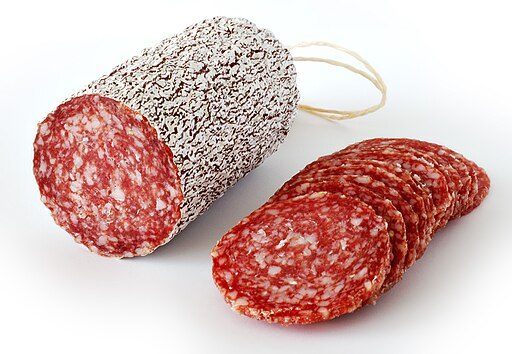
The Italian language is gourmet: this can also be seen in the use of food expressions to define people. Among all the foods that populate the figurative lexicon, the salami occupies a place of its own. Telling someone “you’re a salami” is one way to describe behavior or cognitive abilities of the person you are addressing derogatory connotation or teasing. This expression is used to indicate someone considered naive, not very smart, easily deceived or incapable of grasping an obvious situation, it directly recalls the oldest food preservation practices.
It may seem strange that a sausage from the Italian gastronomic tradition has taken on a metaphorical meaning of this type, but by reconstructing the history of the expression we can understand why. From a linguistic point of view, the use of food terms to designate human characteristics responds to a mechanism typical of natural languages: given that the body, food and – more generally – the senses are fundamental in daily and cultural life, the vocabulary associated with them has become a tool for describing typically human characteristics such as temperament and theintelligence in a metaphorical sense.
The word salami derives from late ancient Latin salamen (in turn derives from classical Latin salliterally “salt”) used to indicate the use of salt to preserve food, later transforming in the late Middle Ages into salamenin reference to foods preserved with salt such as fish, in particular what is now called baccalà (or stockfish). The historical-etymological meaning of the expression, therefore, would derive from a change in use of the term salamenwhich until the 18th century and beyond identified salted fish or cod, still used today metaphorically to describe an inexpressive person: hence the saying of “be a codfish“.
In the case of salami the metaphor develops above all around its consistency. The salami appears compact and fullfrom here it gives the figurative idea of one “full head“ but not in the sense of intellectual richness – as it could be “have some salt in your head” – but full of dullness, rigidityin short, a lack of mental elasticity. Unlike other sausages, salami is also a seasoned product that does not easily change shape: this static nature lends itself well to representing a person who is not very reactive or slow to understand.
According to some interpretations widespread in the popular traditionthe implicit reference would also be to the section of the salami, because it is a uniform surface, without joints, which reinforces the image of something “not very refined” from an intellectual point of view. Added to this is the role of salami as daily and popular foodfar from any aura of sophistication which, in a figurative sense, represents what is simple and within everyone’s reach, easily becoming symbol of naivety.
Precisely for this reason the Italian language takes an object full of positive value and symbolically reverses it to create an effective and very ironic expression. The tone with which the expression is pronounced must also be considered, because if “you are a salami” it rarely has the violence of an actual insultit works rather like joking rebuke or affectionately sarcastic comment which does not affect the person’s profound identity but their momentary behavior. It is a formula that allows you to criticize without being overtly aggressive, transforming the negative evaluation into an “awkward” image.
Italian, as mentioned initially, is truly rich in expressions related to food (“removing the chestnuts from the fire”, “having ham before your eyes”) and also takes inspiration from holidays (“Christmas with your family, Easter with whoever you want”), foreign cultures (“sorry for the French”) and one’s own land (“see Naples and then die”) to describe the reality that surrounds us in a more colorful way.
