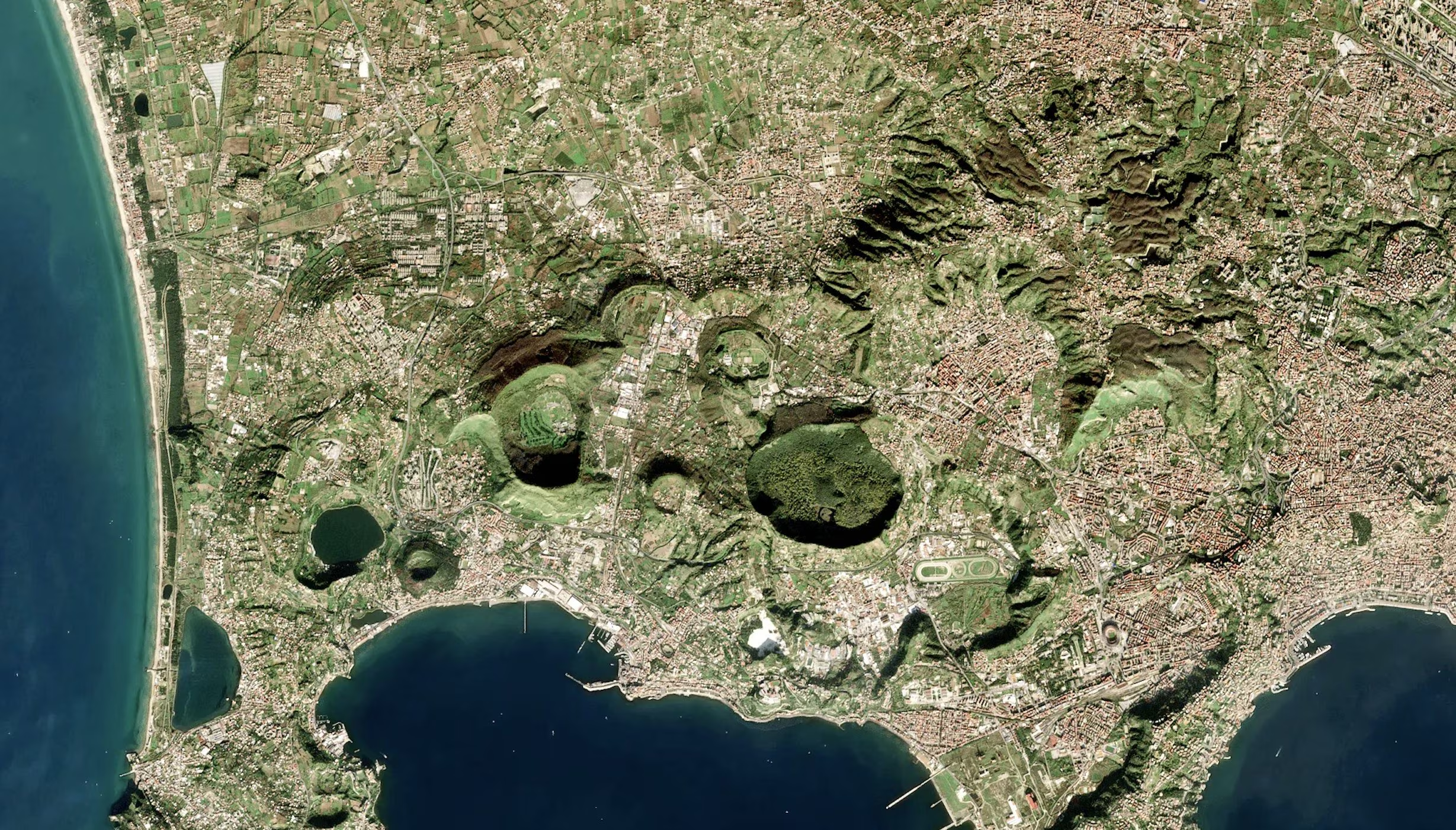
After the Md 4.7 earthquake at the Campi Flegrei, INGV launched the initiative “Understanding the Campi Flegrei: INGV’s responses” to explain the Phlegraean situation in a simple way: a Mw 5.1 earthquake cannot be ruled out, but it is not certain that it will happen; Fewer earthquakes do not mean an end to the bradyseismic crisis, and a stronger sulfur smell does not indicate greater volcanic or seismic activity.
To the Phlegraean Fieldsafter the 4.7 magnitude earthquake (the strongest ever recorded in the area in the instrumental era), the population continues to have doubts and fears on the evolution of the Phlegraean situation. And while the Government has recently approved a new extraordinary plan (with the creation of two funds of 50 million per year for building redevelopment), the INGV researchers have decided to listen to requests directly of the local population by launching the initiative “Understanding the Campi Flegrei: INGV’s answersThe goal is to respond to most common questions to explain in a clear and simple way the ongoing phenomena and the data collected.
Is an earthquake of moment magnitude Mw 5.1 possible at the Campi Flegrei?
The moment magnitude value Mw 5.1 is reported in a scientific article on the Campi Flegrei published in the journal Geophysical Research Letters in 2024. As highlighted by INGV, before knowing whether an earthquake of this intensity is possible, we need to understand what the Moment Magnitude (MW): this is a measurement of the size of the seismic source of an earthquake, obtained by analyzing various elements.
Trying to simplify, the Mw value is associated to the energy of an earthquake.
The 2024 study identified some fault systems in the Campi Flegrei that may be capable of generating earthquakes: based on the dimensions of the structures identified (between 350 and 2700 meters long) and the average characteristics of the earthquakes observed in the Phlegraean area, the authors have estimated a moment magnitude Mw of approx 4.4corresponding to the rupture of the most extensive fault located in the area currently affected by the deformation.
The Mw value 5.1 derives, instead, from one most extreme scenarioin which the authors summed the estimated seismic moments for all selected faults in the deforming area and converted the sum into moment magnitude. In this case, they obtained a reference value of approximately Mw 5.1.
The study, however, Not states with certainty that a MW 5.1 earthquake. This is because the Mw 5.1 value was used to build one extreme risk scenario possible relative to current knowledge, but should not be considered as a prediction of future earthquakes.
In short, the possibility that a MW 5.1 earthquake cannot be ruled outbut it is not certain that this will happen.
If the ground continues to rise, why can there be days or weeks with few tremors?
In this case, the INGV specifies how the soil lifting and the seismicity I am connected in the long termbut do not show a direct correspondence over short timescales. The crust can deform and accumulate tension for days or weeks without producing earthquakes perceptible, until local resistance thresholds are exceeded.
A short phase with few earthquakes, Therefore, does not indicate necessarily an attenuation of the bradyseismic crisis: if the ground continues to rise without being perceived by the population, the crust is still continuing its deformation process. Likewise, the arrival of stronger shocks it’s not necessarily preceded from a phase of soil lifting free of seismicity.
What does the “sulphur” smell that is felt in the Phlegraean area depend on?
The smell of “sulphur” emitted by fumaroles (which in many cases is compared to that of “rotten eggs”) is caused above all by the presence ofhydrogen sulfide (H2S) among the gases emitted, as specified by INGV. It is a gas commonly emitted by volcanic fumaroles and which can be perceived even at very low concentrations: a strong smell of sulfur, however, does not correspond to a signal of greater volcanic or seismic activity.
This is because the intensity of the smell it doesn’t just depend on the amount of gas emittedbut also from the direction of windfrom the humidity rate and from conformation of the territory. For example, at night, a minor atmospheric dispersion it can favor the stagnation or transport of gases near the ground and, consequently, influence perception in certain areas.
The Institute also emphasizes that any sulfur compounds can also arrive from sewers, purification plants or those of waste treatment.
