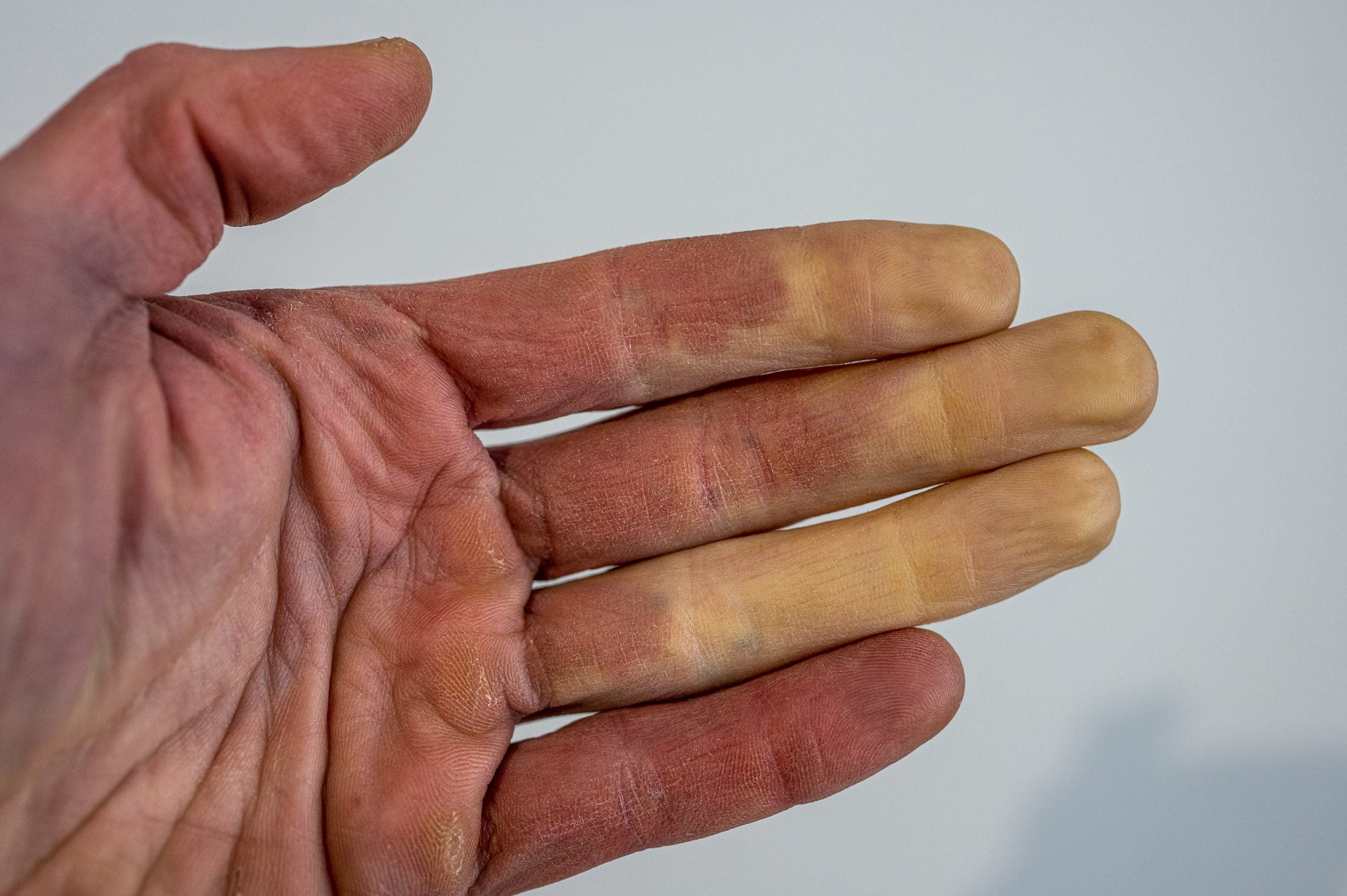
Scientific studies, such as those appearing on Vascular Specialistand bodies such as the Istituto Superiore di Sanità (ISS), define the Raynaud’s phenomenon is a condition characterized by a excessive response of the blood vessels of the fingers to stimuli such as cold or emotional stress. In these situations, the vessel wall contracts temporarily reducing the blood supply to the extremities of the body, resulting in the loss of the natural color of the skin which turns towards white-yellow. The most common symptoms include strong sensation of Freddocolor changes of the fingers and, sometimes, sensory disorders such as tingling or numbness. It is more frequent in young women and can present as a primary form, without other associated pathologies, or as a secondary form, linked to systemic diseases. It is not yet clear what happens at a biochemical level, but according to some hypotheses, adrenaline, which acts on specific vascular receptors, could be involved. A study published in Nature Communications in 2023 also indicates that a genetic predisposition could make some individuals particularly sensitive to this type of vascular response.
The scientific explanation of the color variation of the fingers
In general, the vasoconstriction it is a physiological response to stressful conditions: low temperatures, for example, put the body in a state of alarm and cause it to concentrate the blood towards the vital organs, directing it towards the center of the body to the detriment of the peripheral areas, such as the fingers and toes. Raynaud’s phenomenon occurs when, often in response to cold or stress, the blood vessels in the fingers they shrink abnormally and excessively.
The first to describe this phenomenon was the French doctor Maurice Raynaudwho illustrated it in 1862 in his doctoral thesis where he spoke about vasospasmwhich is precisely the narrowing of a blood vessel following the contraction of its smooth muscles. Even today this medical condition still bears his name and can present itself as Primary Raynaud’s phenomenonassociated with cold or emotional stress, or as secondary Raynaud’s phenomenonlinked to other pathologies, in particular connective tissue diseases such as systemic lupus erythematosus. This phenomenon involves only a small part of the population, estimated between 3% and 5%, and is more widespread in women, especially in the younger age groups.
Symptoms of Raynaud’s phenomenon according to the ISS
The symptoms, as reported by the Istituto Superiore di Sanità (ISS) and by studies such as Diagnosis and management of Raynaud’s phenomenonthey are clear. The reduction in blood supply caused by vasoconstriction causes the skin to lose its usual color, becoming very pale, with shades that can change from white to yellowish. Since blood is one of the main carriers of body heatthis explains why one of the first symptoms is the sensation of cold in the fingers.
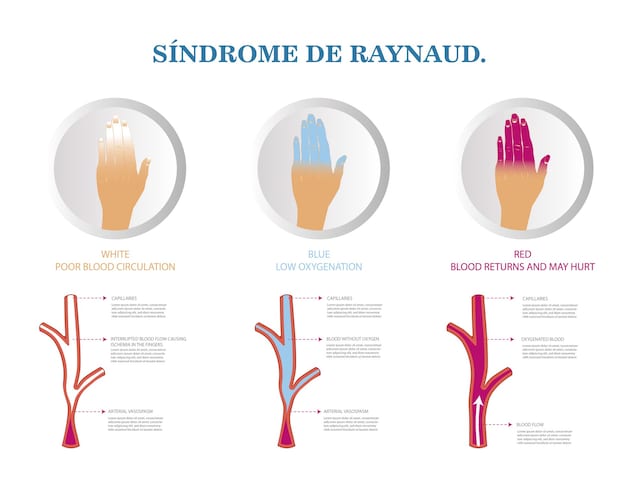
In addition to the cold and the color change, you can then also experiment tingling, numbness and, in rarer cases, even a mild one pain. It usually starts by involving only one finger and then, if necessary, spreads to nearby ones, with the thumb almost always spared. The different coloring can also be divided into phases: In the first stage, the fingers become very pale due to the abrupt vasoconstriction, discoloration may subsequently appear bluish (cyanosis) due to the reduced oxygenation of the little blood left in the tissues, finally when the vessels dilate and the blood flow returns to normal, the fingers can become redoften also accompanied by a sensation of heat and pulsation.
Uncertainties about the biochemical mechanism of the syndrome
It’s not entirely clear what happens at a biochemical level in our cells and what are the mechanisms underlying Raynaud’s phenomenon, but there are some hypotheses. When the body feels in danger, for example at temperatures that are too cold or during strong states of anxiety, the autonomic nervous system is activated and signal molecules are released into the blood which have the task of putting the body on alert: the main ones are adrenaline and norepinephrine. These hormones induce the so-called response of “fight or flight“: we cannot sit back, on the contrary, the heart must beat faster, the blood pressure must rise, the pupils must dilate to let in more light and have better vision. Adrenaline and norepinephrine bind to specific receptors, called alpha-2 adrenergic and mainly expressed on the surface of blood vessels, including the arteries and arterioles of the fingers. Their binding induces the famous vasoconstriction and reduced blood flow to peripheral tissues.
However, These are not the only mechanisms underlying Raynaud’s phenomenon: Recent studies suggest that other factors, such as those, are also involved neuralthat is, linked to the way in which the nervous system regulates the contraction of blood vessels. It can therefore be said that the activation of adrenergic receptors can contribute to the reduction of blood flow to the fingers, but it is not the only cause: it is part of a more complex and not yet fully clarified picture.
The probable genetic basis according to a Nature study
But why does this phenomenon only interest a part of the population? Other studies suggest that primary Raynaud’s phenomenon may be affected also from a genetic predisposition. In particular, a study published in Nature Communications in 2023 identified an association between Raynaud’s phenomenon and gene variants ADRA2Ainvolved in coding the α2A-adrenergic receptor. A study published on tries to explain it Nature Communications in 2023. It is believed, in fact, that primary Raynaud’s phenomenon has a genetic basis: in fact, the ADRA2A genea portion of DNA that is used to synthesize alpha-2 adrenergic receptors. In predisposed subjects, there will be a greater expression of these receptors, making the vessels hypersensitive to adrenaline and noradrenaline, thus causing vasoconstriction exaggerated even in conditions that would not normally determine it.
