
Try this little experiment. Place a hand about 20 centimeters from your mouth and blow on it: the air will seem relatively cold. Now, without moving your hand, breathe on it with your mouth wide open: suddenly the air will appear to you definitely warmer. Even if you have never noticed this fact, you still use it every time you blow on it instead of breathing on it to cool a hot soup. Yet the temperature of the air that comes out of our lungs is always the same (approx 37°C). So how do we explain this difference?
When talking about the behavior of fluids in real situations, such as the air we blow, it is always appropriate to make a fundamental premise: Fluid mechanics is extremely complexeven for professionals, therefore a real and exhaustive answer will have to take into account many more or less complicated factors. However, if we just want to give a simplified idea of what happens, the key to understanding this apparent paradox lies in two main parameters of the air flow we emit with our lungs: the speed and the pressure.
The main difference between blowing and breathing is airflow diameter that we let out of our mouths. When we blow, we make the air exit hole much smaller and therefore, basically, “force” the air to pass through a narrow passage.
Now, when a fluid is moving it tends to keep its speed as constant as possible scopethat is, how much passes through a given section in a given amount of time. Therefore, by reducing the section (which is what happens to the air when we blow it with our mouth almost closed) its speed increases. We notice it clearly on our hand: the air that reaches us when we blow is significantly faster than the one that reaches us when we breathe. It is a consequence of the fact that the air, passing through a narrow passage, opposes accumulating and compressing, preferring instead to accelerate and exit more quickly.
Well, now what happens when a moving fluid increases its speed? It decreases your blood pressure. This phenomenon is called “Venturi effect” in honor of the Italian physicist Giovanni Battista Venturi who first described it. It is the principle that allows planes to fly: the airfoil causes the air under the wings to flow more slowly than the air above, creating a pressure difference which results in a force directed upwards, the so-called lift.
This behavior is a consequence of the fact that fluids, like almost everything else in nature, he wants to keep his energy constant. This is described in physics since Bernoulli’s theorembut here we are mainly interested in a specific consequence of the fact that the blown air has a relatively high pressure: the so-called dragging (entrainment in English). What does low pressure air actually do? It attracts the surrounding air at higher pressure. It’s why the winds blow. On the much smaller scale of our blowing, the fast, low-pressure air we blow attracts and drags the cooler air around it. The flow that reaches our hand is therefore composed only to a modest extent (approximately 40%) from the warm air of our lungs, while the rest is air at room temperature, therefore decidedly colder.
When we breathe, the air comes out from a much larger opening, so its speed does not increase significantly and consequently the pressure does not drop much: the drag is much milder, and the air that reaches our hand is almost completely composed of the warm, humid air that comes directly from our lungs. You can see it in the image below.
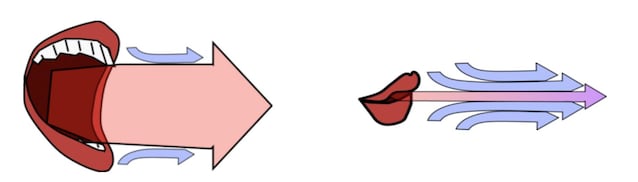
Do you want a demonstration of all this? We have plenty: we’ll give you two.
- If instead of blowing and breathing on your hand held at a certain distance, you do it on the hand held immediately in front of your mouth, you will immediately realize that now the blown air is as hot as the breathed air. This is because the hand intercepts the flow before the dragging has time to occur.
- If you blow and breathe on an empty tube, even in this case you will no longer feel a substantial temperature difference. This is because the walls of the tube mechanically prevent entrainment from occurring.
Going into more detail, there are other minor effects that contribute to the fact that the “blown” air is colder than the “breathed” air. For example, when we blow, the flow of air comes out of our mouth may tend to re-expand and, in doing so, slightly decreases its temperature.
Finally there are phenomena linked not so much to the air temperature itself but to how air interacts with our hand. The blown air, in addition to being colder, is also faster and therefore “better” at getting rid of the air surrounding our hand and warmed by the hand itself. The arrival of new, cooler air favors the release of body heat: this phenomenon is called “wind chill effect” and we witness this every time we tend to feel colder when the wind blows stronger, or every time we turn on a fan in summer.
The air that reaches us may also be less humid than that immediately surrounding our hand, thus favoringevaporation of moisture on our skinanother process that dissipates body heat to the environment. Both of these phenomena, which depend on both the temperature and the speed of the air, are much milder when we breathe: here the air is warmer and slower, therefore it produces much less wind chill and much less evaporation.
