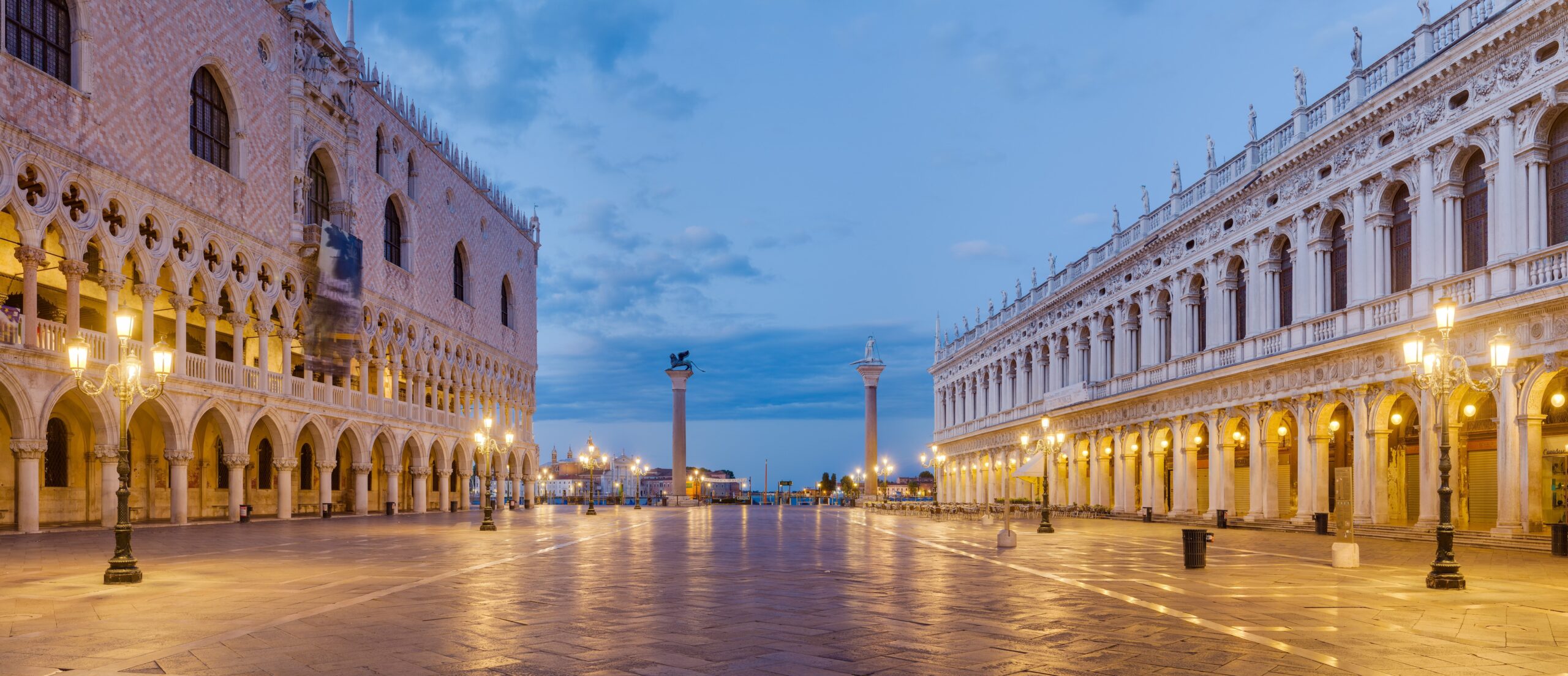
Canals, carnival, vaporettos, gondolas, cicchetti: we are obviously talking about Venice. Among the many peculiarities of this extraordinary city, one in particular is hidden in its second name, “the SerenissimaThis is not a simple poetic nickname: for centuries Venice was one Independent republicled by Dogecalled “serenissimo” for its ability to guarantee balance and stability and, consequently, the city also became “very serene”. Another explanation comes from military history of Venice. For centuries the city, during the period of maximum expansion, dominated the Adriatic and then the Mediterranean, winning decisive wars e protecting his businesses. This force guaranteed stability and security to the Venetians, creating the image of a truly “serene” city.
The date of foundation of Venice is conventionally traced back to 5th century AD. with the construction of the church of San Giacomo on what was theRialto island. Between myth and legend, in reality the birth of the city was a gradual process started more likely starting from the 6th century, with the migrations of the Venetian inhabitants to the islands of the lagoon to escape the barbarian invasions, especially the Lombard ones. Gradually the settlements consolidated, giving rise to a complex urban fabric made up of canals, stilt houses, plots of land and bridges, as well as athriving and lively business. In 697, the Republicgoverned by Paoluccio Anafestothe first Doge in the history of Venice. This figure served as head of state and government, and remained the symbol of the city until May 12, 1797day of fall of the Republic. It is said that the Doge was defined as “most serene” by its inhabitants and that consequently the city he governed was defined as “most serene” like him so much so that, starting from the 17th centuryit was renamed Most Serene Republic of Venice.
Another theory related to this nickname of his is related to his military history. In order to safeguard the trade routes between the 9th and 11th centuries, Venice conducted several wars which ensured its complete dominion over the Adriatic. With them crusades and the trade towards the East it became increasingly stronger and between the 12th and 13th centuries it managed to extend its influence, obtaining the supremacy over the Mediterranean Sea and arriving at the clash with Genoa which lasted until the 14th century, when, after emerging victorious, Venice began its expansion on the mainland. At this point the Venetian Republic, now Maritime Republic established itself as nautical power and politicsguaranteed total economic and social stability in its domains, allowing anyone to live in total serenity.
Furthermore, thanks to a justice system considered among the most efficient of the time, Venice offered its inhabitants a rare sense of peace and security. The city was also famous for his hospitality: accustomed to meeting people from every corner of the world, the Venetians tolerated customs and behaviors that were frowned upon elsewhere, such as the presence of courtesans, an integral part of lagoon social life.
“La Serenissima” is not only the romantic name of the most famous lagoon center in the world, but the recognition of adeep identity: that of a city that knew how to build its splendor onharmony between institutions, economy, culture and sea. Venice invites us to rediscover serenity not as an absence of movement, but as an awareness of its history and its role in the world: remaining “Serenissima” despite always finding itself at the center of the great mercantile, cultural and geopolitical currents of the past and, in a certain sense, also in the present, continuing to stay afloat despite theovertourism aggressive that threatens its identity and cosmopolitan soul.
