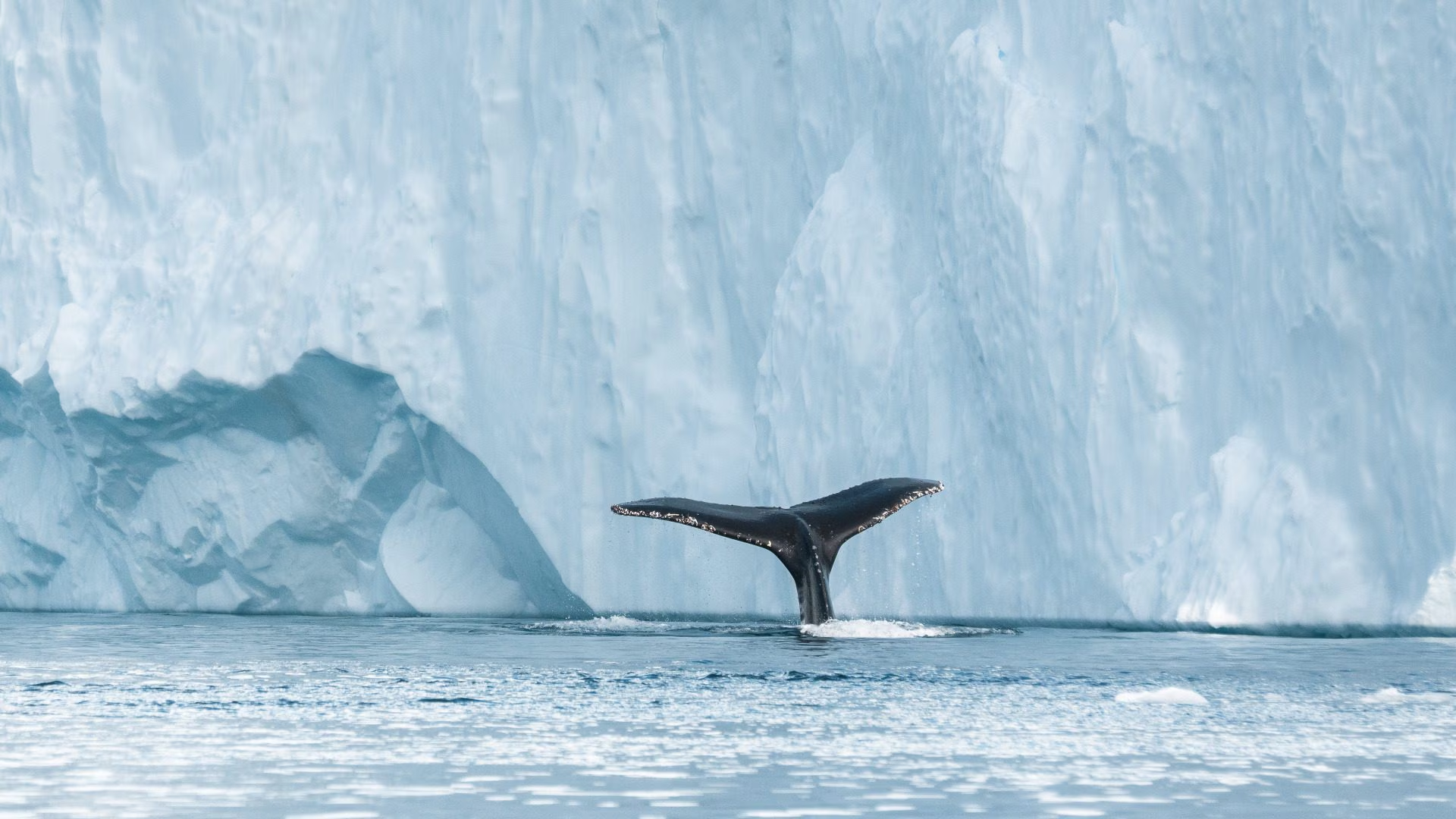
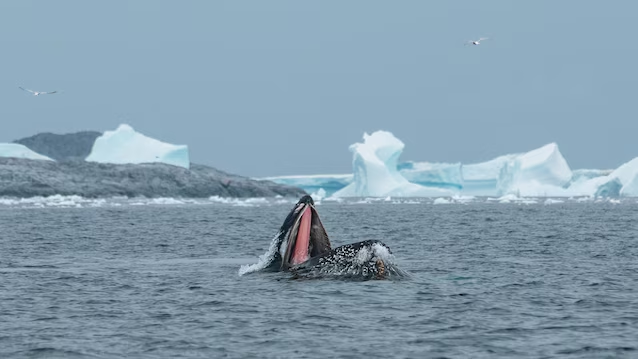
Some of the largest whales in the world, including humpback whales, minke whales and fin whalesare increasingly present in the coastal waters of Greenland eastern. These are areas which until a few decades ago were largely inaccessible to these cetaceans due to sea ice, but which today, thanks to the climate warming and the progressive reduction in ice coverare becoming new feeding areas summer. The study that documented this change speaks of a real one ecological regime change: the decrease in sea ice and warming waters are changing the distribution of species and the food dynamics of the ecosystem, favoring the seasonal arrival of thousands of large whales.
From almost absent humpback whales to thousands of large cetaceans in Greenland
The authors combined aerial and naval surveys, satellite tracking, field observations and oceanographic data, thus reconstructing the evolution of the presence of whales in the area. But one of the most impressive data comes from naval surveys: until 2006 not even a humpback whale had been recorded; in 2007 there were 7 sightings, which rose to 26 in 2015 and in 2024 they even exceeded 150 individuals.
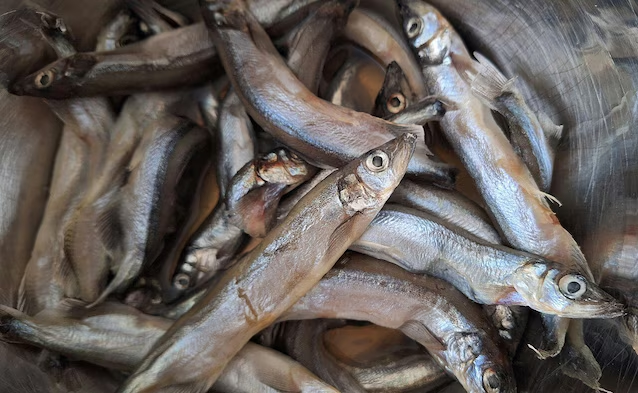
Abundance estimates also confirm the extent of the phenomenon. In 2024 alone, approximately 4,000 humpback whales, over 5,000 fin whales and more than 6,000 fin whales minors would have been present in the coastal waters of eastern Greenland covered by the study. The phenomenon appears to be linked to both the reduction of sea ice and the increase in temperatures, which are also modifying the distribution of prey, including the capelin (Mallotus villosus) – small pelagic fish typical of cold waters and very important for the food chain.
The increase in whales does not depend only on the heat: the recovery of populations
However, this does not necessarily mean that the overall number of these whales has increased to the same extent. The authors point out that the phenomenon could mainly reflect one redistribution of populations in the North Atlantic, with individuals now exploiting areas of eastern Greenland that have become more accessible and rich in food. Added to this is the long-term recovery of some populations after the end of commercial huntinga recovery documented by several studies conducted in the North Atlantic, including those by Punt and colleagues and Robbins and colleagues.
Humpback whales, in particular, show some of the highest growth rates: the West Indies breeding population has increased by about 3.1% per year between 1979 and 1993while regional increases of up to approximately 9.4% per year. However, the recovery of fin whales appears slower, generally estimated at around 2–4% per yearwhile for minke whales the signals are less marked, also because historically this species had been less heavily reduced by hunting.
Up to 800,000 tons of prey in a single summer
The current increase in whales in the region would therefore be the result of multiple factors acting together: larger populations, less summer sea ice and a progressive “atlantification” of the waters. We are therefore talking about new habitats and above all new feeding areas. However, this greater presence could also have consequences on the local food web.
According to the researchers, the seasonal arrival of thousands of large cetaceans introduces much higher predatory pressure than in the past, with possible effects on the biomass of the capelin and, in turn, on other predators and commercial fish stocks that depend on this species. According to the authors’ estimates, in fact, during a summer season the three species of whales considered in the study could consume together at least 800,000 tons of fish and krill.
How climate change is transforming the Arctic food web
However, the same authors underline that consumption estimates must be considered as orders of magnituderather than as precise values. The main source of uncertainty concerns the actual number of whales present in the area. Furthermore, systematic surveys are mainly concentrated in the range between 60°N and 70°N, while several observations suggest that numerous cetaceans go even further north. As a result, estimates of abundance and overall prey consumption may even be conservative.
Even with these uncertainties, however, we are talking about enormous numbers, especially when compared with those of ten or twenty years ago. Plus the whales represent just one of the clearest signs of a much broader change: not only are the species that swim among the northern ice changing, but also who eats whom – and therefore how energy is transferred along the food web – and where resources are concentrated.
Sources
Berrow, S., & Whooley, P. (2022). Managing a dynamic North Sea in the light of its ecological dynamics: Increasing occurrence of large baleen whales in the southern North Sea. Journal of Sea Research, 182, 102186. Heide-Jørgensen, MP, Ditlevsen, S., Hüllert, SM, Sigurðsson, GM, Teilmann, J., Ugarte, F., & Stormholt, S. Feeding frenzies of baleen whales along East Greenland. Frontiers in Marine Science, 13, 1839547. Punt, A. E., Friday, N. A., & Smith, T. D. (2006). Reconciling data on the trends and abundance of North Atlantic humpback whales within a population modeling framework. J. Cetacean Res. Manage., 8(2), 145-159. Robbins, J., Bérubé, M., Clapham, P.J., Mattila, D.K., Palsbøll, P.J., Asmutis-Silvia, R., … & Pace III, R.M. (2024). Before and after delisting: population dynamics of North Atlantic humpback whales over two decades in the Gulf of Maine. bioRxiv, 2024-02.
