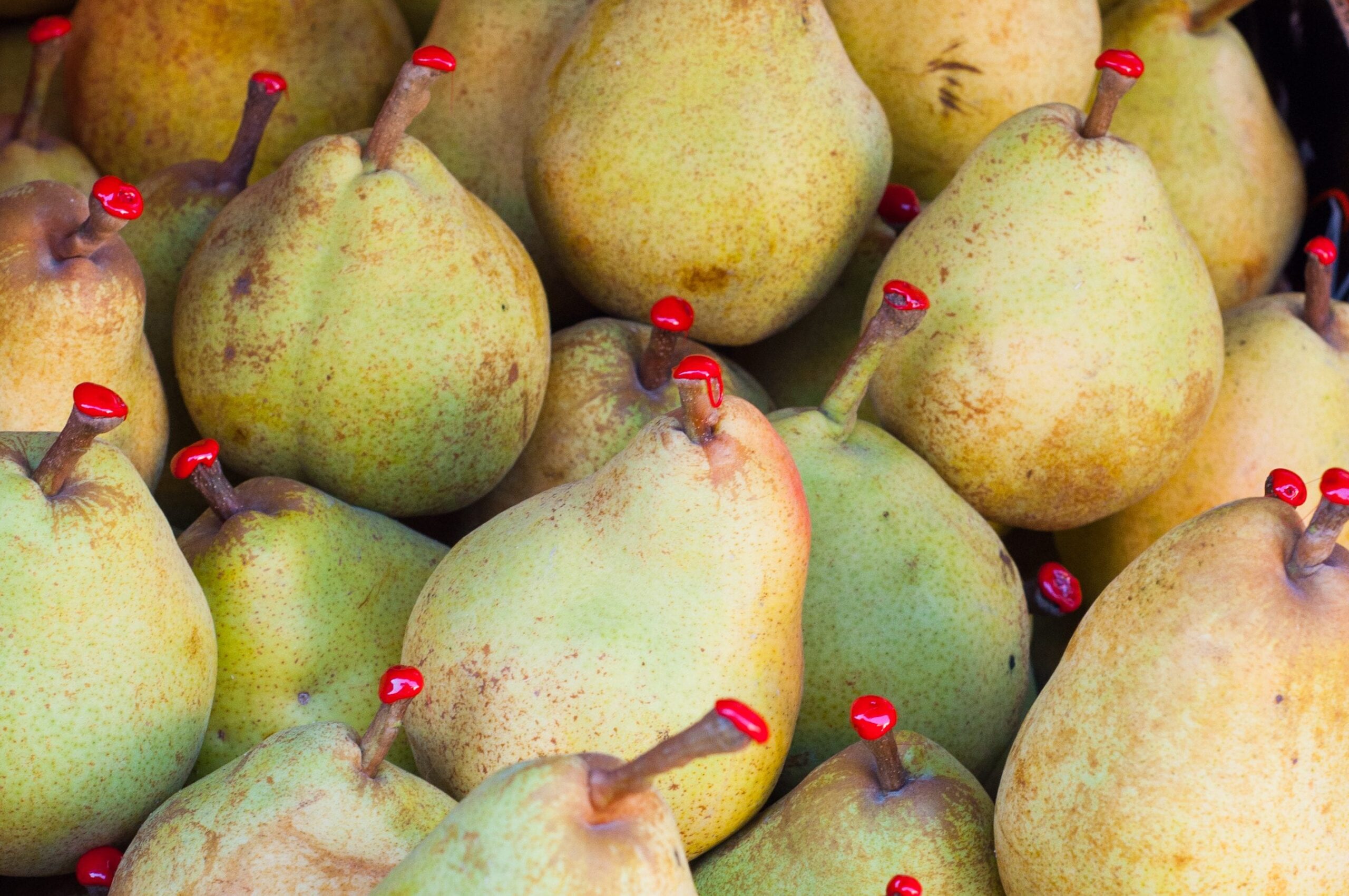
Often at the greengrocer you will see carefully arranged boxes of pears, each with a small drop of sealing wax on the stem. Today the red seal is essentially a decoration and one marketing strategy of the product, but the practice has ancient origins and very precise technical reasons. In the past, when there were no industrial fruit preservation systems, that drop it served to “seal” the petiole, thus slowing down the loss of humidity and the ripening of the pear. The sealing wax cap is still applied today on prized varieties such as the Decana del Comizio, the Angys or the Abate pear and also serves to reduce the risk of cuts and scratches caused by the stem of a pear on the peel of another within the same box. The technique was developed by French farmers in the second half of the nineteenth century, with the aim of preserving the fruit of a new variety of pear: the Doyenné du Comice (precisely the Dean of the Comitium), selected in 1850 in Angers, France.
The petiole or peduncle it is that woody part that keeps the fruit attached to the branch and is rich in vascularized tissues (xylem and phloem) through which water and nutrients (sugars and mineral salts) are transported to the fruit.
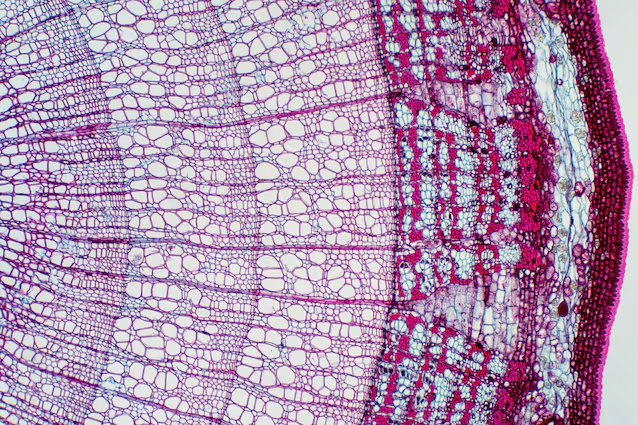
When you cut the peduncle to harvest the pear from the tree, a process of water loss and viruses and bacteria can penetrate the fruit. Furthermore, the pear is a climacteric fruit and its maturation is regulated byethylene. After detachment from the tree, the respiratory activity of the fruit increases, with greater production of CO₂ and ethylene, which in turn activates the enzymes responsible for maturation. If you intervene sealing the detachment pointyou get more effects:
- Reduces water loss and consequently dehydration
- It slows down the maturation process because yes reduces ethylene production
- The entry of microorganisms through the petiole
In the sector of post-harvest fruit conservation, the first point in the list above is fundamental. Dehydration and wilting affect the quality of the product, on storage time and, therefore, on his market value.
Pears in particular have a rather high water content (85-95% wet weight) and, in the absence of protective packaging, they are easily perishable due to water loss due to transpiration. At an industrial level, the closure of the petiole apex is almost no longer used, replaced by more effective methods. Modern industrial techniques provide for storage in cold storage with control of concentrations of oxygen and carbon dioxidefrom the temperature (generally around 5-10 °C) andhumidity.
Furthermore, the application of coatings and films on fruits in order to form semi-permeable barriers that limit transpiration and ethylene production. These are edible and tasteless coatings that do not affect the nutritional properties of the pear. They are applied by immersion or spraying and are generally based on polysaccharides, such as pectin, cellulose and chitosan, or of a protein nature such as casein or lipid-based such as beeswax and shellac. Sometimes antioxidant products and substances with an antimicrobial function are added to complete the preservation.
