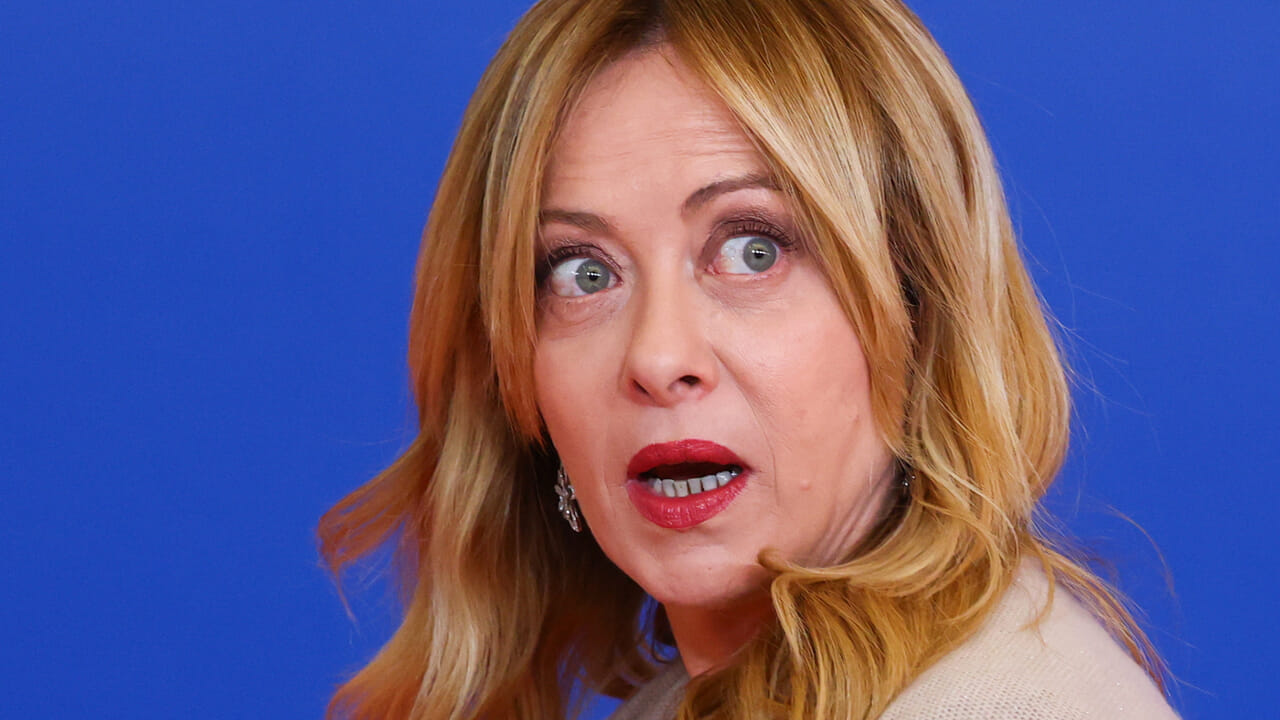
Why Russia insults Giorgia Meloni (and why Trump also has something to do with it)
Giorgia Meloni’s image was sinking, between Vinitaly and the Salone del Mobile in Milan, becoming a memes good for The Journalai and for some other video podcasts, after the unfortunate episode in the “Pulp Podcast” of the Fedez-Mr duo. Marra. The idea was that: to transform “Giorgia” into a funny comic, so as to dispel the very recent memories of the lost referendum and, even more seriously, of the economic situation of the country caught between the end of the PNRR, the European Stability Pact – and no, we have not left the EU infringement procedure – and a manoeuvre, the third in a row, of tears and blood that we are just beginning to glimpse.
This is the “Giorgia” perceived within national borders, immersed in the debate of internal politics. Then there is a “Giorgia” of the two worlds, within the affairs of international politics. Between the Trumpian USA, Putin’s Russia and the Europe of the Willing. Here the prime minister has just joined, belatedly, the group of the Willing – primarily France and Great Britain – and for this very reason she is attacked – in unison and simultaneously – by Donald Trump and Russian disinformation. Here, exactly.
Who really is Vladimir Solovyov
The pro-Putinist Vladimir Solovyov, one of the most well-known and aggressive faces on Russian television, heavily insulted Giorgia Meloni during his evening talk. The attack was not a simple personal outburst, but an episode that is part of a climate of strong political and media tension between Russia and our country. Solovyov, presenter of leading programs on Rossija 1 – the main television channel of the public company VGTRK, among the most followed in Russia – chose deliberately offensive and provocative language, hitting the Prime Minister (in masculine form, of course) with heavy and vulgar expressions. Solovyov is often presented as the television megaphone of Putin’s power.
His style is direct, polemical, theatrical and his programs have a strong political imprint. Solovyov’s talk is the perfect context to convey to Russians the orientation of the Putin regime on various current issues: a communication built not so much to inform, but to orient, polarize and fuel the narrative of power. An element that is most striking of all is that a good part of the insults directed at Meloni were uttered in Italian. Almost as if he wanted to address our people and the Italian institutions directly. A sort of declaration of open hostility, a content brought precisely into the Italian public debate. The only precedent for a Russian program that was expressed in our language, but in a playful and playful way, was the special by the Russian comedian Ivan Urgant – today somewhat disliked by Putin’s power – entitled “Hello 2020!” which parodied the Sanremo of the 80s.
Melons as a political target
The reason for this attack must be sought in the logic of Russian propaganda. Meloni is represented as part of the Western front hostile to Moscow: a European leader close to the interests of the European Union – a truly great enemy of Russia, as well as all the other democracies on the planet. And this attack comes in the aftermath of Donald Trump’s “excommunication” against the European NATO countries and Giorgia Meloni, who, aligned with the Volenterosi, denied Italy’s direct involvement in the conflict in Ukraine. Solovyov implied that the Italian prime minister would have “betrayed” Trump and the American voters, thus constructing a narrative in which Meloni becomes an inconvenient figure, to be publicly delegitimized. In this sense, the insults are not just offensive: they serve to reinforce a broader political narrative, in which Italy and the West are portrayed as enemies, hypocritical or hostile to Russia. Solovyov, in this scheme, is not just a presenter: he is a political actor who uses television as a weapon, with the aim of hitting, dividing and orienting, on the direct mandate of Putin’s government power, a political opponent.
The case also fits into the broader theme of hybrid warfare. It is now clear that Russia uses a combination of indirect tools to influence public opinion, institutions and decision-making processes in European countries. This framework includes propaganda, disinformation, cyberattacks, espionage and attempts to influence the media and political environments. The general objective is to weaken Italian and European internal cohesion and reduce, for example, support for Kiev.
How Russian hybrid warfare works
In Italy these dynamics manifest themselves through the diffusion of pro-Russian or anti-Western content, the revival of narratives that minimize Moscow’s responsibility and the tendency to exacerbate divisions on war, sanctions, NATO and the cost of energy. Disinformation almost never presents itself explicitly: more often it infiltrates public debate, distorting real facts, amplifying conflicts and fueling distrust towards institutions. Added to this is cyberspace, where attacks or intrusion attempts against digital infrastructures and public administrations have been reported. Even when they do not produce visible damage, these actions serve to test defenses, gather information and create a climate of vulnerability. Another front is that of espionage and the collection of information: this includes intelligence activities, confidential contacts and attempts to approach people useful for obtaining data or influencing political choices. In parallel there can be a more subtle work of influencing commentators (be they print journalists or talk show guests), cultural environments, associations and informal networks, with the aim of circulating narratives favorable to Moscow.
Hybrid warfare also exploits internal fractures already present in a given country, such as the war in Ukraine, the increase in prices of energy and basic necessities. By wedging themselves into these debates – through testimonials, well-oriented and paid political figures, social profiles and influencers – Russia and its disinformation agencies are trying to polarize the debate. In this sense, hybrid warfare does not only aim to convince, but to divide, confuse and wear down the political and military institutions of the country under attack. In Italy, as in many other European countries and also in the United States, these phenomena do not present themselves as a single visible operation, but as a sum of debates on disparate and separate topics, which however are linked by a single common thread: disinformation aimed at weakening citizens’ trust in national institutions and in the principles of Western liberal democracies. What seem like isolated opinions on the most disparate topics – mostly conspiracy theories – in reality, especially on social media and in the public debate that animates the media, are linked together by the aims of this hybrid war.
Energy, geopolitics and the Italian turning point
Today, Russian hybrid warfare works on two fronts: the Ukrainian war and the dependence of European countries on Russian gas. And the Italian government, from Draghi onwards, has expressed its orientation: on the one hand we have always been aligned with NATO and an Atlanticist position, therefore, against Russia’s deliberate attack on sovereign Ukrainian territory; on the other, we have undertaken a path that has made us progressively independent from Russian gas. For many years Italy was heavily dependent on Russian gas. In 2021, approximately 40% of the gas imported by our country came from Moscow. A huge share that made Russia one of the pillars of Italian energy security. This dependence had built up over time, also due to the convenience of prices and the structure of the national energy system, which is heavily based on gas. The break came after the Russian invasion of Ukraine in February 2022. From that moment Italy began a rapid diversification of supplies, first reducing and then eliminating purchases from Russia. According to the latest data, the share of Russian gas fell from 39.4% in 2021 to 4.2% in 2023, while in 2024 imports remained close to zero.
Alternatives to Russian gas
To replace Russian gas, Italy has increased imports from Algeria in particular via “Transmed” – the Trans-Mediterranean Pipeline, also known as the “Enrico Mattei” gas pipeline, which connects Algeria and Italy, passing through Tunisia – and has increasingly resorted to liquefied natural gas, arrived by ship and regasified on national territory. In just a few years, therefore, Italy has gone from a historical dependence on Moscow to an almost complete exit from Russian gas. It was a very rapid turning point, made possible by the geopolitical crisis, but also by a precise political choice: reducing Italian vulnerability towards a supplier now considered unreliable. In the same way, this government – precisely by pursuing a direction initiated by the Draghi government – is freeing itself from the deadly embrace of Donald Trump. A reaction, belated if we want, given Giorgia Meloni’s illusion of wanting to make Italy the ideal bridge between the MAGA USA and the Europe of the Willing. A path – that first fall in love with Trump and the MAGA world – which could be fatal for her in view of the 2027 political elections, especially if Trump’s star were to set prematurely and the future new American course were to find safer and more similar sides in other Italian political exponents.
