We are used to thinking that i numbers are the same everywhere and used in the same way to describe the physical world: We count the years, the money, the kilometers, even the calories and daily steps. But this familiarity hides a surprising fact: not all cultures use large numbers. In fact, in some societies numbers beyond three or four simply do not exist. So how do societies function without our large numbers?
Numbers as cultural constructions, not universal ones
In industrialized societiesthe numbers look like a neutral, universal language, almost natural. We are in fact accustomed to rationalizing the entire reality that surrounds us by giving it logical rigor, through geometry and the mathematics. Yet, anthropology has shown that i numerical systems they are not simply technical tools, but cultural constructions deeply rooted in ways of life.
Already Claude Lévi-Strauss underlined that the Human classifications reflect specific practical and symbolic needs. Numbers, in this sense, do not emerge everywhere with the same complexity: some societies do not develop terms for large numbers not because they are incapable of doing so, but because they do not need them.
What it means to live without numbers beyond the many: the Pirahã population
One of the most discussed cases is that of Pirahāan indigenous population that lives in the Amazon rainforest, in the region of Central Amazon in Brazil. The linguist and anthropologist Daniel Everettwho lived with them for years and recounted his experience in the book entitled Don’t sleep, there are snakes (2008), noted that their language contains no words for precise numbers beyond two or three.
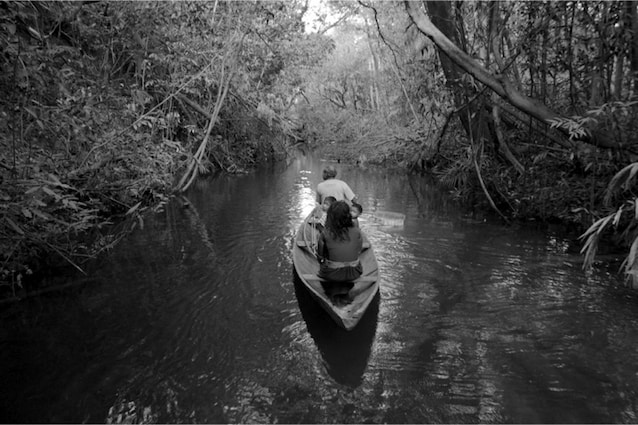
Rather, there are terms that can be roughly translated as “one”, “two” and “many”. However, this does not prevent the Pirahā from living, trading or making decisions: rather, it reveals that the High numerical precision is not central to their social organization. This observation led to questions about a central question: does language influence the way we think about numbers?
The cognitive psychologist Peter Gordon in this context has conducted experiments aimed at demonstrating that, without specific words for large numberspeople can estimate quantities but with – obviously – less precision. This, however, does not seem to mean that they cannot understand numerologyor the high multitudebut that the exact thought, the one that distinguishes for example between 27 and 28 depends in part on the linguistic tools available and is not, ultimately, necessary to understand the multitudes.
But when counting becomes necessary
There presence or absence of large numbers it does not reflect a different level of “development”but different cultural, economic and relational priorities. But when counting is necessary, how to do it absence of a specific language? The answer comes to us from the examples traced back to some populations of the Papua New Guineawhere they exist counting systems based on other criteria which are not verbal language, but the body.
In this sense, the different parts of the body act as abacus and in case how “shared cognitive map” as the different anatomical parts are used as “reference points”culturally shared, established within a sequence.
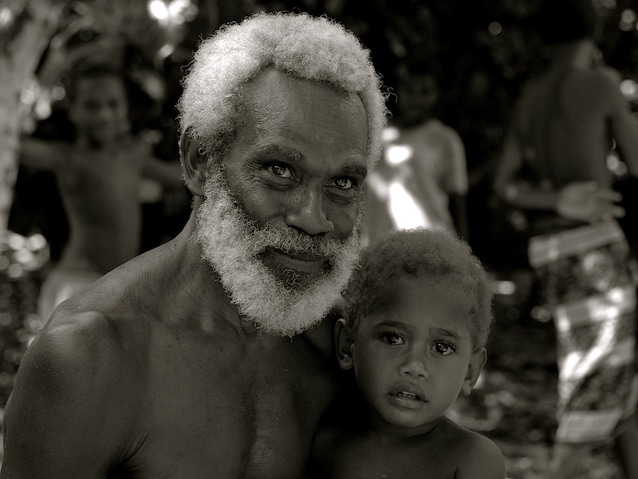
In concrete terms, counting, in Papua New Guinea, is not limited to the fingers, but continues along the body following a precise order: after the fingers it moves on to the wrist, forearm, elbow, shoulder, neck, face and then moves down to the other side of the body. Each point corresponds to a specific quantity.
This means that the number is not represented by an abstract word, such as “seventeen”but from one concrete position on the body. From a cognitive point of view, this system exploits the memory no longer verbal, like our system, but spatial and corporealone of the oldest and most universal forms of human memory.
Rethinking our relationship with numbers
These examples call into question a profound assumption of modernity: that quantify is one way universal and necessary to know the world.
In contemporary societies in fact everything seems to be translated into numbers: productivity, value, performance, even personal well-being, popularity and so on. But these “other life possibilities” remind us that this obsession with quantification is historically situated, and probably born with the standardization of the clockin the Industrial Revolution.
Cultures that do not use large numbers do not represent a form of lack or backwardness, but one different form of society and relationship with the world.
Sources
Everett DL (2008). “Don’t Sleep, There Are Snakes: Life and Language in the Amazonian Jungle”
Gordon P. (2004). “Numerical Cognition Without Words: Evidence from Amazonia.” Journal: Science, V. 306 (N. 5695), PP. 496–499.
Chrisomalis S. (2010). “Numerical Notation: A Comparative History”
Owens K. (2018). “History of Number: Evidence from Papua New Guinea and Oceania”
