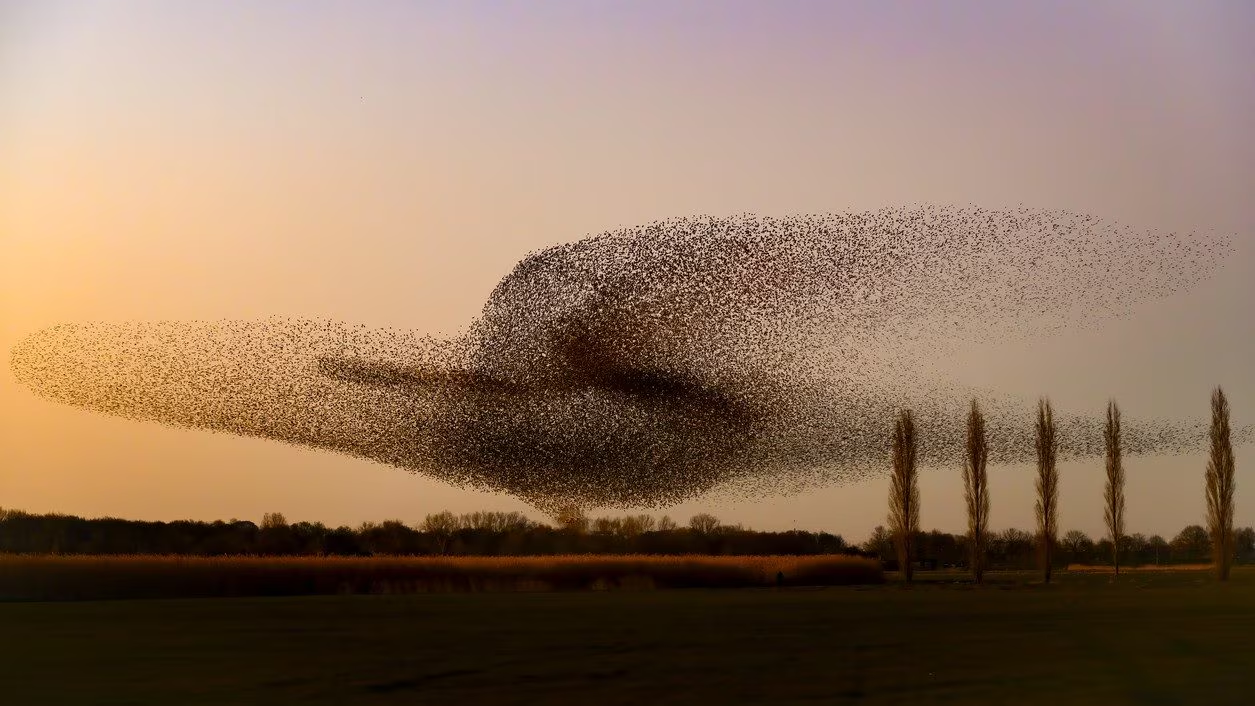
Murmurations, the way in which starlings aggregate into flocks with complex dynamics, serve above all to confuse predators. The movements, similar to those of a fluid, arise from the interaction of the single bird with a few nearby individuals.
It is one of the most fascinating sights of the autumn skies: flocks of starlings which, flying in groups, draw complex shapes in continuous change, a phenomenon called murmurings. A group dynamic that has not yet been fully understood on a scientific level but which, based on a few factors at an individual level, allows starlings to disorient predators and defend the group.
The main reasons to fly in a group
The common starling (Sturnus vulgaris) is not the only one belonging to the Sturnidae family, but it is the most common in Italian skies and the easiest to observe. It is a small, distinctive bird dark plumage with white feather tips, and green and purple metallic reflections. It is a gregarious animal that lives in groups of hundreds of individuals, looking for places to feed and nest. In Italy some populations are sedentary, others instead migrate in autumn and winter from the North to the South, while still others arrive from colder parts of Europe. It is very easy to observe them at sunset, when at the end of a day spent getting food they move en masse towards resting places, noisily competing for the most protected shelters in trees and ravines.
Group flying is essentially one defensive strategy: the natural predators of starlings, such as the peregrine falcon, fly towards the flock trying to capture one, but are disoriented by the continuous and unpredictable changes of the direction, which make it difficult to concentrate on a single specimen. This collective behavior increases the chances of survival of the single individual compared to an attempt to escape in isolation. If you see a flock thickening and thinning suddenly in a sort of wave, it is possible that it is reacting to the incursion of a predator.
However, there are some contradictory points that make the murmurations still poorly understood. Even if it is true that unity is strength, coming together in groups like this numerous and conspicuous It signals its presence to predators, making the group more susceptible to attacks. Furthermore, group flights can hover in the same area for several minutes and change shape even in the absence of disturbing elements, one energetic effort no small feat that it is done even when the animals could be resting.
One hypothesis on the behavior of starlings proposed that these long performances served to attract as many flocks as possible into the same group, so as to accumulate more in their resting places and increase the temperature, warming each other. But a 2017 study by the University of Gloucestershire and the Royal Society of Biology revealed no correlation between temperature and flock size.
How do they manage to move without colliding?
At first glance, a murmuration recalls the dynamics of fluids: the mass of the flock compresses, stretches and bends on itself like a liquid agitated by waves. But in reality the individual elements of the flock do not behave like particles but have their own decision-making autonomyinfluenced by the behavior of others. Even if, taken in their entirety, the murmurs of starlings represent a complex system, each starling in fact adheres to few behavioral “rules”: maintain a preferred speed of about 43 km/h, keep an eye on the distance with other birds close to them, and adapt to their changes in speed.
Just as a car braking on the highway causes the cars behind it to slow down, the movements of a single individual are transmitted to those nearby spontaneously. A study by Princeton University and the “La Sapienza” University of Rome suggests that every single starling monitors and reacts to the behavior of six or seven nearby birds to him, a mathematically efficient number to obtain sufficient information: checking fewer birds increases the degree of uncertainty about what to do, while keeping an eye on the entire flock would be impossible for a single bird.
Starlings are a so-called example in nature consensus model: a group converges on a collective decision to avoid fragmentation and dispersion. There is no leader who decides for others, but decisions are not made randomly either: they are based on those of surrounding individuals.
Sometimes, the movement of a single specimen leads the entire group to follow him in one chain reaction, in a very short time, and it is precisely these sudden changes that give the flock its fascinating and complicated shapes. Shapes that are also difficult to predict and describe on a mathematical level. A study by the Universities of Groningen and Tuscia published in 2026 on Communications Biologyanalyzed the morphology of flocks in the wild, observing how they reacted to a remotely piloted robotic falcon.
He then played it all in one computerized modelto carry out various simulations. In this model, each virtual bird decides whether to implement an escape maneuver with a probability that depends on the distance from the predator, but can also limit itself to copying the maneuver of its closest companions.
All it takes is for a few individuals in the front line to start turning or diving for the maneuver to spread from neighbor to neighbor, until it evolves into a turn for the entire flock. If information travels too slowly within the group, or if two birds in the front choose opposite directions, the flock fragments.
The complexity of the murmurations, which we also find in animals that organize themselves in groups (such as schools of fish or herds of cattle) is a so-called emergent propertywhich is based on very simple starting rules.
