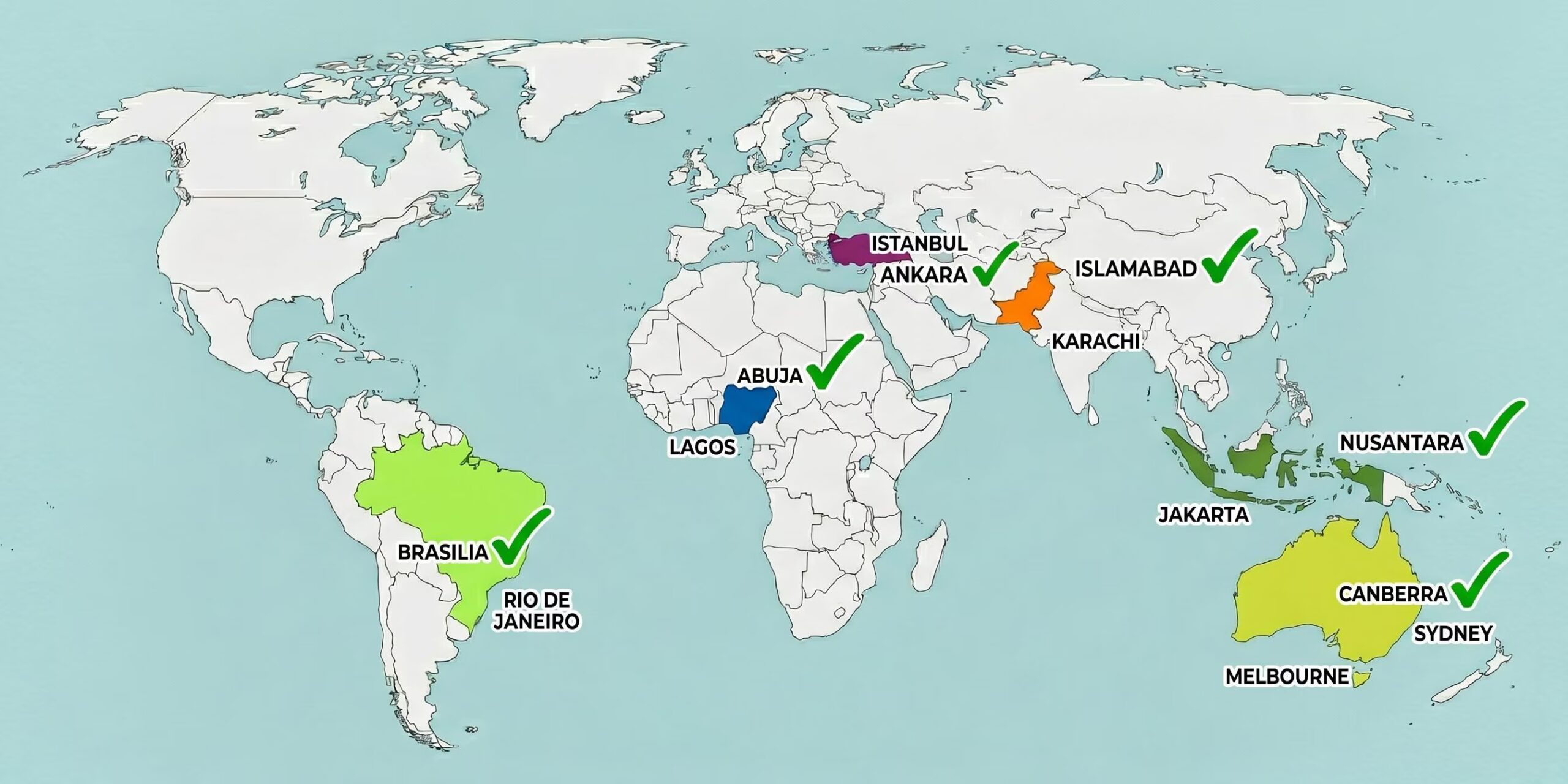
To the question “What is the capital of Brazil?” we often hear “Rio de Janeiro”, and although the answer is certainly wrong, it is not such an absurd mistake: it was in fact the capital until 21 April 1960, the date on which it was replaced by Brasilia, it was founded to decentralize political power from the coast and encourage the development of the country’s hinterland, at the behest of president Juscelino Kubitschek.
Of course, Rio is home to some of the most famous tourist attractions on the planet, such as the famous beaches of Ipanema and Copacabana, the statue of Christ the Redeemer and the carnival, but the city was, effectively, the capital of Brazil until the 1960s. It is not the only case, however, in which a State has decided to move your capital from one city to another for the most disparate reasons. Let’s discover the most famous cases in this article!
What’s behind the decision: the causes
Before proceeding with some famous examples it is good to pause for a moment on the causes and consequences of the change of location of a capital. As we were saying, in fact, countries all over the world change, have changed, and will certainly change again in the future, the location of their capital. We are therefore not talking about such a rare event and, almost always, the choice arises from natural needs strategic, management or politics.
One of the most frequent needs is that of territorial rebalancing: Many states relocate their capital to reduce the concentration of power in very specific areas and redirect investments And resources towards less developed and generally more isolated territories.
A similar case is that which derives from policies of urban decongestionaimed at reducing demographic pressure in cities of ancient foundation that have experienced strong boom cheap in recent times. In still other cases, the move could respond to needs safety and of political control of the territory or hire one valence symbolic following specific historical and geopolitical events, such as unifications, proclamations of independence, regime changes…
Finally, especially in more recent years, many countries decide to move their capital in view of a heavy one reorganization internalaimed at changing the face of the State with metropolises designed from scratch to become ultra-modern and efficient administrative centers.
From Rio de Janeiro to Brasilia in 1960
Let’s start from our opening example with the transfer of the capital of Brazil from Rio de Janeiro to Brasiliawhich occurred in 1960. The city of Brasilia was designed and built completely on paper and for this reason it takes the name of city of foundationthat is, a city that was born following a precise administrative decision.
In just 4 years, from 1956 to 1960, the new capital was built from scratch by the will of the government, which intended shift the political and administrative center of gravity towards the interior of the country. This choice was therefore the result of a policy of rebalancing territorialand served to reduce the concentration of resources and investments on the more developed coastal strip, to give greater attention to the inland regions, thus strengthening national unity.
In Australia the capital is Canberra
Another capital that usually never gets it right in quizzes is Canberrathe capital ofAustralia. Canberra is another city of foundation created with the precise aim of finding a compromise, more or less halfway, between the dynamic rival cities of Sydney And Melbourneboth pretenders to the title but both too influential to become the capital without causing significant territorial imbalances and discontent on the part of the local population.
Canberra therefore arose in the early years of the twentieth century: specifically designed to be an efficient, balanced administrative capital and far from the pressures of the powerful coastal cities.
Abuja, capital of Nigeria since 1991
Other city of foundationthe city of Abuja was born in more recent times and was decreed the capital of Nigeria in 1991. In the mid-seventies, the old and chaotic coastal capital Lagos it was the most important economic center of the country, but the overcrowding was starting to put excessive pressure on facilities, infrastructure and services.
For this reason, the government chose to move its administrative center inland with a dual objective: reduce demographic pressure And rebalancing the territorial structure to promote greater stability between the different ethnic groups of the country.
Islamabad in Pakistan is the provisional capital
In the second half of the twentieth century the capital of Pakistan was moved from Karachi to Islamabad. Islamabad, also a city of foundation, was built between 1961 and 1966 near Rawalpindidecreed in turn capital provisionalbetween 1959 and 1968, a short “transition” period.
Huge port on the Tue Arabian, Karachi it is historically the main economic hub of the country, but its coastal nature and distance from the northern regions place it in a position vulnerable to attacks and, at the same time, too far from areas considered strategic from a political and military point of view.
Türkiye, from Istanbul to Ankara in 1923
With the end of theOttoman Empireone of the largest empires in history, and the birth of the Republic of Türkiye which occurred on October 29, 1923, the Turkish capital was moved from the historic and rich Istanbul to Ankara. Here too, strategic reasons had a certain weight in the decision: the coastal reality was considered vulnerable and difficult to defend from possible naval incursions, while Ankara’s position, in the heart of the Anatolian peninsula, was considered safer.
In addition to this, the choice was also motivated by reasons historical And symbolic: Istanbul represented, in fact, the center of the past imperial and monarchical power, while Ankara should have embodied the values of the new and modern nationalist Turkey, born after the war of independence.
Indonesia, from Jakarta to Nusantara
THE’Indonesia decided to move the capital from the city of Jakarta to the one currently under construction Nusantaralocated on the island of Borneo. The Jakarta metropolitan area is today considered the most impressive of the planet’s megacities (with 42 million inhabitants in 2025), intensely overpopulated, trafficked and polluted. In addition to all this, Jakarta is the victim of a phenomenon that is as particular as it is disturbing: the metropolis is in fact sinking slowly in the soil ofJava island on which it is located.
