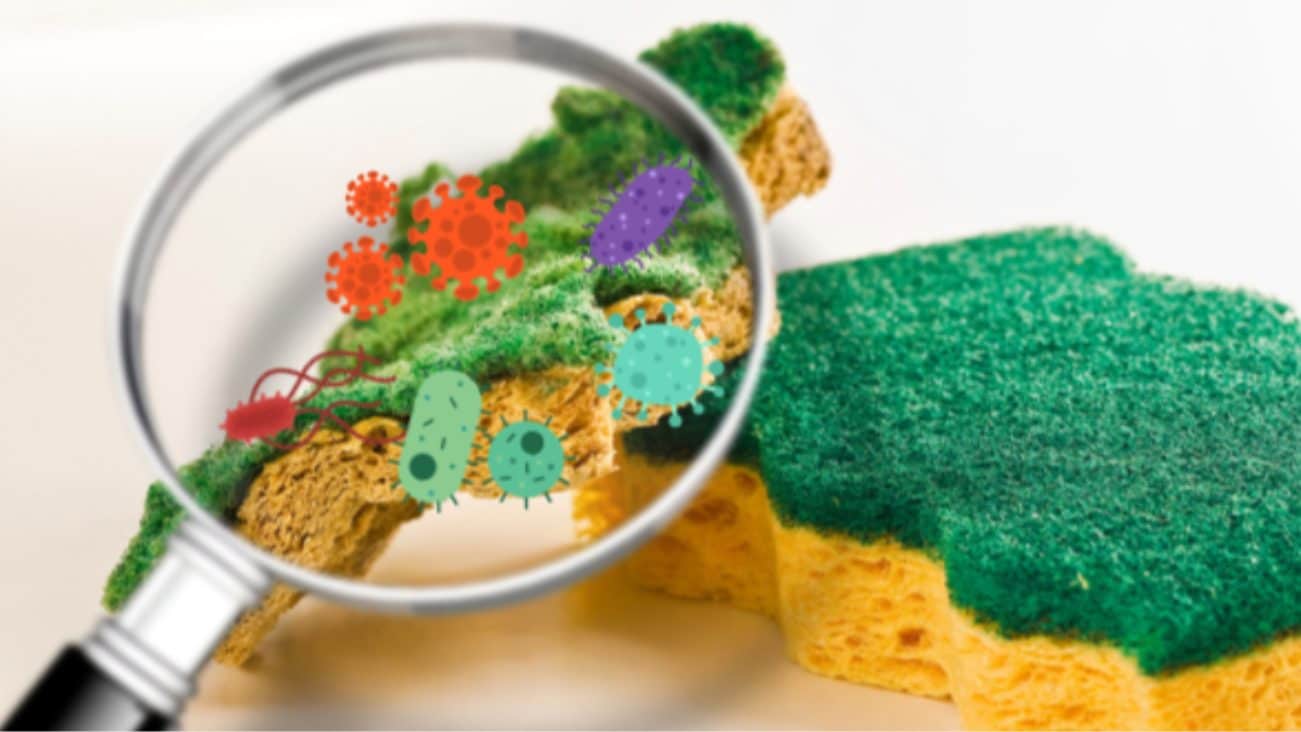
How many times, after lunch, do we wash the dishes by hand and, once finished washing, we leave the still wet sponge on the sink and then use it again a few hours later, even just to rinse a glass that we will use for drinking. Well, science says we should pay a little attention. Well yes, contrary to what we may think (after all, we use them with soap to clean“what will happen?”), kitchen sponges can become a real receptacle for bacteria. This is due to three main factors: they remain moist for a long time (perfect habitat for bacteria), they have a porous structure which protects microorganisms and accumulate food residues which act as nourishment. According to some studies, used household sponges can contain extremely high concentrations of bacteriawith a large variety of different species, even including – in extreme cases – those potentially pathogens, especially family microorganisms Enterobacteriaceae, as Escherichia coli And Salmonella. Germs not only survive, they multiply and can be transferred from sponges to dishes, surfaces and foods. To avoid this, a good squeeze of the sponge or replacing it frequently may be enough.
Humidity: ideal bacterial habitat
The first key factor is thepersistent humidity. Sponges are designed to absorb and hold water, but after use they rarely dry out completelyespecially if we don’t squeeze them enough. From a microbiological point of view, this is crucial: water availability is one of the fundamental requirements for bacterial growth. The inside remains humid even many hours after usecreating a stable environment in which bacteria can survive and replicate at room temperature. In fact, when compared with drier objects, the researchers of the study Bacterial levels and diversity in kitchen sponges and dishwashing brushes used by consumers published on Journal of Applied Microbiology, they had no surprises: the constantly moist sponges host significantly higher microbial colonies compared to surfaces that dry quickly, such as thin cloths or stiff brushes.
Porous structure: a home for microbes
The second element is the internal structure of the sponge. Unlike a smooth surface, the sponge is composed of a 3D network of microscopic channels, given by the pores deliberately present in it. The porous cavities are useful, in fact, for retain water better when washing, but for the same reason they can also do it after washing. The pores themselves can provide gods physical shelters for bacteria, often protecting them by the mechanical action of washing: the germs adhering to the internal cavities manage to remain anchored, forming micro-aggregates that are difficult to remove. This is why even apparently “clean” sponges continue to retain numerous and well-organized bacterial communities.
Organic residues and microbial transmission
The third factor is ours foodwhich ends up nourishing the bacteria as well. Each use of the sponge transfers inside it small quantities of food residues: proteins, fats and carbohydrates, the same food residues that remain on the plates. These substances, not always clearly visible, constitute a excellent nourishment for microorganisms. Some studies, in particular research conducted in some university dormitories, Microbiological quality of kitchen sponges used in university student dormitories and published in BMC Public Health, identified high concentrations of bacteria associated with the degradation of household sponges organic matter (like the food itself), in particular Enterobacteriaceae. The many feared bacteria are part of this family Escherichia coli And Salmonella spp., responsible for gastrointestinal infections and even serious food poisoning.
Repeated use of the same sponge on different surfaces (sink, dishes, oven, etc.) facilitates transmission of microorganismsmaking the sponge a “hub” of contamination, by collecting bacteria from one surface and moving them to the next one that we will clean: the bacteria travel and spread.
How to reduce the risk of contamination: does the microwave trick work?
In reality, to overcome the problem of bacterial contamination due to used household sponges, simple daily precautions may be enough. Among the most common actions, you can Wring out the sponge well after each use – so as to limit the presence of humidity – or simply replace it frequently with a new one. The more “worried” could also resort to in-house treatments dishwasherfor a super-effective wash, or even in the microwave (temperature kills bacteria), but maybe they are methods more “extreme” which we do not feel comfortable indicating as essential. You simply need to be more careful at home: none of these methods guarantee overall sterility, but they reduce quantity and diversity of sponge microorganisms with which contact should be avoided.
