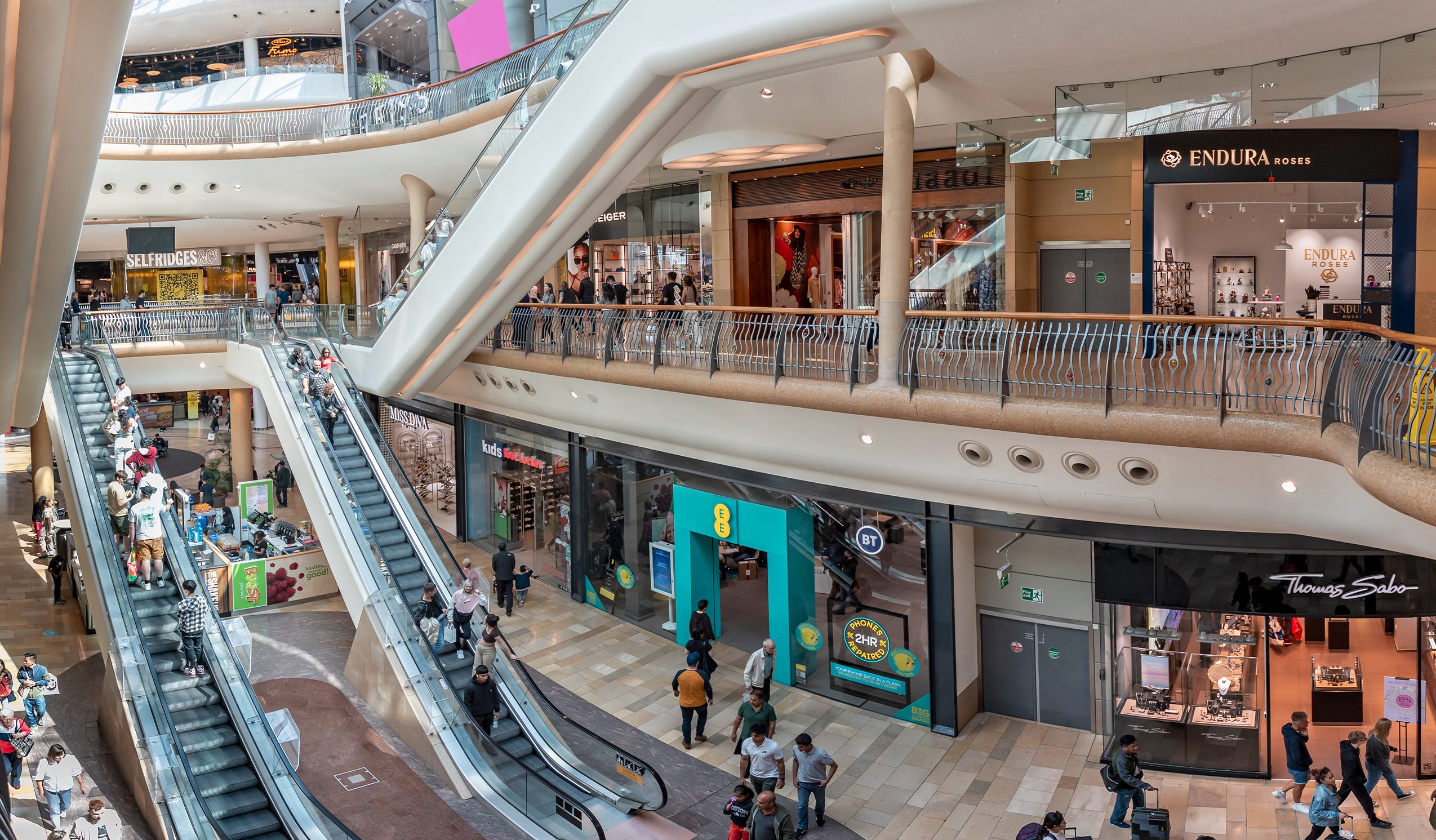
Bright galleries, wide corridors, shiny floors, the same chain stores and fast food outlets… from Italy to China, passing through the United States and the United Arab Emirates, shopping centers surprisingly share the same look and feel. It is no coincidence: these similarities are the result of the logic – now standardized – that over the last seventy years has shaped our way of shopping. Indeed, there are people behind the design of contemporary temples of consumption economic and psychological criteria well defined; building spaces and flagship stores that are almost completely identical to each other cuts costs, guarantees brands immediate recognition and makes the customer feel at ease in a family environment and controlled, a condition that encourages shopping. So, whether we are in Rome, Singapore or New York, the experience remains almost identical.
The Gruen effect that drives purchases: how it works
Modern shopping malls were born in the United States in the 1950s, when society and cities, driven by post-war prosperity and suburban expansion, were becoming increasingly car-centric. The first mall, completely indoors and air-conditioned, was the Southdale Centerdesigned by the Austrian David Viktor Grünbaum, a Jewish architect who emigrated to America under the name of Victor Gruen. Inspired by the Viennese boulevards and inaugurated in 1956 in Edina, Minnesota, it was conceived as a sort of covered square for the new American suburbs: a pedestrian place, protected from the harsh climate of the Midwest, in which to shop, but above all to spend free time and socialise. This was originally the vision of Gruen, who ended up distancing himself from the drift of his own project when he realized that the model he had imagined as a space for the community had been transformed into a mere commercial device. Ironically, the feeling of disorientation and suspension that we often experience when entering a large shopping center (we lose the perception of time, we forget the purpose for which we entered and we end up staying longer than expected, sometimes purchasing more than necessary) is precisely called “Gruen effect”.

Within twenty years, the typology, easily replicable and well-established, spread widely throughout the United States, to the point of becoming a standard exported throughout the world. In the 70s it also arrived in Europe, without undergoing substantial transformations. The concept therefore remained the same: large buildings equipped with large car parks on the outskirts of cities (so as to avoid, especially in the Old Continent, any interference with the historic centres), and divided into galleries along which there are shops, rest areas and large atriums from which the vertical connections branch off and distribute the flows on the different levels.
In Italythe first shopping center opened in 1971 in Bologna, followed in 1974 by Shopping Center B in Cinisello Balsamo (MI). Since then the number has exploded: in our country there are now over 1,000 shopping centers distributed from the north to the islands.
Because shopping centers are all similar
Upon reflection, the reason for the success – and consequent standardization – of shopping centers is quite clear: the public can purchase goods of all types in the same place, reducing travel times and costs, also thanks to the large car parks that are almost always free; traders can count on a constant flow of potential customers, while investors can count on one proven formula and universally effective. If shopping centers are so similar, it is therefore because their structure is designed to be profitable and easily replicable.
As for the measures, these are both spatial and linked to the commercial strategy; what stands out, for example, is the distribution of functions and shops according to precise hierarchies, designed to guarantee a homogeneous flow of visitors, and the definition of routes, sometimes labyrinthine, which push people to walk as much as possible in front of displays and displays, making it less immediate to identify the exits. Elements such as i also contribute to a similar effect transparent handrailswhich offer a continuous view along the galleries and shop windows. The big brands, from fashion to catering, then adopt standardized layouts, technical solutions and furnishings, identical everywhere for brand identity reasons: characteristics that make the points of sale almost indistinguishable from each other and significantly speed up their creation.

The reassuring power of familiarity
Another fundamental dimension is that of familiarity: the natural predisposition to move with greater confidence in environments that we now recognize or appear predictable to us, immediately putting us at ease. The artificial lightsalways lit or modulated as the natural one decreases, almost canceling the perception of the passage of time, combined with acontrolled atmosphere in which the music and the absence of windows on the street shield any noise or stimulus coming from the outside, contribute to creating a sort of bubble of comfort: a “non-place” in which local specificity is neutralized in favor of a universal experience, made psychologically satisfying by the act of shopping itself. The result of years of market analysis, observation of behavior and sales metrics, shopping centers are structures designed from scratch to guide flows and encourage impulse buyingrelieving people from the need to decipher cultural codes, even in different contexts. A mirror of contemporaneity, the mall shows how globalization has produced architecture without identity, which no longer belongs to a specific place but to a planetary network based on consumption.
