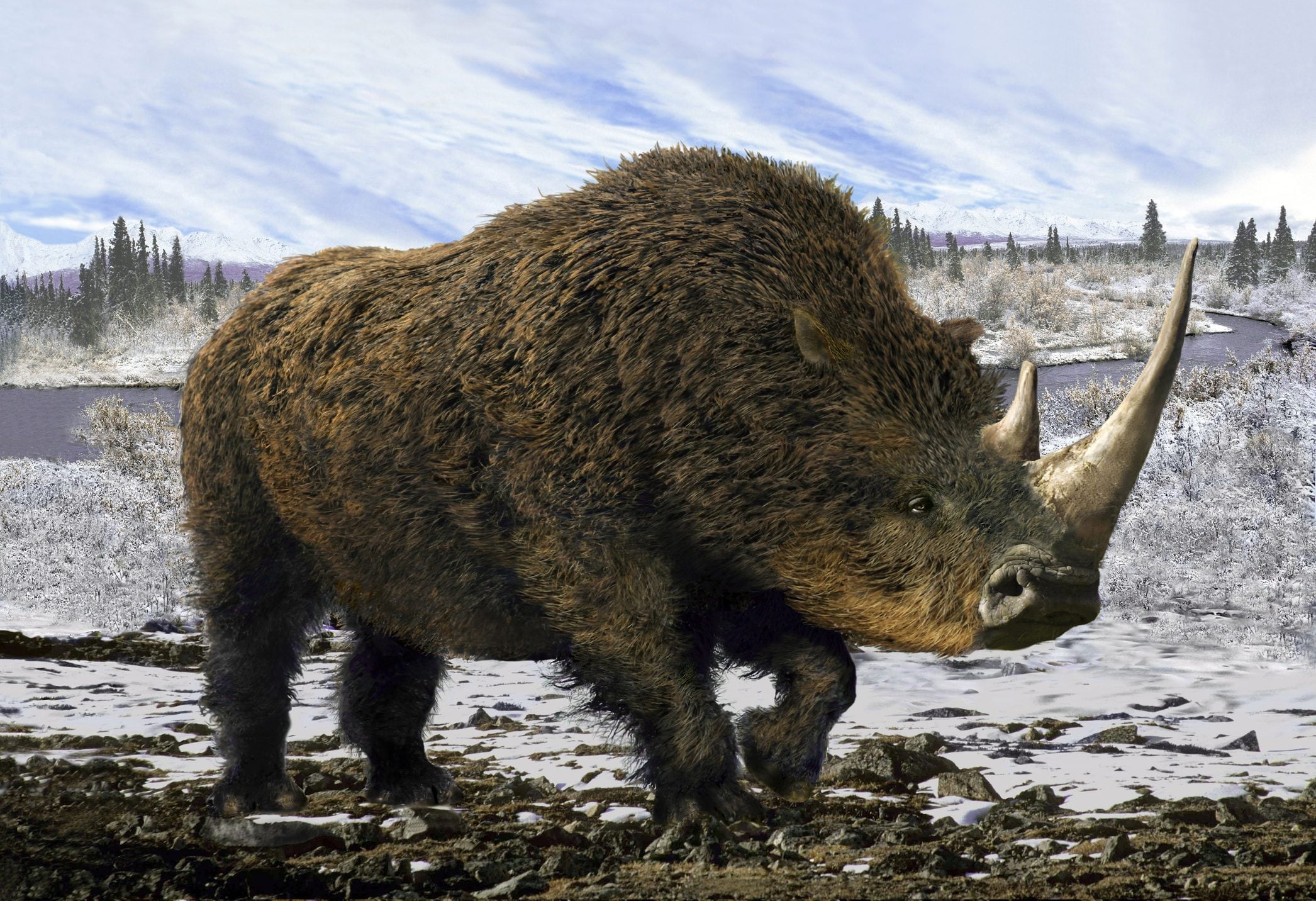
A recent study published in Genome Biology and Evolution by Guðjónsdóttir and colleagues describes the recovery and analysis of the DNA of a woolly rhinoceros from a fragment of tissue found in a completely unexpected context: the stomach of a frozen wolf cub in the ground for more 14,000 years and discovered in 2011 in northeastern Siberia. From that small fragment, preserved almost intact by the cold, the researchers managed to extract and reconstruct DNA of a woolly rhinoceros that lived about 14,400 years ago. It is the first time that an animal’s genome has been reconstructed from tissues preserved in another animal.
This operation then allowed us to reconstruct a high coverage genomeone of the closest in time to the last moments in which the species was still present, offering new clues to the final stages of the species’ extinction. Compared with two other older woolly rhino genomes, which lived approximately 18,000 and 48,000 years ago, this DNA shows no signs of increased inbreeding (crossing between closely related individuals), loss of genetic diversity or accumulation of harmful mutations, as you would expect for an endangered species. This result suggests, however, a population that was still stable until shortly before its disappearance, compatible with a rapid extinction linked to abrupt climate changes of the end of the last ice age.
An out of the ordinary find
The wolf was found in the region of Tumatin the Northeastern Siberia. He was young, mummified by the cold and with his stomach still sealed. When the stomach contents were examined, a fragment of tissue unusually well preserved. It did not belong to the wolf, nor to any prey. DNA analyzes confirmed that it was a woolly rhinoceros (Coelodonta antiquitatis). Thanks to radiocarbon datinga method that allows you to estimate the age of organic remains by measuring how much radioactive carbon remained in the material after the death of the organism. It was possible to place that tissue around the 14,400 years agoprecisely in the same centuries in which the species disappears from fossil evidence (bones and mummified remains). In fact, one of the last woolly rhinos of which we have direct evidence.
Because DNA is more important than bones
In fact, a bone tells how an animal was made, while DNA tells how the whole species was doing. When a population begins to slowly collapse, the genome “records” it. Genetic diversity is reduced, individuals become more and more similar to each other, mating between relatives increases and unfavorable mutations accumulate. This process has a specific name and is called genomic erosion. For the woolly rhinoceros, until now, the most delicate piece was missing: the DNA of individuals who lived at the end, when extinction was imminent. The champion of Tumat fills that void.
Since ancient DNA is fragile, broken, full of “chemical scars” left by time, researchers have worked on many small fragments of the tissueextracting DNA multiple times and combining the results. The genome obtained is defined high coverage: This means that each stroke has been read many times, reducing the risk of errors. It is a fundamental condition to really understand whether a population was in difficulty or not.
No trace of genetic decline was found
The recovered genome was then compared with that of two other older woolly rhinos and with the Sumatran rhino, its closest living relative. And this is where the surprise comes.
The woolly rhinoceros from 14,400 years ago shows no obvious signs of genetic deterioration. The diversity of its DNA is similar to that of individuals who lived tens of thousands of years earlier. The regions of the genome that indicate mating between relatives are no longer numerous. Even the so-called genetic loadi.e. the set of potentially harmful mutations, is not increased. Basically this animal he did not belong to a genetically impoverished population or “consanguineous”.
The extinction of the species was very rapid
Using models that allow us to reconstruct the trend of populations over time, the researchers estimated the effective size of the population. It’s not the actual number of individuals, but how many actually contribute to genetic variety. Here too the message is clear: in northern Siberia, woolly rhinos seem to have maintained a relatively stable population until shortly before the end. So there wasn’t a slow shutdown, but something more abrupt. If the genome, in fact, does not show deep scars, the most solid hypothesis is that the extinction occurred too quickly to leave any signsperhaps within a few generations.
The authors link this event to the warming period known as Bølling–Allerødwhen the climate suddenly changed. For a species adapted to freezing steppes and cold environments, such rapid transformations can be devastatingeven without a genetic crisis behind us. In certain cases, a species can disappear before its DNA even has time to “record” it.
