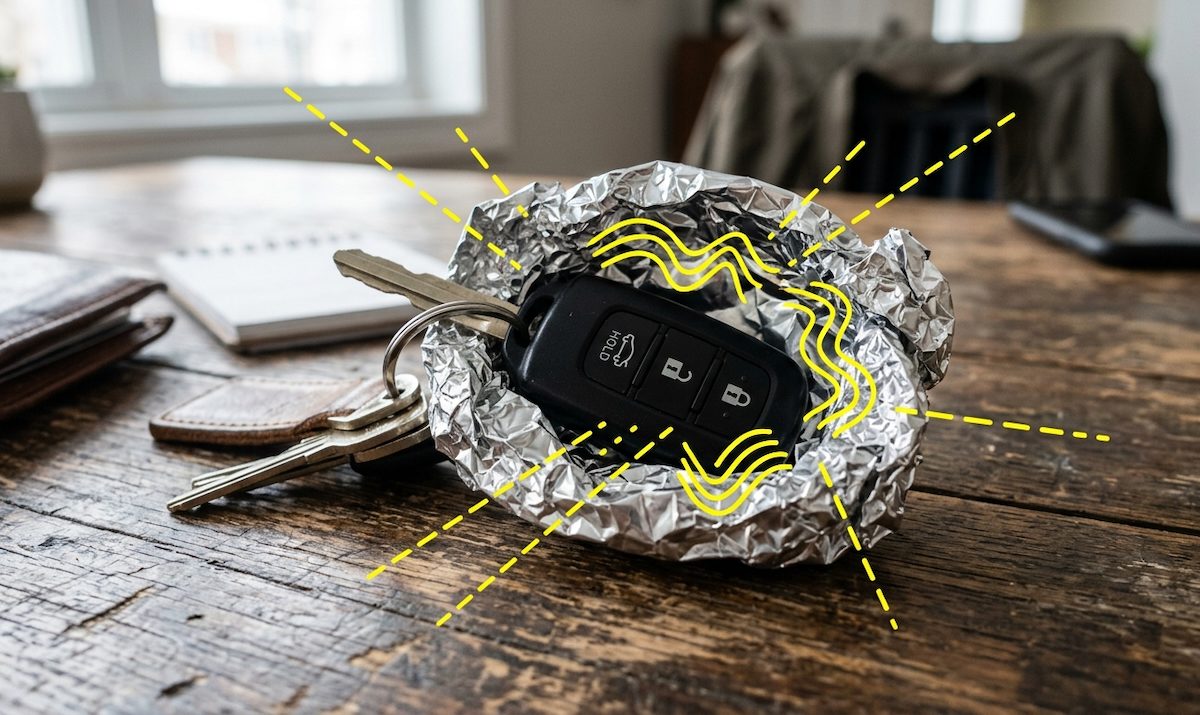
Can wrapping your car keys in tinfoil really stop thieves from stealing your vehicle? Yes, but only in part: this “home trick” can work because aluminum is able to shield radio signals. It is worth specifying, however, that this is not a definitive and totally reliable solution. The physical principle underlying this expedient is however correct: modern remote controls communicate with the car via electromagnetic waves and, if these are blocked, the vehicle theoretically no longer “sees” the key. In practice, however, many variables come into play: the type of keyless system adopted, the signal strength, the quality of the insulation and even the way in which the key is wrapped in foil.
While tin foil can be a simple and immediate countermeasure, it is not a substitute for specially designed solutions or the good safety practices we would all do well to adopt. To understand why, we need to look at how our car remote controls work, what vulnerabilities they present, and how criminals try to exploit them.
How your car remote works and why tinfoil should shield it
We press a button and the car opens, or we simply approach and the doors unlock automatically: this convenience is made possible by a small chip integrated into the remote control. This chip generates a code that is transmitted via radio to the vehicle. The car, in turn, uses an internal system that recognizes that code: if it coincides with the expected one, authorizes the opening or starting of the vehicle.
In newer systems, called keyless or “passive keyless entry”the remote control does not need to be activated manually: it is listening and can respond automatically when it detects the car signal. This means that the car can automatically detect the presence of the key within a certain radiusoften less than a meter. And it is precisely here that the greatest critical issues emerge.
Thieves can in fact try signal decoding. We can better understand these vulnerabilities by looking at some academic research. Some studies conducted byUniversity of Birmingham and fromRadboud University have shown that remote opening systems are not always as safe as one might think. In particular, researchers have demonstrated that, by intercepting a limited number of communications between the key and the vehicle, it is possible to reconstruct the code necessary to open the car. This process is based on cryptanalysis techniques, i.e. mathematical methods used to identify weak points in encryption systems. Once enough data is obtained, a computer can trace the digital key relatively quickly, thus bypassing the security system.
Much more widespread is the so-called “relay attack”. In this case, thieves use devices capable of picking up the key signal even from tens of meters away and retransmitting it to the car. The vehicle is thus deceived: it believes that the key is nearby and unlocks. This type of attack exploits the fact that the signal RFID (Radio Frequency Identification) is constantly active.
And this is exactly where tinfoil comes into play. THE’aluminumbeing a good conductor, can block or attenuate electromagnetic waves creating a sort of rudimentary “Faraday cage”a structure that prevents radio signals from entering or leaving. If we completely wrap the remote in multiple layers of foil, we can dramatically reduce the chance of the signal being intercepted or amplified.
Empirical tests conducted by Snopes – a popular website specializing in refuting urban legends, hoaxes and fake news – show that this solution can work, but not always in the same way. In some cases, the signal is completely blocked even at close range; in others, the flow rate is reduced but does not disappear completely. The differences depend on numerous technical factors: remote control design, frequency used, signal strength and insulation quality. Even small details, such as creases or openings in the foil, can compromise the effectiveness of the system in question.
Alternatives to tinfoil to prevent car thefts
Wrapping your car keys in tin foil, therefore, is certainly not a reliable anti-theft system. Let’s consider, for example, a purely practical aspect. Constantly removing and replacing the key is inconvenient and not very sustainable in daily use. And then they exist more reliable alternatives designed specifically for this purposesuch as shielded cases or “Faraday bags” (similar to those used by politicians and soldiers to shield their smartphones), which integrate metallic materials capable of blocking radio signals more consistently.
In the absence of these ad hoc devices, you can resort to do-it-yourself solutions that are more reliable than tinfoil, such as place the keys in the refrigerator or in the microwave (without turning it on, of course). The metal of these appliances, in most cases, allows the keys to be shielded, preventing their signal from being picked up by someone with bad intentions.
