
We are used to seeing them everywhere, lit between the fingers of millions of people or crushed on the sidewalks of our cities. That the cigarettes are very bad for your health is a fact known to all: you certainly don’t need Geopop to remind you of it. Yet, behind this object lies a level of chemical complexity that few people really know about. From the role of sugars added to tobaccopassing through the true origin of tar and the toxic reactions that are triggered almost 900°Cto the point of revealing the behind the scenes of the map and the great historical illusion of filter. In this article we will take a real journey inside the cigarette, dismantling it piece by piece to dispel the most widespread false beliefs and understand the factory of harmful compounds that is set in motion when it is lit.
Sugar is added to tobacco
It’s not just tobacco. If you look at the ingredients declared by the producers (Philip Morris reports it on his website) you will find sucrose or others sugars added, in the order of 3% by weight. The reason stated by the manufacturer? “Reduce irritation and make the taste more delicate.”
The problem is what happens to the sugar when it reaches the very high temperatures of the cigarette. According to what was reported by Scientific Committee on emerging and newly identified health risks (SCENIHR), the sugars subjected to pyrolysis generate aldehydes, and in particular acetaldehyde. The combination of acetaldehyde and nicotine appears to be more addictive than nicotine alone. Simply put: sugar added to tobacco could enhance addiction.
The filter is practically useless
It is true that the filter, made of intertwined cellulose acetate fibers, retains the particles larger ones present in smoke. But the particles more smallthe so-called ultrafinewhich are also the most harmful, are so small that they are not trapped by the fiber network. Not to mention all the gas toxic And carcinogenicwhich pass undisturbed.
Yet, the filter has existed for decades and practically covers 100% of the market. How come? It’s a question of marketing. Before the 1950s, all cigarettes were unfiltered. Then, around 1950, the first studies came out that established a strong link between smoking and lung cancer. The tobacco companies needed an answer. And the answer was the filter: not because anyone had proven it worked, but because it gave the impression of protecting. In a decade, the market share of filtered cigarettes in the United States went from less than 1% to more than 50%.
The lines on the map are not tar
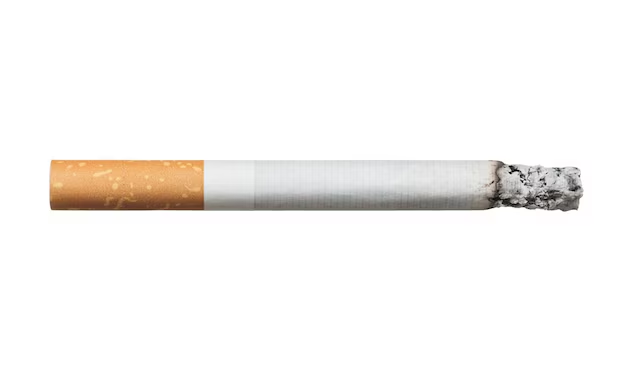
It is one of the most widespread beliefs. In reality those lines are simply areas where there is more paper subtle. If you look at the map against the light you can see clearly. Their function is to do burn the cigarette evenlypreventing it from going out on one side, the phenomenon that smokers call “nail”.
The problem is not combustion
Technically, complete combustion only produces anhydride carbonic And waterfalltwo harmless gases. If only combustion occurred in cigarettes, water vapor and CO would be sucked in2and no toxic smoke would be formed.
The problem is that at temperatures between 600 hey 900°Cwhich are reached during the shot, a whole other series of chemical transformations take place: incomplete combustion, pyrolysis, pyrosynthesis, thermal decomposition and many other reactions. And it is from these transformations that the others are formed 5,000 chemicals present in smokeof which over 70 are classified as carcinogenic. And this also applies to pure tobacco, without additives: at those temperatures, any plant material undergoes the same reactions.
Tar is not added: it is formed
When we talk about tar in cigarettes we often think of something addedor even to bitumen of the asphalt. It is neither one nor the other. Cigarette tar is the sticky residue formed by all the parts together solid And semi-solid of smoking, once the water and nicotine have been removed. It is not in the tobacco before you light it: it is formed during combustion and other chemical transformations, and then it is deposited in the lungs.
These are five of the many details that emerge when analyzing a cigarette from a chemical point of view. All the in-depth information, with practical experiments and detailed explanations, are in the complete overlay video.
