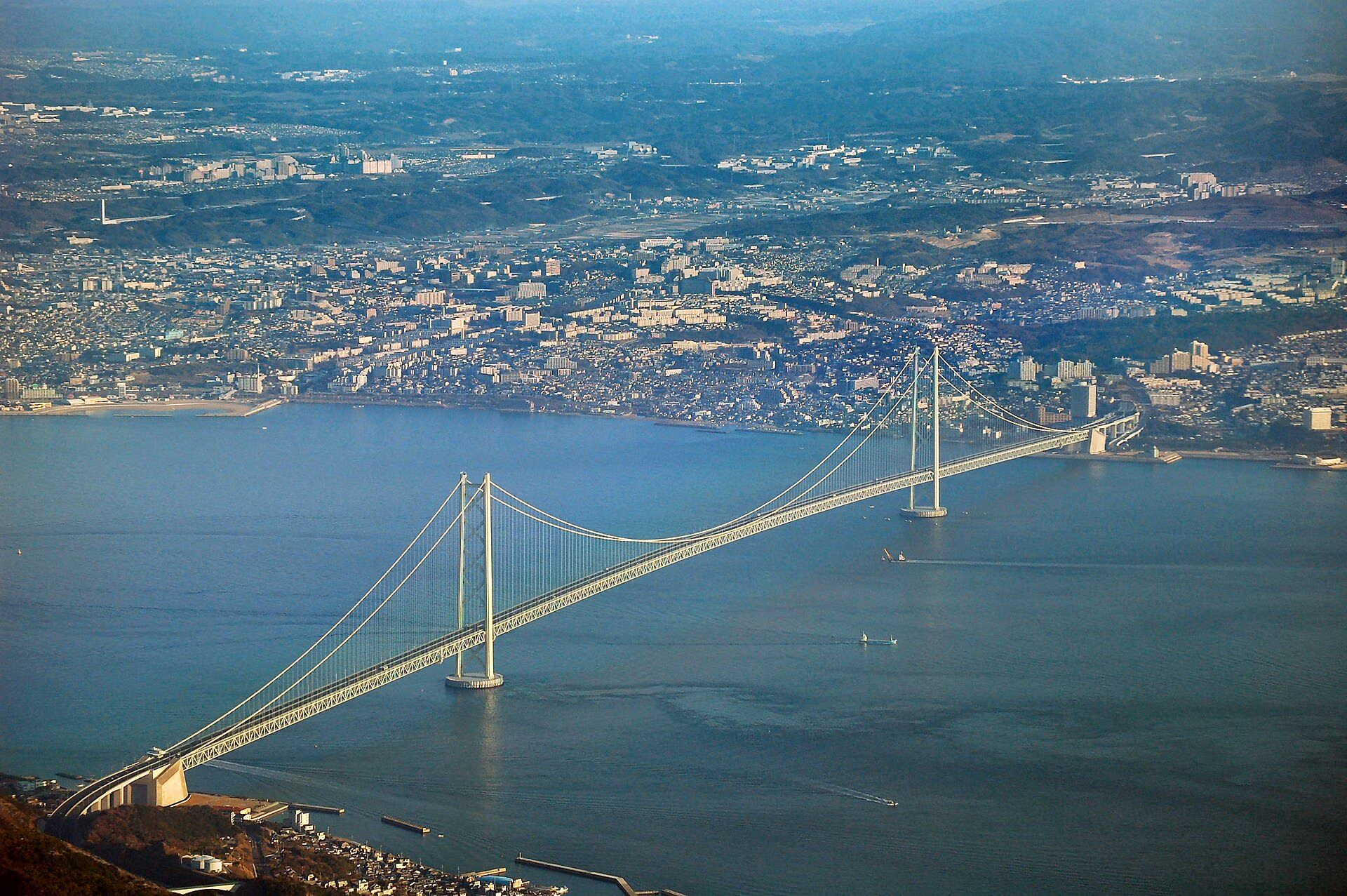
The Akashi Kaikyō Bridge (明石海峡大橋), also known as the Pearl Bridge, is a masterpiece of modern, seismic and structural engineering located in the Akashi Strait, Japan, and connects the city of Kobe on the island of Honshū to Awaji Island. Inaugurated on April 5, 1998, it is a high bridge 282.8 m, with one total length of 3,911 metersone central span of 1,991 metres and two tall main towers 297 meterswhich has held the world record for the world’s longest suspended span since its inauguration in 1998 until 2022 – now it is the second, after the Dardanelles bridge in Türkiye. The work, still the longest bridge in Japan today, was designed to withstand earthquakes of magnitude 8.5 on the Richter scale, to marine currents up to 4.5 m/s (approx. 14 km/h) and to typhoon winds up to 286 km/h.
The project of the second longest suspension bridge in the world
Construction work began in May 1988 and ended with the inauguration on April 5, 1998for a total duration of approximately 10 years. The two main cables have a diameter of 1.12 meters and each is composed of 36,830 steel wires very high resistance (tensile strength equal to 1,800 MPa). The total length of the steel wire used is approx 300,000 kmenough to circle the Earth more than 7 times.
The foundations of the main towers were designed and built by placing giant cylindrical steel caissons in the sea 80 meters in diameter And 70 meters highsunk beyond 60 meters deep and filled with a special, highly fluid concrete resistant to marine run-off. The January 17, 1995during the cable assembly phase, the area was hit by the devastating Kobe earthquake (magnitude 6.9), whose epicenter was then identified just 4 km from the construction site. The structure suffered zero structural damage, but the axis of the strait widened, and the distance between the towers increased by 1.1 metresbringing the planned central span from 1,990 m to the final height of 1,991 meters.
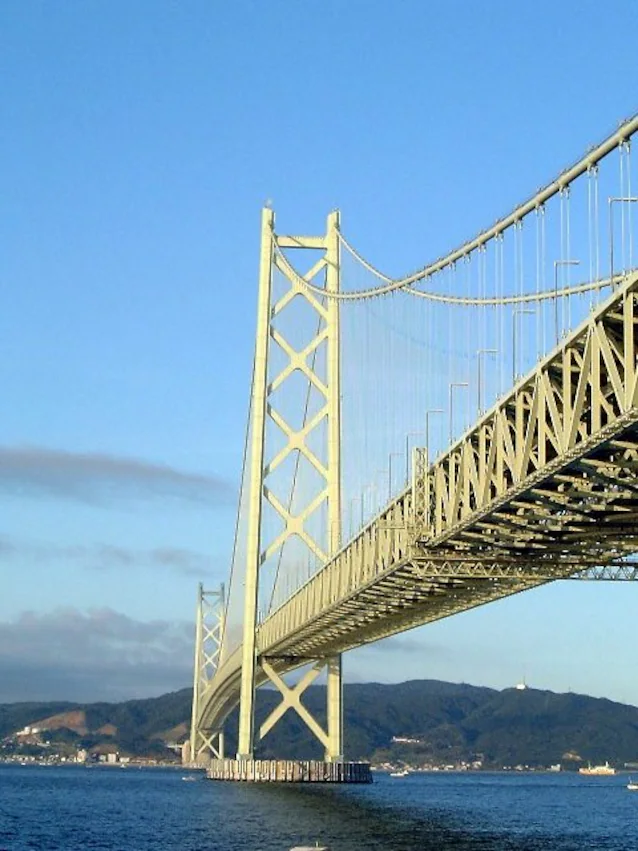
The deck beam adopts a rigid open steel truss section of 14 meters high to minimize wind lift. Inside the towers were installed 20 impact mass dampers in order to dampen and dissipate the energy of aerodynamic and seismic oscillations.
The economic impact of the Akashi Kaikyō Bridge
From the point of view of the economic impact, we can say that the construction of the work required an investment of approximately 500 billion yen (equal to approximately 3.6 – 4 billion dollars of the time). The infrastructure is part of the Honshu-Shikoku Bridge Project highway system and accommodates an average traffic of over 23,000 vehicles per day. The economic impact on the Kansai region and on the island of Awaji was profound: the construction of the bridge replaced the ferry service which previously took approximately 45 minutes for the crossing (often blocked by the strait’s frequent storms), reducing the road travel time to just 4-5 minutes.
Another great advantage in economic terms was that relating to transport. In fact, the bridge allowed the continuous road transport of agricultural and industrial goods between the islands of Honshu and Shikoku without weather interruptions, increasing the estimated regional GDP by several billion yen per year. Infrastructure management via toll guarantees coverage of ordinary and extraordinary maintenance costs.
The environmental impact of the great bridge in Japan
The construction of the bridge required an unprecedented environmental impact study to preserve themarine ecosystem of the Akashi Straitcharacterized by rich marine biodiversity. To this end, the designers have adopted a whole series of technical measures. First, the use of sunken hollow caissons without massive invasive excavations limited the dispersion of suspended silts and sediments, protecting local fish routesie fishing for mullet and shellfish, which are fundamental for the local economy.
Furthermore, the replacement of the fossil fuel ferry fleet with fluid vehicular traffic has significantly reduced CO2 and nitrogen oxide emissions related to discontinuous shipping.
