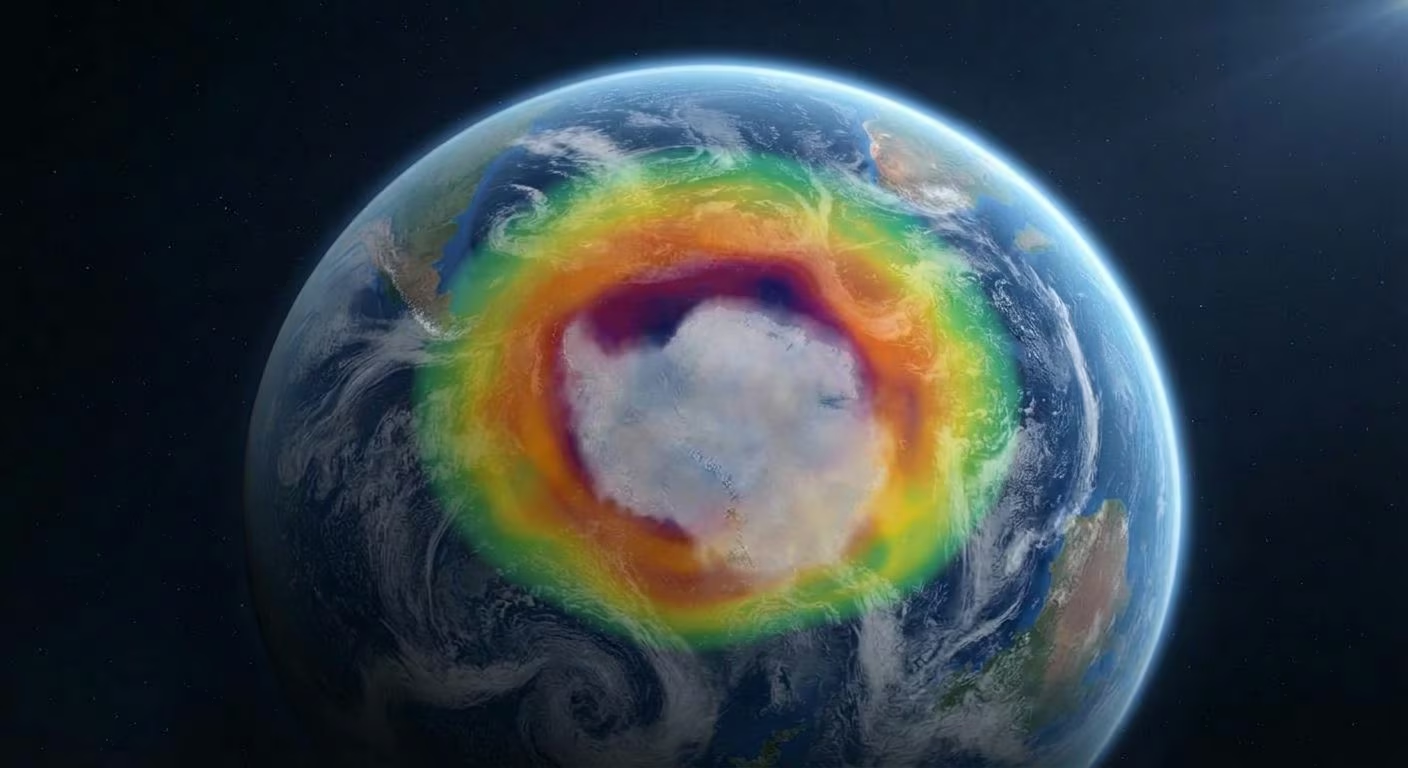
The 2026 ozone hole is the seventh largest since monitoring began 48 years ago: it covered about 9.6 million square miles, according to NASA. This happens due to a record polar vortex. But science confirms: the layer is healing.
In recent years we have almost become accustomed to the idea that the ozone hole it was a problem in the process of being filed. Yet, recent data released by NASA and NOAA remind us that atmospheric dynamics can be unpredictable: the hole in the ozone over Antarctica recorded in 2026 was ranked at seventh place among the largest of the last 48 years of monitoring and, between September 7 and October 13, 2026, the average extent covered approx 25 million square kilometers.
But before shouting the alarm or thinking that the old problems have returned, we must stop and read the numbers with the eyes of science. Why did this hole grow? And above all what does it mean for the Earth?
What is the ozone hole and why in 2026 the extension is among the largest in the last 48 years: NOAA data
Before we understand what happened this year, let’s take a step back. Ozone is a gas present mainly in the stratosphere (between 10 and 50 km above sea level) which carries out a vital task: it absorbs most of the ultraviolet (UV) radiation harmful emissions from the Sun. Without this filter, life on Earth would be exposed to devastating damage to human health and ecosystems.
The “hole” is not a real geometric hole, but a drastic thinning of the ozone concentration that occurs each southern spring over the South Pole.
Between September 7 and October 13, 2026, the average extent of the ozone hole covered approximately 9.6 million square miles (25 million square kilometers)reaching a maximum daily peak of 10.5 million square miles (27.1 million square kilometers) on September 18th.
An immense area, which places 2026 among the years with the largest hole in recent history. How come? The fault lies not in a massive return of old pollutants, but in the extreme meteorology of the stratosphere:
- A giant and “lazy” Polar Vortex: atmospheric circulation has generated an extraordinarily large and stable polar vortex.
- Lack of tropospheric disturbances: in August and September, planetary heat waves that normally rise from the lower atmosphere to “break” and disturb the polar vortex were exceptionally weak.
- The chemical mix: this glacial stability created the perfect and long-lasting environment for the residual chlorine and bromine still present in the stratosphere to destroy ozone molecules for weeks.
Good news: the hole is wide, but not “deep”
Here comes the fundamental interpretation that distinguishes a real crisis from a meteorological fluctuation. Although the surface extension was notable, the hole of 2026 was not deep like those records recorded in the past (such as in the infamous 2006).
Data collected by NOAA weather balloons at the South Pole recorded a minimum concentration value of 105 Dobsonian unitswell above the historic negative record of 92 Dobson units reached twenty years ago.
As NASA scientists explain, if harmful chemicals (the famous CFCs, once used in refrigerators and spray cans) were still present in the volumes of the early 2000s, this year the hole would have been large another 3.5 million square kilometers more.
Does the Montreal Protocol still work?
Absolutely Yes. The international controls born with the Montreal Protocol in 1987 continue to bear fruit in the long term: the levels of chlorine resulting from old pollutants in the stratosphere have decreased by about a third compared to the highs of the 1980s.
CFCs are extremely long-lived compounds: they continue to persist in old appliances, insulation materials and landfills, slowly releasing over decades. However, the path towards definitive recovery remains charted. Experts estimate that the ozone layer will return to normal levels around the 70s of this century.
In short, the big hole of 2026 does not deny the healing of the planet: it simply reminds us that the atmosphere is a complex system, in which the variability of the climate and winds can still play temporary tricks.
