
Two golden eagles che trasportano in volo un giovane stambecco: è la scena immortalata lo scorso 3 novembre dal fotografo naturalista Enzo Massa Micon in Valnontey, nel Parco Nazionale del Gran Paradiso. The rare photograph portrays two specimens of golden eagleone adult and one young, together with their prey, probably an ibex of about 5-6 monthsborn in the spring of this year. According to Park experts, prey of this size could be too heavy to be carried in flight by a single eagle, especially a young one. It is not clear whether the scene represents an opportunity to learn hunting techniques, but it is possible that the younger specimen is still gaining experience in the presence of the adult.
The shot offers an interesting starting point to delve deeper into the physical capabilities of these birds of prey: How much weight can a golden eagle actually carry in flight? And how does she manage to hunt animals that weigh even more than twice her size?
How much does a golden eagle weigh and what are its dimensions
THE’golden eagle (Aquila chrysaetos) è uno dei più grandi rapaci presenti in Italia, dove vive prevalentemente nelle regioni montuose delle Alpi e degli Appennini ed anche in Sicilia e Sardegna. It belongs to the Accipitridae family and is characterized by a predominantly brown plumage, with golden shades on the head and nape, from which its scientific name (“golden eagle”) also derives.
Aquila chrysaetos)”conducted by a team of US zoologists on a sample of individuals of this species, a golden eagle can reach a length of between 76 and 93 cma wingspan between the 190 in males hey 220 cm in females and a weight between 3kg in males and up to 6.6 kg in females. Widespread in Europe, Asia, North Africa and North America, the species includes different subspeciesincluding Aquila chrysaetos chrysaetosalso present in our country, and Aquila chrysaetos canadensiswidespread in North America, including Alaska.
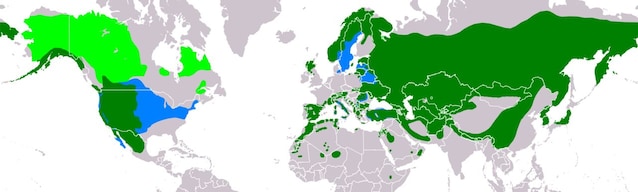
As happens in many species of diurnal birds of prey, the golden eagle has a reverse sexual dimorphismthat is, females are generally larger and heavier than males.
The large wings, the powerful muscles and the robust and curved claws make the golden eagle a particularly effective predator, capable of capturing animals even significantly heavier than itself.
How much weight can a golden eagle carry during flight
Precisely establishing the maximum weight that a golden eagle can lift is not simple, because its load capacity depends both on physical characteristics of the individual specimen and the conditions atmospheric and environmental where the flight takes place.
More generally in birds of prey, a large part of the captured prey must be transported to nest in the period of breeding of pullets (chicks). In this case the choice of prey depends on the relationship between the energy needed to lift and transport and then the distance from the nest.
Birds of prey that feed on prey that are large in relation to their body mass have developed specific strategies to maximize the benefits of selecting these larger prey, especially when they must transport them over longer distances. The vulturesfor example, do not carry the entire carcass of the prey, but swallow only the most nutritious parts of the carcass and carry them in the crop to their young. Golden eagles hunt in open spaces and use gliding flight to carry prey to the nest.
According to theAlaska Department of Fish and GameUS government agency responsible for managing Alaska’s wildlife, Aquila chrysaetos can lift approximately between 1.4 and 1.8 kgmanaging to sustain greater loads if it captures prey when it is already in flight at a certain speed.
A scientific study published in March 2026 onInternational Journal of Osteoarchaeologydedicated to the analysis of the bone remains of prey accumulated in golden eagle nests in southern France, reports instead an in-flight transport capacity up to 5 kg. This value, however, does not derive from experimental measurements carried out within the study itself.
Even higher estimates were reported in 2022 by Chloé Pang, an environmental scientist from the Swiss Ornithological Station in Sempach, on the occasion of a similar episode to that of the Gran Paradiso. Interviewed by Swiss Radio and Television (RSI), the expert indicated the possibility for this bird of prey to transport loads up to 7 kg.
These values do not necessarily represent directly comparable limits: lifting prey from the ground, keeping it in the air for a few seconds or transporting it long distances are very different operations from a physical and energetic point of view.
Even the National Park of Abruzzo, Lazio and Molise, in its sheet dedicated to the species, underlines the importance of the difference in altitude, reporting the possibility of transporting prey of approximately 1.5kg when the capture occurs at a higher altitude than that of the nest.
How do they hunt such heavy prey
According to the Gran Paradiso National Park, the golden eagle can prey on very different animals: from small rodents, marmots, hares and other birds, up to young chamois and ibex weighing around 20 kg (a weight several times higher than its own). If necessary, being an opportunistic predator, it also feeds on carcasses.
To overwhelm such large prey, the eagle combines the speed of his divesthesurprise effect and the fluffs of the claws with the characteristics of the mountain environment: in the case of particularly heavy animals, it can make them fall along rocky walls or let them fall from above. Once the prey has been killed, it consumes it directly on the spot or dismembers it to transport only individual portions to the nest.
The golden eagle’s ability to carry prey in flight depends on several factors, including the wing surface area, flight speed and muscle poweras well as the possibility of exploiting the upward currents and the difference in height of the territory to reduce energy expenditure.
An important parameter is precisely the “wing loading“that is, the ratio between the mass of the bird and the surface of its wings. The higher the wing load, the greater the energy expenditure to maintain the speed and efficiency of flight; this parameter also influences the choice and capture of prey. It should be considered that in eagles, adult females have a significantly higher wing load than both young females and males, therefore, the capture of heavy prey is more tiring for an adult female.
Sources
LIPU (Italian League for Bird Protection) Wing Loading in North American Golden Eagles (Aquila chrysaetos), Journal of Raptor Research Alaska Department of Fish and Game Ripond, J., V. Laroulandie, J.-B. Mallye, R. Nadal, P. Bayle, and C. Itty. 2026. “ Neo-Taphonomic Analysis of Prey Bone Remains Accumulated by Golden Eagle (Aquila chrysaetos): A Case of Nests in Southern France.” International Journal of Osteoarchaeology Swiss Radio and Television (RSI) National Park of Abruzzo, Lazio and Molise Gran Paradiso National Park Douglas Mitchell & Gary Ritchison. (2026) Experimental manipulation of apparent mass has no effect on body mass and wing loading of nestling and near-fledging American Kestrels (Falco sparverius). The Wilson Journal of Ornithology Gran Paradiso National Park Büntgen U, Jenny H, Galván JD, Piermattei A, Krusic PJ, Bollmann K. Stable body size of Alpine ungulates. R Soc Open Sci. 2020 Jul 15