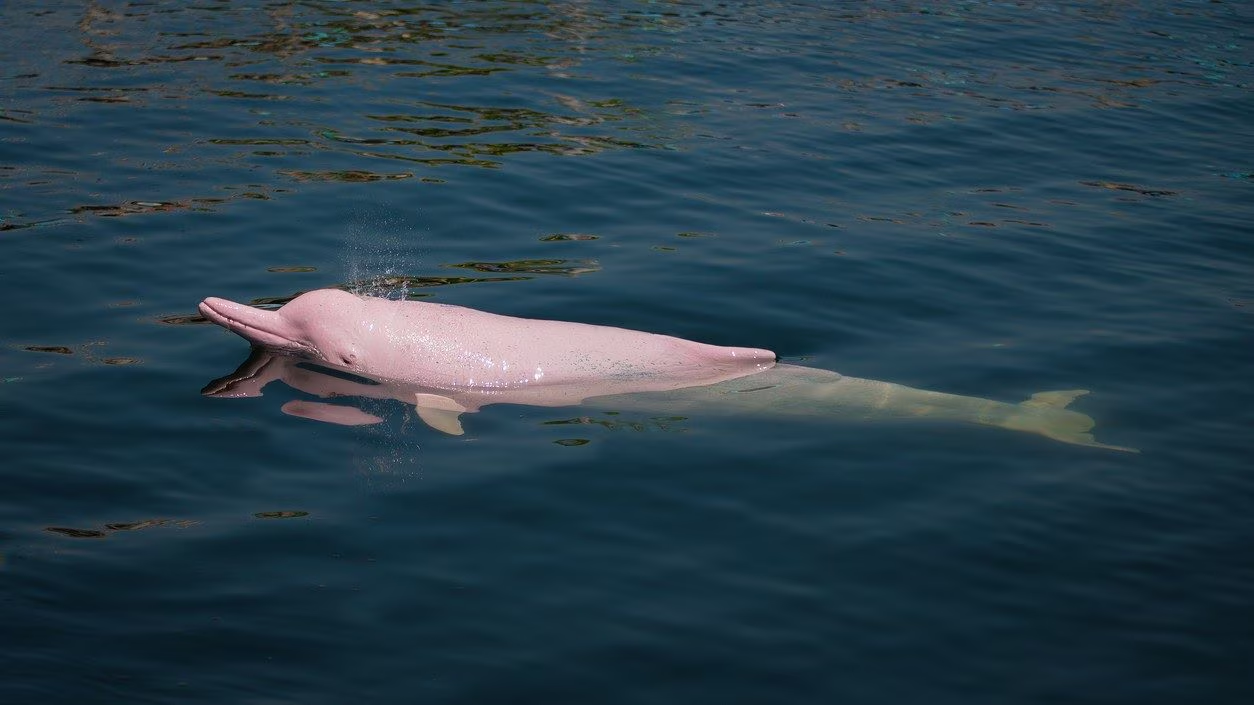
The Amazonian pink dolphin lives in the rivers of South America and also moves through flooded forests. It is born gray and becomes pink as it grows, but the color depends on age, sex and other physical and physiological characteristics.
Each of us is familiar with dolphins: super intelligent cetaceans that usually have more or less similar shapes and colors. Yet, there is a dolphin that is a little different from the others, namely the Amazonian pink dolphin, also known as bang and by the scientific name Inia geoffrensis. Unlike most dolphins, which we associate with gray, this cetacean can have varying coloration from dark gray to pale pinkup to very intense shades.
But it’s not just the color that makes it special: unlike most dolphins, it lives in rivers of South America and has developed characteristics that help it move even among the trees of submerged forests.
And then there’s a question: why is it really pink? The answer is a little more complex than you might think.
Who is the pink dolphin of the Amazon and where does it live?
The Amazonian pink dolphin is a freshwater cetacean which lives in the Amazon and Orinoco basins in South America. Its distribution includes areas of Brazil, Peru, Ecuador, Colombia, Venezuela and Bolivia.
But we shouldn’t just imagine it swimming in the middle of a large river: when the rains come and the water rises, it can also go into narrower channels and flooded forests, where it hunts for fish. In practice, it manages to exploit environments that change a lot over the course of the year. A study conducted in the Mamirauá reserve, in Brazil, has in fact shown that the distribution of dolphins varies based on the water level and the movements of their prey.
His body is also made to move in different environments. It has a long snout, a poorly developed dorsal fin and a very flexible neck, which allows it to turn its head more freely than many other dolphins. A useful feature when it has to make its way through trunks, branches and submerged vegetation. And there is another peculiarity: males and females are not the same. Adult males are generally larger and tend to have a more noticeable pink coloration. As reported by the IUCN Red List, there is no global census on the number of individuals but studies indicate a declining population (classified as “Endangered”).
Because Inea Geoffrensis has exactly this color
The first thing to know is that they are not necessarily born pink. Juveniles are generally gray and the color changes with growth: in adults it can become pink, patchy, or remain partly grey. But what does this difference depend on?
A study published in Marine Mammal Science in 2006, based on the observation of adult specimens in the Amazon region of Mamirauá, found that males were pinker than females and they also had a greater number of scars. According to the researchers, one possible explanation is linked to competition between males: during fights and aggressive interactions, in fact, they can get bites and wounds that leave marks on the skin. These scars may help make the pink coloration more noticeable.
The scars, however, don’t seem to tell the whole story. THE temporary changes in the intensity of pinkin fact, they can also be associated with the animal’s activity and the dilation of the superficial blood vessels. This means that color does not only depend on skin pigmentation: at least in part, it can also change in relation to physiological processes. This is different from the production of a pink pigment, but could contribute to the observed color variations.
In short, the pink dolphin is not pink for a single reason nor does it always have the same color: the shade varies with age and between individuals, and can also be influenced by scars and physiological changes. It is precisely this combination of characteristics that makes it one of the most recognizable freshwater cetaceans on the planet.
