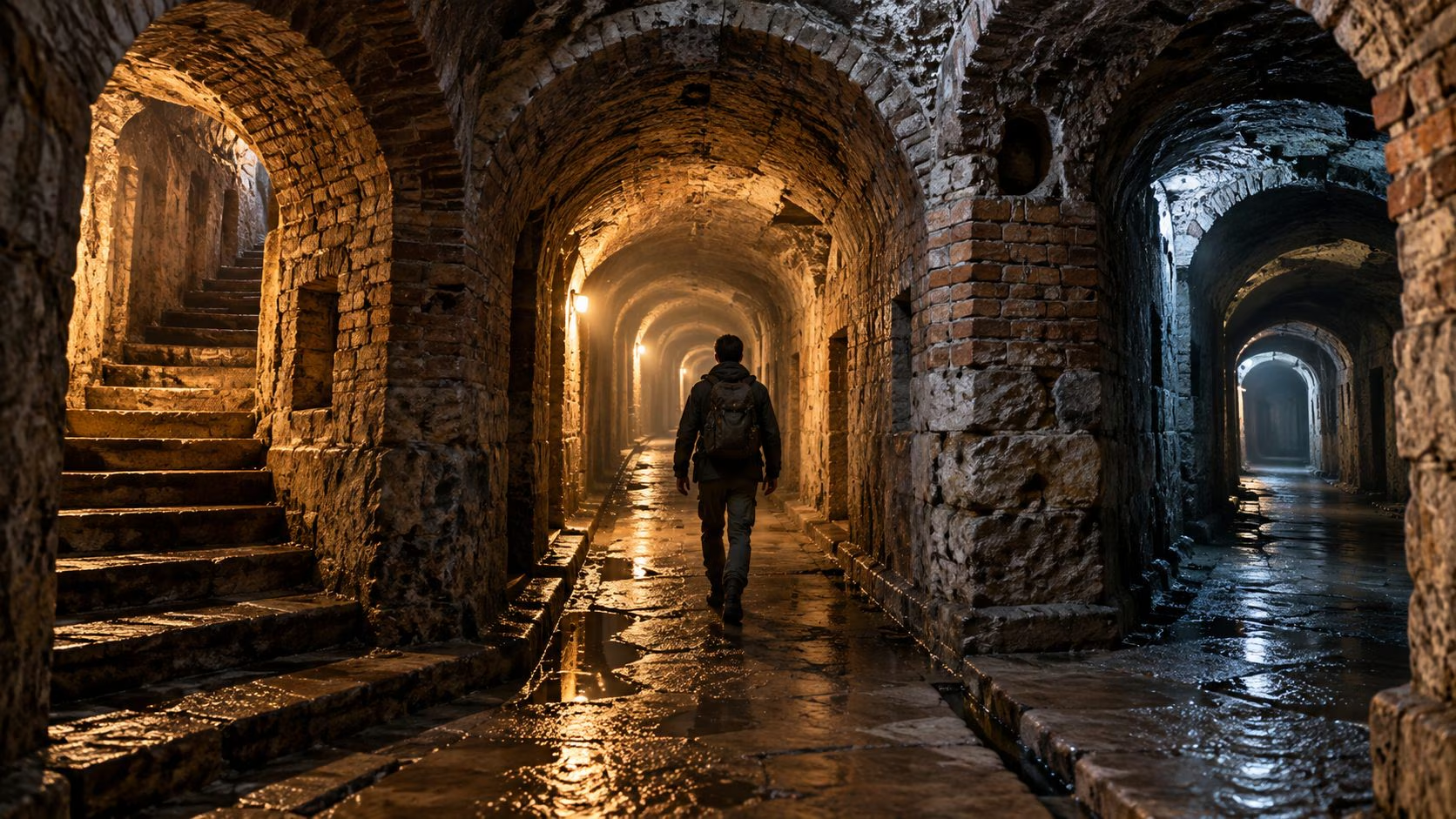
Under the Italian and European cities lies a dense network of tunnels, passages and secret passages which have been built over the centuries for very different purposes: from allowing escapes in case of danger to providing connections between the palaces of power, to transport water or perform military functions.
From the underground passages of the Castello Sforzesco in Milan to the Passetto di Borgo in Rome, up to the catacombs of Paris and the alleged secret tunnels of the royal palaces of London, here are some of the numerous underground tunnels in Italy, Europe and around the world.
Secret passages in Europe
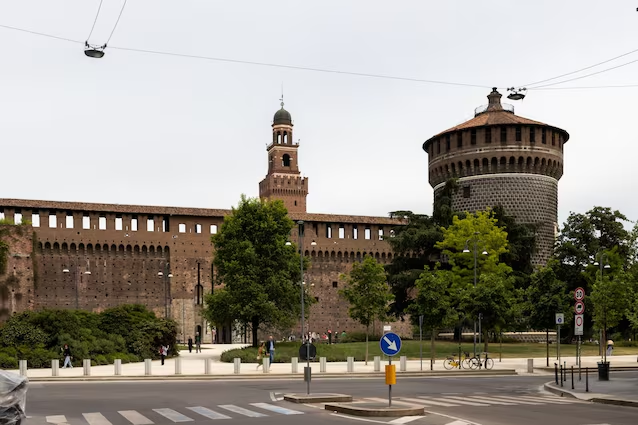
The secret passages under the Sforzesco Castle
Under the Sforzesco Castle in Milan several secret passages have been discovered: this is the news recently released by the Polytechnic of Milan, thanks to an analysis carried out with the support of Codevintec, a company that deals with technology for science. Leonardo da Vinci – who lived in Milan from 1482 to 1500 and again from 1508 to 1513 – had included these underground tunnels in some architectural drawings: today it has been possible to map the subsoil and discover its actual existence thanks to the use of ground penetrating radaran electronic system with which it investigates the terrain using reflection and propagation of electromagnetic waves.
But what were these tunnels for and where did they lead? According to historical sources, one of them was wanted by Ludovico il Moro to be able to reach the tomb of his wife, his beloved Beatrice d’Este, in Basilica of Santa Maria delle Grazie. In Milan, therefore, we have walked for centuries on secret tunnels without knowing it, but it is certainly not an isolated case: there are many underground tunnels whose existence has been discovered over the years, and many of them are still to be discovered.
A tunnel and a labyrinth under the statue of Vittorio Emanuele II in Milan
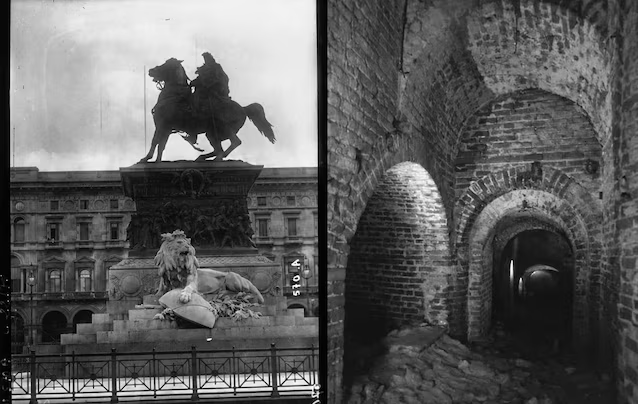
We are still in Milan, and apparently the tunnel under the Castle is not the only one. The secret rooms under Piazza Duomo they have not been so secret for some time now: the news of their discovery dates back to 2012, when the Municipality of Milan requested an inspection under the statue of Victor Emmanuel II to investigate the stability of the structure.
It was noted, in fact, that there are not sufficient safety conditions, the stone is damaged and the metal pins are seriously oxidized.
From the checks carried out, it emerges that under the statue there is a cavityand not just any cavity: an underground tunnel one meter wide and three meters high, probably built around 1894. But not only that! It also dates back to the same period a labyrinth of seven roomsall connected to each other. What were these steps for? And why a labyrinth? Even though the tunnel is no longer secret, there are still many questions about it.
In Rome there is a tunnel that connects the palaces of power and one for the Pope to escape
The existence of a hidden tunnel in the bowels of Rome that connects different palaces and centers of power It was born about ten years ago as an indiscretion, but it caused so much talk that the Chamber of Deputies itself opened a question to verify its existence.
It would, in fact, be one real underground roadwhich connects the military forts Trionfale and Boccea, crosses the headquarters of the Italian 007, passes over the Tiber, touches the Ministry of the Interior, the Quirinale, Palazzo Chigi and Montecitorio, until reaching the Ministry of the Navy.
Legend? Suggestion? What is certain is that, even today, people talk about the tunnel and there are conjectures about it that link it to the Borghese coup and the kidnapping of Aldo Moro.
Another tunnel in the past secret – but no longer today! – is the passage that connects Castel Sant’Angelo and the Vaticansaid the Passetto di Borgo or, in affectionate Roman dialect, “er Runner”. Built in 1277, “er Corridore” is partly open and partly hidden underground, and was intended to allow the escape and protection of the Pope in case of imminent danger. And on some occasions, it served this purpose: to Pope Alexander VI Borgia when the French invaded Rome in 1494 and to Giulio de’ Medici during the Sack of Rome in 1527.
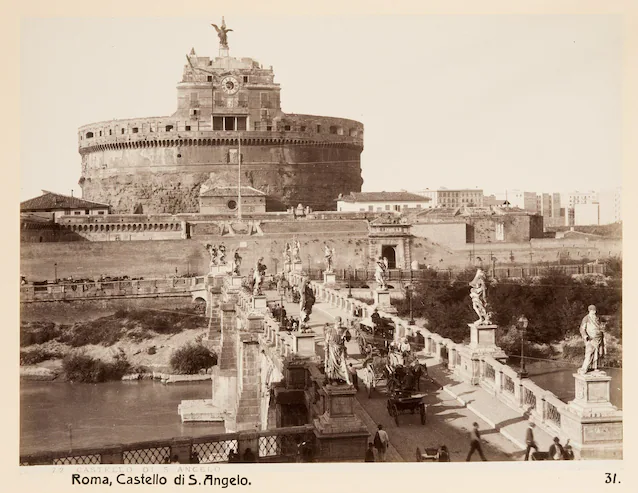
Source WikiMedia Commons
A tunnel under the Arno in Florence
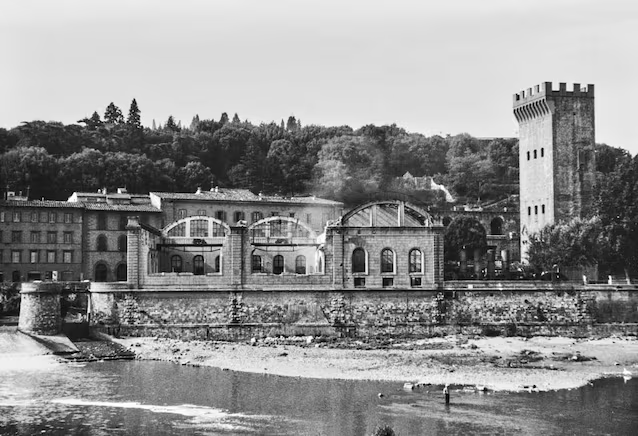
It passes under the Arno, and connects the Mint Tower – where the florin was minted – to San Niccolò Tower. We are talking about an underwater tunnel built in Florence in 1870, and it is nothing less than one of the the city’s first major infrastructure.
250 meters long, it flows 5 meters under the river bed: at the time, in fact, it connected what was the Water Factory with the aqueduct that supplied the water network, thus bringing running water directly to the houses. More than a real “secret” tunnel, here we are faced with a little-known work which however now aims to be restored, in order to be able to donate it to citizens and tourists, not without controversy in this regard.
In Taranto, a network of tunnels used during the War
In Taranto, a few months ago, one was discovered network of underground tunnels of which, from the Second World War onwards, traces were being lost. The entrances have been walled up for public safety reasons, and many of them are now hidden by buildings and other infrastructure. But the tunnels are there, and they connect different points of the city up to the Chiapparo naval base and other coastal areas.
According to the operators who carried out this real “urban exploration” the underground network is larger than you thinkand its functions were multiple: in fact, it seems that there is also a vast room that housed machinery for generating energy and distribute fuel during the War.
In Paris there are forbidden underground tunnels (and someone explores them)
If there is a city where underground tunnels proliferate, it is Paris. The urban history of Ville Lumièrein fact, confirms the existence of numerous tunnels, viaducts, built over the centuries with the most disparate functions, from the conduction of gas and electricity, to old subway lines, or actual underground quarries.
Many underground tunnels in the city are, to date, known and used, but there are numerous which are instead part of catacombsto which access is prohibited.
Many accesses to these tunnels are from the manholes and, depending on the inscription above them, you can understand what type of connection that access leads to. In Paris there is a movement of urban explorers – i cataphiles – who, breaking the rules but giving rise to their spirit of adventure, seek entrances to explore the underground road network, practically a hidden world under the city.
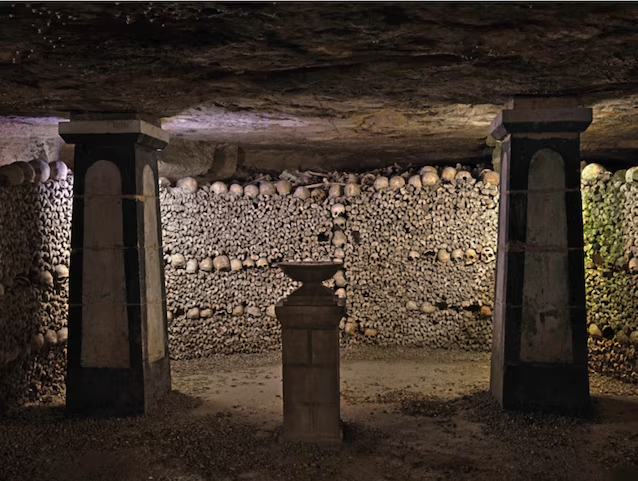
© Gautier Deblonde/ Les Catacombes de Paris
The secret passage in London that leads to a famous bar
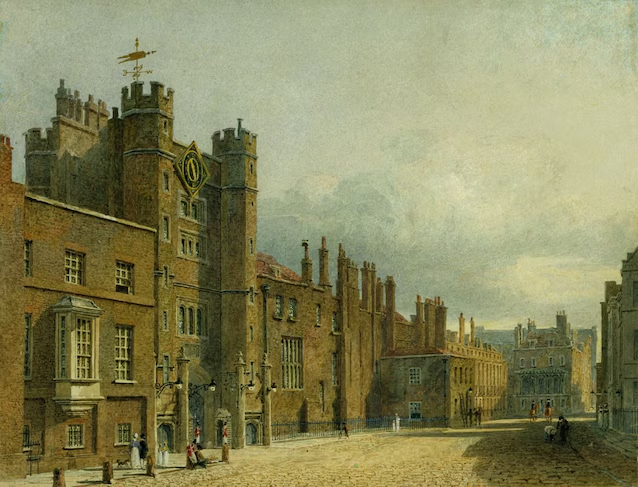
An indiscretion that arrived in 2021 Jack Brooksbank, husband of Princess Eugenie of York, nephew of King Charles, reveals that from vaults of Saint James’s Palacenear the royal palace of Buckingham Palacea secret tunnel starts that connects the residence to a sophisticated venue a Mayfair.
What makes this tunnel interesting is not just that it’s secret, but its destination: it’s about the Dukes Bara famous venue, in which – coincidences? – Ian Fleming, author of the saga, used to go James Bond. And it is at Dukes Bar that the special agent orders his martini, obviously “shaken, not stirred”.