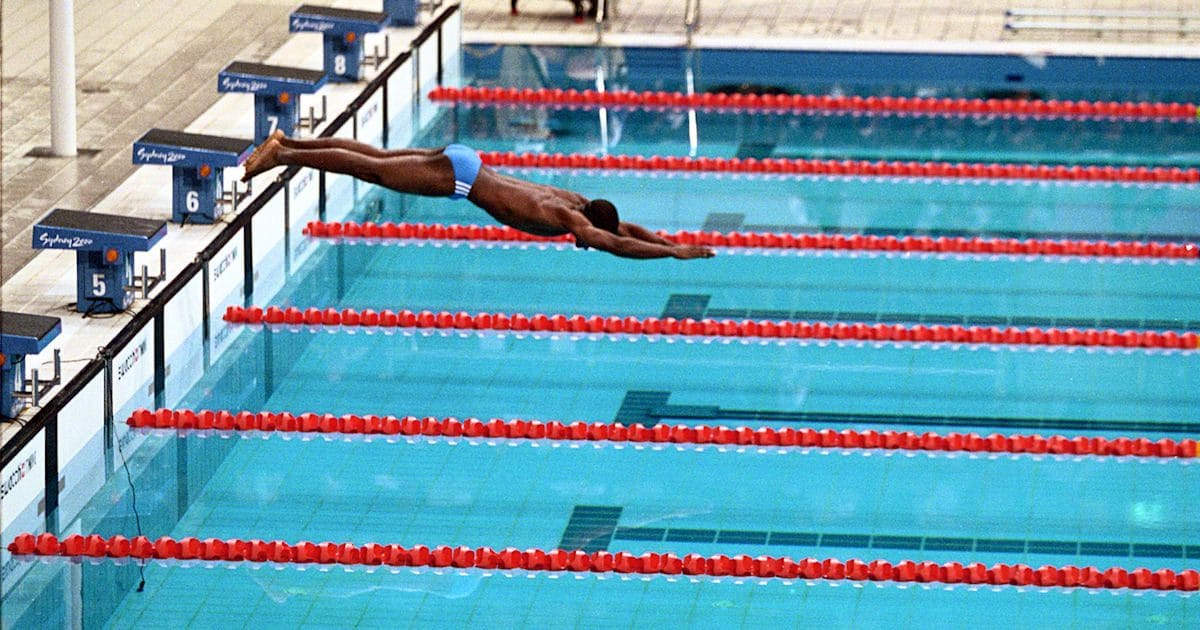
Eric Moussambani Malonganicknamed “Eric the Eel,” went down in history as the slowest swimmer ever. We are at Sydney 2000 Olympicsin Sydney’s huge swimming stadium, where 17,000 spectators are enjoying the exploits of their home idol Ian Thorpe (5 medals including 3 gold with as many world records in that edition) and the first historic Italian gold medals in swimming at Olympic level (Domenico Fioravanti in the 100 and 200m breaststroke and Massimiliano Rosolino in the 200m medley). However, those same 17,000 people also witness one of the most unlikely and unforgettable scenes in Olympic history: a man who swim aloneslowly, so slowly that one fears he might not make it. It will eventually hit the edge after that 1 minute and 52 secondsalmost the double the time of the penultimate place. Yet the stadium will explode in ovation, making that man a true legend.
Every now and then the Games surprise everyone, reminding us that their deepest meaning is not just winning. Sometimes, the challenge is simply to get to the finish line. The story of Eric the Eel it is much bigger than his awkward swim, which talks about geopolitics, inequalities, and the true meaning of the Olympics, that “The important thing is not to win, but to participate” according to a phrase erroneously attributed to the creator of the modern Olympic Games Pierre De Coubertin.
Who is Eric Moussambani: an impossible journey from Malabo to Sydney
Eric Moussambani Malonga was born in 1978 in Malabo, the capital of Equatorial Guinea, one of the smallest countries in central Africa. A place where swimming, in fact, does not exist: no swimming pools, no coaches, no federal programs. In 1999, however, an unrepeatable opportunity arrived: the International Olympic Committee, to make the Olympics more inclusive, had introduced the “Universality Places”, a sort of wild card intended for smaller countries without adequate sports infrastructure to participate in the Games. The declared objective was to give everyone, even the poorest or most isolated nations, the opportunity to be represented.
Eric decides to take advantage of this great opportunity and asks to represent his country in the Sydney Olympics in swimming. But only when his candidacy is accepted does he decide to learn to swim. He trains as best he can in a 20 meter long pool in a hotel in Malabo, without a coach, without preparation plans. In Sydney it will even be the flag bearer of his nation which thanks to Universality Places will bring 4 athletes: two in swimming, two in athletics.
The Sydney Olympic race which made him the slowest swimmer in history
Eric then finds himself participating in the heats of the 100 meters freestyle without ever having seen a 50 meter pool and without ever having actually competed. In heat with him there are other athletes who arrived there with the same program: Karim Bare (Niger) and Farkhod Oripov (Tajikistan), in what is now a classic of Olympic swimming in recent years: the first morning heats are reserved for athletes who are there to participate, not to aspire to a medal. But Eric’s story is about to get even more incredible, because his two fellow competitors are coming disqualified for false start. Eric therefore remains alone at the starting blocks, the swimming pool is all to himself, in front of a packed arena.
Off we go. Eric dives but it is immediately clear that something is wrong: disorderly strokes, labored breathing, his head above the water like someone swimming to avoid sinking. It certainly doesn’t feel like we’re witnessing an Olympic-level competition. The first pool is difficult but controlled, but the return becomes harrowing. Eric is clearly in difficulty, he doesn’t seem to be able to finish those 100 metres. And then the help of the Sydney International Aquatic Center arrives: 17 thousand people starting to cheer him on, all together pushing that boy who arrived from Equatorial Guinea who had never seen an Olympic swimming pool. When it touches the edge, after 1:52.72the slowest time ever recorded in the Olympic 100-meter freestyle, the arena explodes in a standing ovation which immediately becomes one of the highlights of those Games. Before social media, before we could “go viral”, everyone fell in love with Eric Moussambani.
Fame, difficulties and rebirth
From one day to the next Eric becomes a planetary phenomenon. The TV channels look for him, he receives invitations, letters, job offers. For many it is the symbol of the purest Olympics: the one where the courage to try counts, but once he returns to Equatorial Guinea he discovers that the real challenge was yet to begin.
He decides to learn to swim seriously, to return to 2004 Games in Athenswhen however a problem with the visa will deny him the Olympic joy. However, he continues to work to bring swimming to his country, becoming technical commissioner of the Equatorial Guinea national swimming team, creating from scratch a Federation that had never existed, and will return to the Games in that capacity, in London in 2012. Thanks to Eric the first swimming pools were builtand young people in Equatorial Guinea learn about the sport.
Eric Moussambani he won no medals and set no recordsbut he used the notoriety he gained for being the slowest Olympic swimmer in history to highlight how sport reflects inequalities in the world, and how wild cards they Universality Places could be useful programs to give global representation to elite sport.
His participation in the Games, like that of the other athletes registered with this program, may make many smile or seem like a small thing, but for smaller and less developed countries it is an enormous opportunity to see themselves represented on a very important stage, the Olympic one, and to be able to offer a future in the sporting field to their compatriots.
