When Matteo Salvini defended social centers
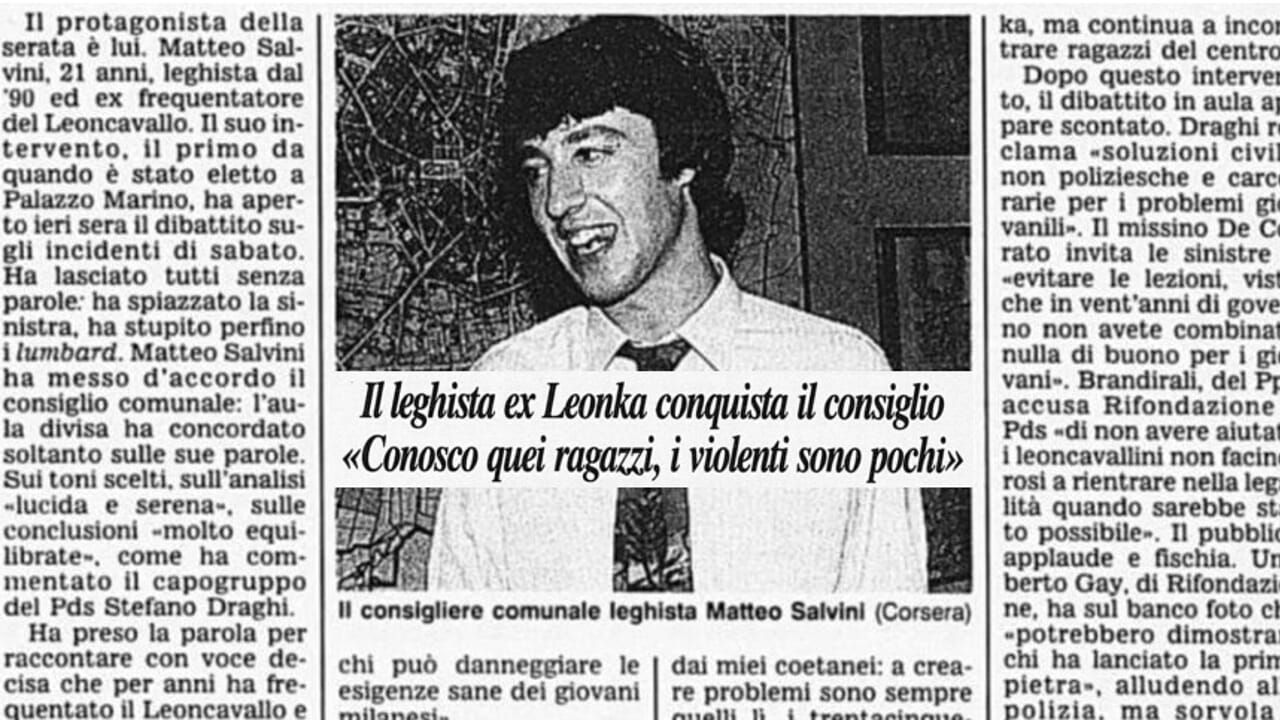
Everything flows, we all change, and politicians more than others, having to conform their speeches to the variable colors of opportunity as well as, like all of us, to the natural and changing passage of time. However, it is quite impressive today to see Matteo Salvini standing in the front row on the barricade against the excesses of the social centers (see the Turin case) and, at the same time, casting his eye on a clipping from the Corriere della Sera of 13 September 1994, with a very explanatory title: “The former Northern League member Leonka wins the council / «I know those guys, the violent ones are few»”. In the middle of the piece, a photo with a young municipal councilor from the Northern League, long hair and rumpled elegance like the Northern League members of those years, very similar to another boy who had made his TV debut shortly before in Corrado Tedeschi’s program Doppio Slalom. The raven hair was the usual, the smile too: yes, in both cases it was Matteo Salvini.
The piece in the Corriere gave an account of the first speech of “city councilor Matteo Salvini”, elected in 1993 (it was the time that Marco Formenti became mayor, and the League achieved its first truly great success), a speech made following the incidents that in the previous days had devastated the center of the Lombard capital, and which had seen the police on one side, and the Leoncavallini on the other. These were the years of greatest splendor of the most famous Italian social center (vacated in recent months by Piantedosi).
Surprising his fellow Northern League members, Salvini recalled that “in social centers we meet to discuss, discuss, drink a beer and have fun”, and explained that it is often a few troublemakers who ruin everyone’s party. The same thesis that, after the events in Turin, Fratoianni and Bonelli supported a few days ago.
“To do five billion in damages – said Salvini in ’94 – 50 or 100 violent people are enough. I appeal to my peers to reject the logic of armed conflict and to isolate those who can damage the healthy needs of young people”. Once outside Palazzo Marino, the young Salvini then stopped to talk to reporters, adding that he had “attended Leoncavallo from 16 to 19 years old”, while he was in high school.
Salvini and Leonka
Rereading them now, those sentences really have a certain effect, considering the right-wing drift that Salvini himself has given to the League, especially now that, after Turin, the government is preparing to launch a new security decree, in which the leader of the Northern League is always the one who enjoys playing the toughest one. To wit: in the case of preventive detention for the most dangerous elements, while the other majority parties were asking for a 12-hour detention, Salvini proposed 48… And so on with a thousand other examples, from t-shirts with the words “stop the invasion” to social slogans.
But for those who remember the League of those years, the one in which Bossi was in charge in his (coffee-stained) undershirt, which D’Alema had renamed “a rib of the left”, the words of the beardless (politically) Salvini are ultimately not that surprising. It was a truly popular League, a party born from scratch that had broken through in a short time, also gaining several votes from the left.
Salvini smiles, like the Po
Beyond the green underwear with the writing The League has it hard, the scent of sausage from the rallies in the meadows of Pontida was the same one you could smell not far away at the Feste dell’Unità. Quite understandable, therefore, that a young exponent of that Po Valley world making his debut on the national scene, like the city councilor Matteo Salvini, indulged in arguments that he believed brought him closer and brought him closer to people he imagined not too distant, at least socially. The League was “the base” and he, identifying with Leonka, wanted to be the “base”.
On Monviso, in Pontida, in the Northern League marches on the Po and in Venice there was talk of Padania and not of Italy, of “southerners” rather than immigrants, of “thieving Rome” rather than of self-defense, of the harsh hand of the police rather than of safe havens. Then a lot changed, also due to the will of Salvini himself, and judging by the upheavals within the Carroccio, from the stomach aches of the Venetian traditionalists to who knows what will happen after Vannacci’s farewell, it is not certain that the ball has stopped. Everything flows, really.
