In the enlightened chaos, the Games become a useful thing again
There is a moment, in the Olympic ceremonies, when you understand whether you are watching a ritual or a show. At the opening ceremony of Milan Cortina 2026the answer was both, and with constant friction. An interesting, even necessary friction. Because Italy, when it puts itself on stage, always risks slipping into the Pavlovian reflex of “look how beautiful we are”. Only this time the beauty wasn’t a backdrop: it was a field of tension.
The strongest idea – and also the most contemporary – was not a song or a light effect. It was geography: a “widespread” ceremony, four places lit simultaneously, as if the country had decided to no longer tell its story from just one centre. Milan, Curtain, Livigno, Predazzo: not a single stage, but a network. And within that network, the athletes are not compressed as extras in the stadium, but rather distributed by proximity to the competition venues, almost as if to reduce the distance between protocol and real sport. It is a logistical choice, yes, but also a narrative one: Italy not as a showcase, Italy as a map.
Between anthem and whistles
Then, of course, comes the ritual. Laura Pausini sings live, and precisely this detail – in the midst of a gigantic direction – reminds us how today every ceremony is also a test of trust: not because authenticity is lacking, but because contemporary television has accustomed us to doubt everything, even when it is true. And no, our anthem does not lend itself to vocal virtuosity – the mountain choir of Cortina is much better -, but someone hasn’t understood this yet.
The flag gesture, double and mirrored, was one of the most successful steps: in Milan the delivery of the tricolor to the cuirassiers, in Cortina the parallel gesture to the carabiniere. It is a direction that tries to say: the State and sport are not two separate rooms.
And here politics comes in, as inevitable as the cold in February. There were boos at the Israeli delegation at San Siro, but they were “dirty”: covered by the volume, mixed up in the sound, as if even dissent needed to pass through the mixer to become audible. Elsewhere, particularly in Cortina, the climate seemed different. It’s a detail, but it tells a lot: today geopolitics no longer enters ceremonies by breaking down the door; it enters through the cracks, and then everyone feels it – or denies it – in their own way.
The grandstand, meanwhile, was a postcard of the world: among those present too JD Vance – US vice president –greeted by hostile reactions when his face appeared on the big screens, and António Guterres – Secretary General of the United Nationsas if to remember that the word “truce” has become a permanent background, not an achieved objective.
They taught us wonder…
Yet, just as all this was happening, the ceremony produced its counterpoint: the minute beauty, the one that makes no noise. The parade of small nations – those that large countries see only as a list – was the most Olympic point of the evening. Because there the world returns to its real scale: an athlete, a flag, a tense smile, a jacket too light or too heavy, and that way of walking that says “I’m here, anyway”. If there is an idea of ”harmony” that holds, it is this: not rhetoric, but coexistence.
On the topic of “Made in Italy”, Italian journalists, as often happens, exaggerated. And, I’m sorry to say, on this and other topics, the commentary was at times embarrassing: «… from the undeniable demonstration of professional inadequacy offered in four hours of commentary: even capable, among a hundred other errors, of ignoring the champions of Italian and world volleyball…», the words of Roberto Natale, Rai board member, read on ANSA.
They told Italians about Italy as if it were a discovery. It is a reflection that we carry with us: when there is an international camera, we feel like explaining ourselves, to certify our identity out loud. But Italy didn’t need to be explained: yesterday it was already all there, in the way it tried to keep Milan and the Dolomites together without making a joke of it.
And speaking of style: the show was also a catwalk, in the most serious sense of the term. There Germany – forgive us the brutality – she seemed to dress with the anxiety of not making a mistake, and in fact she made a mistake: heavy, not very harmonious, almost bureaucratic and in some ways ridiculous. Great Britain And United States they did what they know how to do: legible elegance, coherent image, no screams.
Italy, on the other hand, has chosen the paradox: not “blue”, not “snow”, but mélange grey. Minimalist, urban, with the tricolor reduced to detail: a gesture that leaves you speechless precisely because it doesn’t seek easy applause. It’s as if he said: we don’t have to prove anything, we just have to be there. And in fact, by tradition, the Azzurri closed the parade: 93 countries in total, ovation for the Ukrainians, while the evening was a reminder that the Games are never out of this world.
From Mattarella to Ghali, the best of Italy
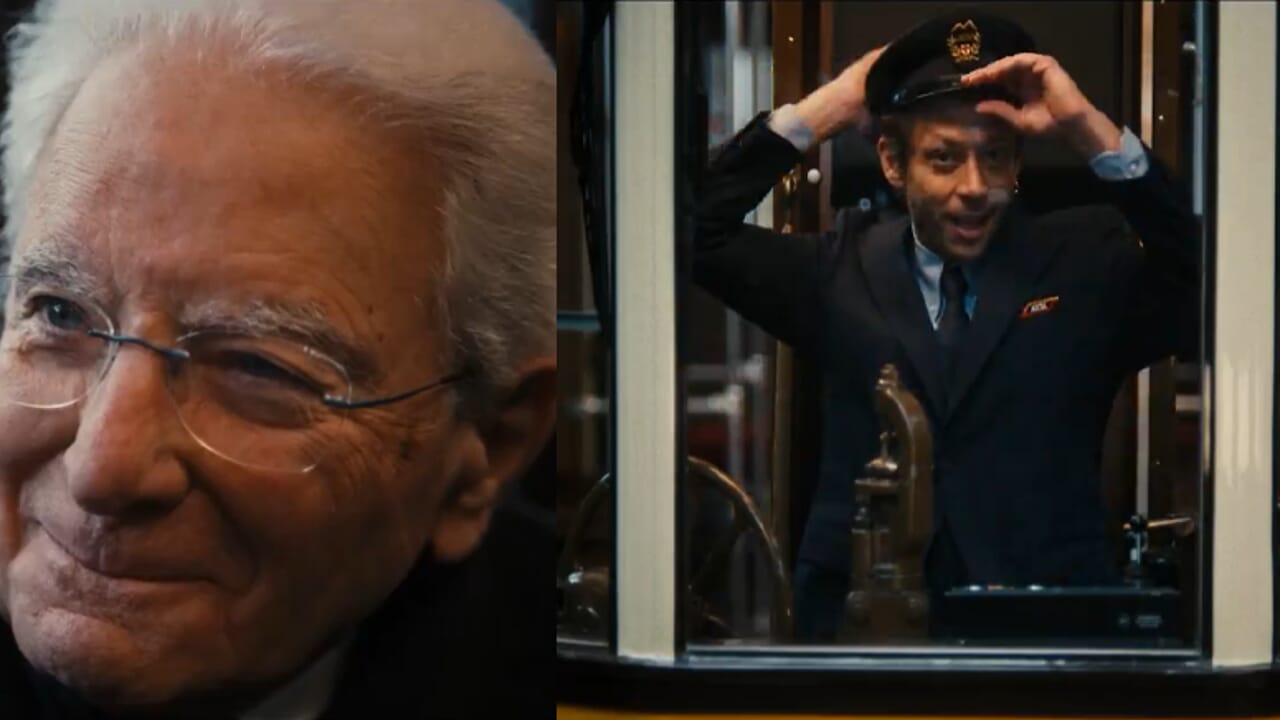
The most “Italian” moment – in the best sense, that is, unpredictable – was the narrative arrival of Mattarella: first a video, a tram, and driving Valentino Rossi. It’s a scene that, when put that way, seems like a caricature. Instead it worked because it was seriously strange: not the usual packaged “national pride”, but a short circuit between institution and pop, between discipline and myth. And when the President declared the Games open, the stadium responded with a roar that was not propaganda: it was, much more banally and much more humanely, affection.
And then there was Ghali. The point here is not just that Rai “cancelled” him; already enough controversy to describe a country that does not know how to manage what it does not control. The point is that he did one specific thing on stage: he read Rodari, “Reminder”, while he drew a dove on the lawn. He spoke in multiple languages, asked for the weapons to be stopped, and did so without shouting. It is a choice that puts into crisis both those who demand “pure” sport and those who would like politics only as a noisy gesture. Here, however, politics was a short text and a human figure.
Finally, fire: the relay race as a sporting genealogy, and the simultaneous lighting of the two braziers. In Milan with legends like Alberto Tomba And Deborah Compagnoniin Cortina with Sofia Goggia, who took the torch from Gustav Thoeni’s hands; and before that a chain of champions, a change of hands which is also a change of responsibility. Two braziers lit together, as if to say that these Games do not have a single heart, but two coordinated beats. We don’t know if it will remain in history as a perfect innovation: but it is certainly a serious attempt to make cities and mountains dialogue without reducing the latter to a background.
The whole world is a stage
In the end, the feeling was this: Milano Cortina tried to do something difficult, that is, be modern without becoming cynical. He showed beauty, but he could not – and, perhaps, should not – sterilize the noise of the world. The boos, the applause, the television omissions, the patriotic rhetoric, the tiny nations that become gigantic for thirty seconds.
And perhaps it is precisely here, in the well-lit chaos, that the Games become a useful thing again: not because they make us forget the world, but because they force us to watch it while it tries – for a moment – to walk in the same direction.
