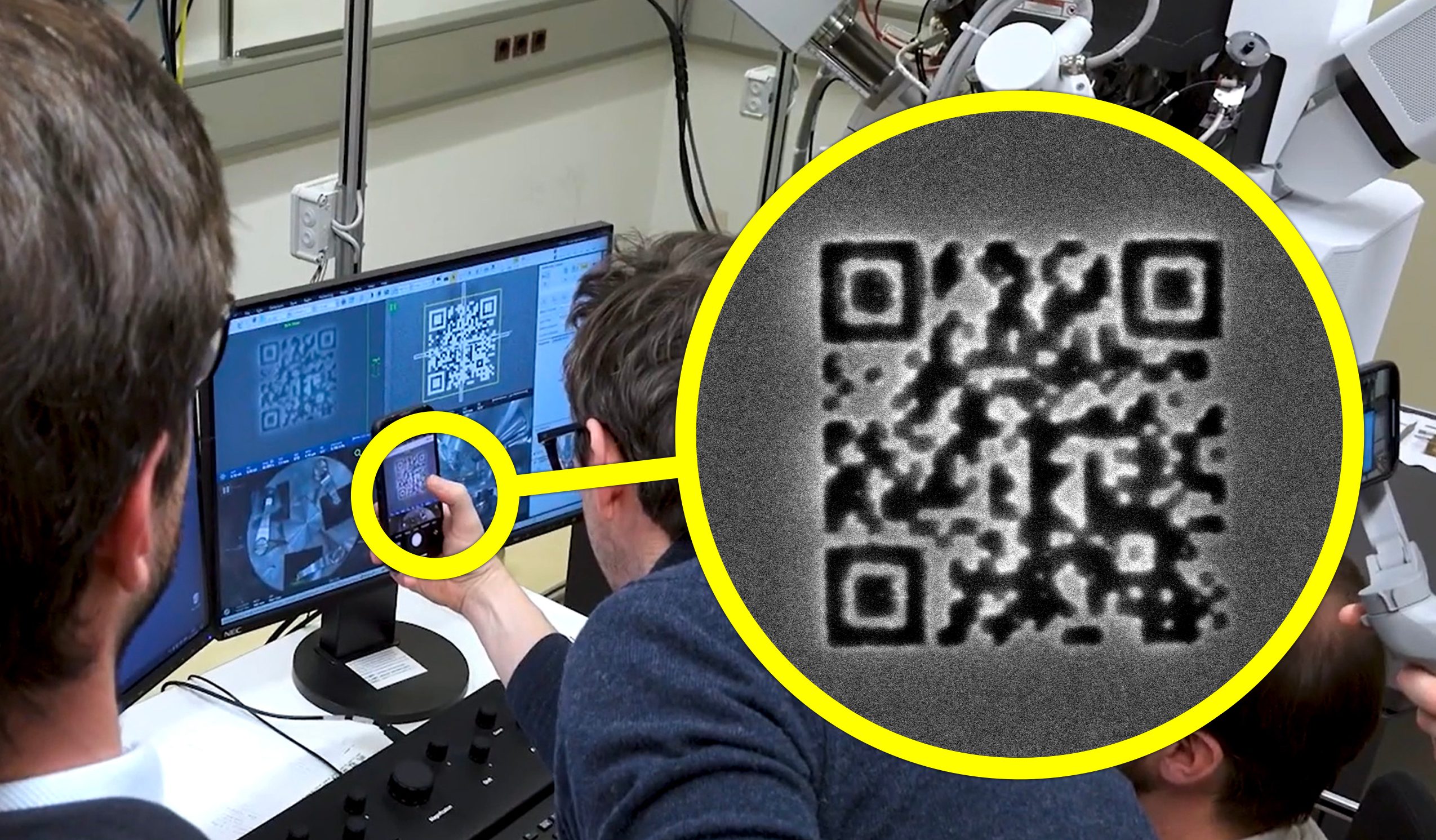
The smallest QR code in the world barely measures 1.98 square micrometersa surface area smaller than that of many bacteria and absolutely invisible (the only way to use it is to use a microscope electronic) and with pixels just 49 nanometers wide, 39% less than the code that held the previous record. The code, entered in the Guinness World Recordswas created by a team from the Technical University of Vienna in collaboration with the tech company Cerabyte. For those who are wondering, by scanning the QR you are redirected to a university page with the presentation of the research group that obtained this incredible result.
They were employed to make it happen ion beams focususing a ceramic film extremely thin of chromium nitride. As confirmed during an interview by two of the authors, Erwin Peck and Balint Hajas, the choice of materials was made to guarantee stability over time, even in extreme conditions.
But what’s the point of making a code of this size? This work was not done just to achieve a Guinness World Record: the technology has enormous potential applications for long-term data storage. There are many such systems magnetic or electronic and – typically – after several years they need to be replaced. However, if the information is literally engraved on top of ceramic materials, it can last for centuries, if not even millennia, and what’s more, it doesn’t even require energy to function.
Furthermore, the storage density of this method is very interesting: in an area the size of a single A4 sheet, it is possible to store more than 2 terabytes of data! These are the words of Alexander Kirnbauer, one of the authors of the study:
With ceramic storage media, we are pursuing a similar approach to that of ancient cultures, whose inscriptions we can still read today (…) We write information on stable and inert materials, capable of withstanding the passage of time and remaining fully accessible to future generations.
