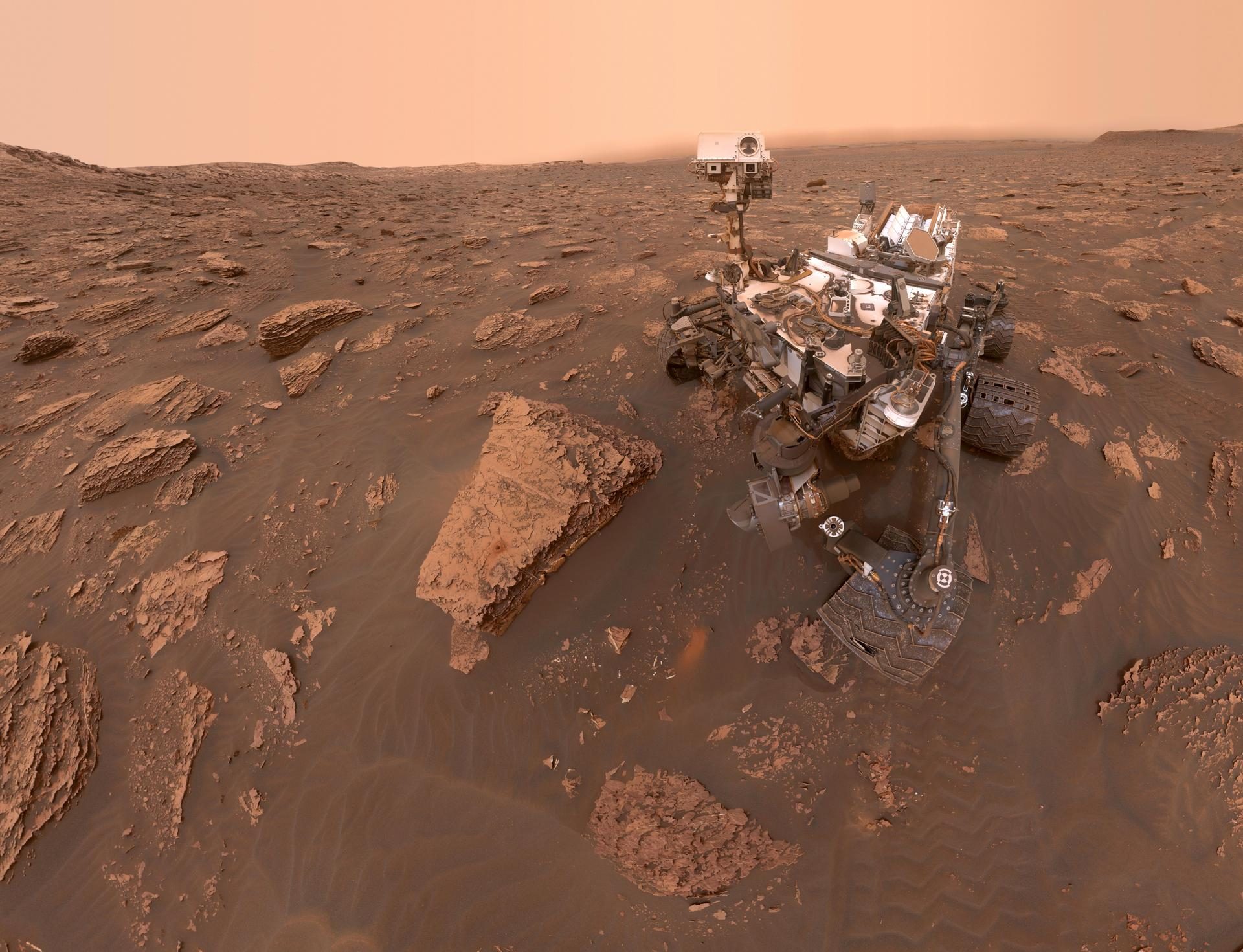
A sample of Martian rock analyzed by Curiosity rover of NASA in the Martian crater Gale contains relatively long-chain hydrocarbons (dean, undecan And dodecanethe largest ever found on Mars) which on Earth can be produced by geological processes or transported by meteorites, but can also derive from biological organisms. A study published in the journal Astrobiology took into account the possible known non-biological origins for these organic compounds, but according to the researchers none of these could explain the abundance of decane, undecane and dodecane found in the sample studied by Curiosity.
In short, there is the possibility that these compounds derive from life forms that inhabited the red planet of the Solar System in the distant past. This is not proof (further studies are needed), but it is still a clue to ancient Martian habitability which adds to others that have been collected by rovers and probes studying the red planet.
According to researchers, decane, undecane and dodecane could be derived from ancient fatty acidssimilar to those produced on Earth by living beingsalthough these compounds can also form via non-biological processes. The shale in which these compounds were found, in the Gale crater, is a stone that forms in the presence of water: in fact, it is believed that in ancient times Gale may have been a lake, an environment particularly predisposed to hosting life.
The Curiosity rover does not have on board instruments capable of discriminating whether these hydrocarbons were produced by biological or other processes. For this reason the researchers used an indirect method conceptually similar to radiometric dating. The basic idea is this: in a rock exposed to the Martian surface these hydrocarbons decrease over time, because they are gradually destroyed by cosmic radiationto which Mars is particularly subject since it does not have a magnetic field and its atmosphere is very thin. So if I know the current abundance of hydrocarbons, how long they have been exposed to cosmic radiation, and if I can determine the rate at which hydrocarbons decline over time, I can get an idea of how many there were when the rock came to the surface.
That’s what they did: they measured the abundance of these compounds (30 to 50 parts per billion), estimated how long they had been exposed to cosmic radiation (80 million years), and tried to “go backwards” in time to estimate their “primordial” abundance. Using a mix of computer models and laboratory analysis, they arrived at ranging values from 120 to 7700 parts per billion. A quantity greater than what normal non-biological chemical processes could produce, according to the authors of the study. This suggests that life, in the past, may have contributed to their formation.
We repeat: this it is not definitive proof of the presence of biological forms on Mars in the past. This is a hypothesis that requires further studies and analyzes to be confirmed.
