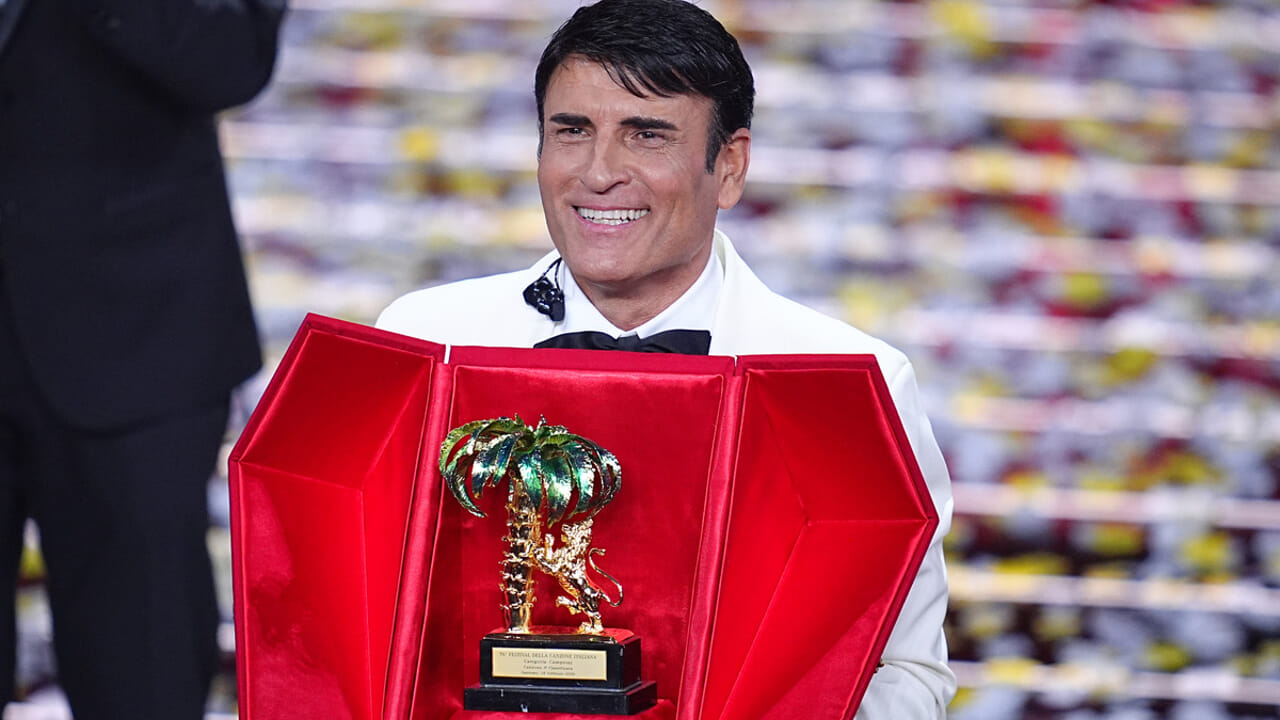
Sal Da Vinci, hero of the people
In January, at the first and only preview listening with journalists of the songs from Sanremo 2026, Forever yes it had passed as a meme, an anthem for wedding TikToks from Gaeta downwards – which it is in part, but not only – by an artist, Sal Da Vinciwhich only went to the Sanremo Festival one other time, in the late Middle Ages in 2009, third with I can’t make you fall in love and also renegade – from Ariston himself, he had been hurt – with a long series of subsequent exclusions. Someone in the room laughed, Carlo Conti made a comment like this: “We need this too”. As if to say: we understand each other, it’s a piece of relief, a quota that the cast certainly foresees, it certainly won’t reach the podium. Meanwhile, the polls, which are time consuming, were contradictory, with few taking it seriously. A month later, Sal Da Vinci rocked the Festivaleven thanks to the opinion of the Press, Radio and TV, rather than a televote which saw him arrive 3 points behind Sayf, first. What happened?
Who (didn’t) see it coming
The phrase that is said most often, in these cases, is that “no one saw him coming”, but the truth is that we have long felt the breath on the neck of this tireless worker of Italian pop music, full name Salvatore Michael Sorrentino, born in New York in 1969 during a tour of his father, the singer Mario Da Vinci – Alfonso Sorrentino, the family also inherits the surname of art – who in turn introduced him to the profession as a child (the chronicles report 1976, only seven years). From there, ups and downs, an infinite apprenticeship starting from his city, Naples, and arriving everywhere, including musicals (you’ve seen how recites?), to the point of making us feel like we’re breathing down our necks Lipstick and coffee (2024), a sort of neomelodic pop lent to social media, an independent song – with an irresistible refrain and lyrics of bellyfrom karaoke, Sal Da Vinci was ashamed of it because he, who sings it, is not very young – which thanks to TikTok has sold 200 thousand copies, becoming popular everywhere, alone. It sounds like music of the peoplenot because it is elitist but because it is outside certain industrial circuits, in short from the bottom. And in fact, it’s not that we didn’t see it coming: it’s that few, given his background, took it seriously.
Forever yes – which already shows the first signs, forgive us, of bourgeoisisation: produced by Warner Music, it has eight authors compared to just three Lipstick and coffeeincluding the hitmakers Alessandro La Cava and Federica Abbate – followed suit, even a year behind schedule, expecting participation as early as 2025 (but Conti had said “no”, only to retrace his steps this year). In some ways, this easy and elementary electro-pop, a dedication so simple that it cannot be misunderstood, which speaks of an institution so ancient that it reaches everyone (marriage, in the face of the crisis, and moreover in the Church), with a sort of ballet which, where the words do not add up, uses gestures, indicates faith, etc., well, all of this at the time even represented a further simplification compared to Lipstick and coffee.
There’s no going back
Yet, people fell in love with it. Everyone fell in love with him, from a criticism – at least that of Sanremo – who continued to grasp his ironic, exaggerated side, but recognized his skill, coherence, integrity and a certain cheekiness, in the face of many other competitors who got entangled in incomprehensible, unsustainably pretentious solutions, preferring Sal Da Vinci’s Act of Faith, to himself, to a belly music, of the people. And then, obviously, all those who allowed themselves to be infected, not only in the South (of course), as if by a fever: a new song was needed for weddings, the old ones have expired and the solution, in this era, evidently lies in a song that is bread and butter, certainly containing some hit gems, but nevertheless sincere in its pretending that the problems – that is, the structural ones of marriage – do not exist, passing over them with a steamroller of such obstinacy, and ostentation (“Bound for life”, “It will forever be yes, only yes”, you said nothing, these days). Like Saturn in Goya’s painting, Sal Da Vinci has devoured his children: the competing Neapolitans, the memes like Elettra Lamborghini herself, the hitmakers of yesterday and today, the chic Italy that we have brought to Eurovision in recent times, finally Sanremo itself.
The context – little and confusing competition, the lack of a leading favorite – helped him, but this does not change the fact that this victory is a short circuit compared to the Festival of recent years: where there have usually been, at least recently, up-and-coming young people (Mahmood and Blanco, Angelina Mango, Olly, the Måneskin themselves), now sits a 56-year-old in eternal pursuit, the third oldest winner of the last forty years. And perhaps, from here, there is no turning back: certainly a song designed for TikTok had never won, in general at Ariston they have always had serious songs or songs that were taken seriously, without giving space to who knows what ironies (that, in fact, has always been penalized). Forever yes it’s a white fly, with an enormous and unexpected legitimacy from Sanremo: who knows whether it might create a precedent, who knows whether Stefano De Martino – the next host of the Festival, will now make it a workhorse for Your business – don’t start from here, multiplying the presence of songs of this kind in the cast. We are warned.
