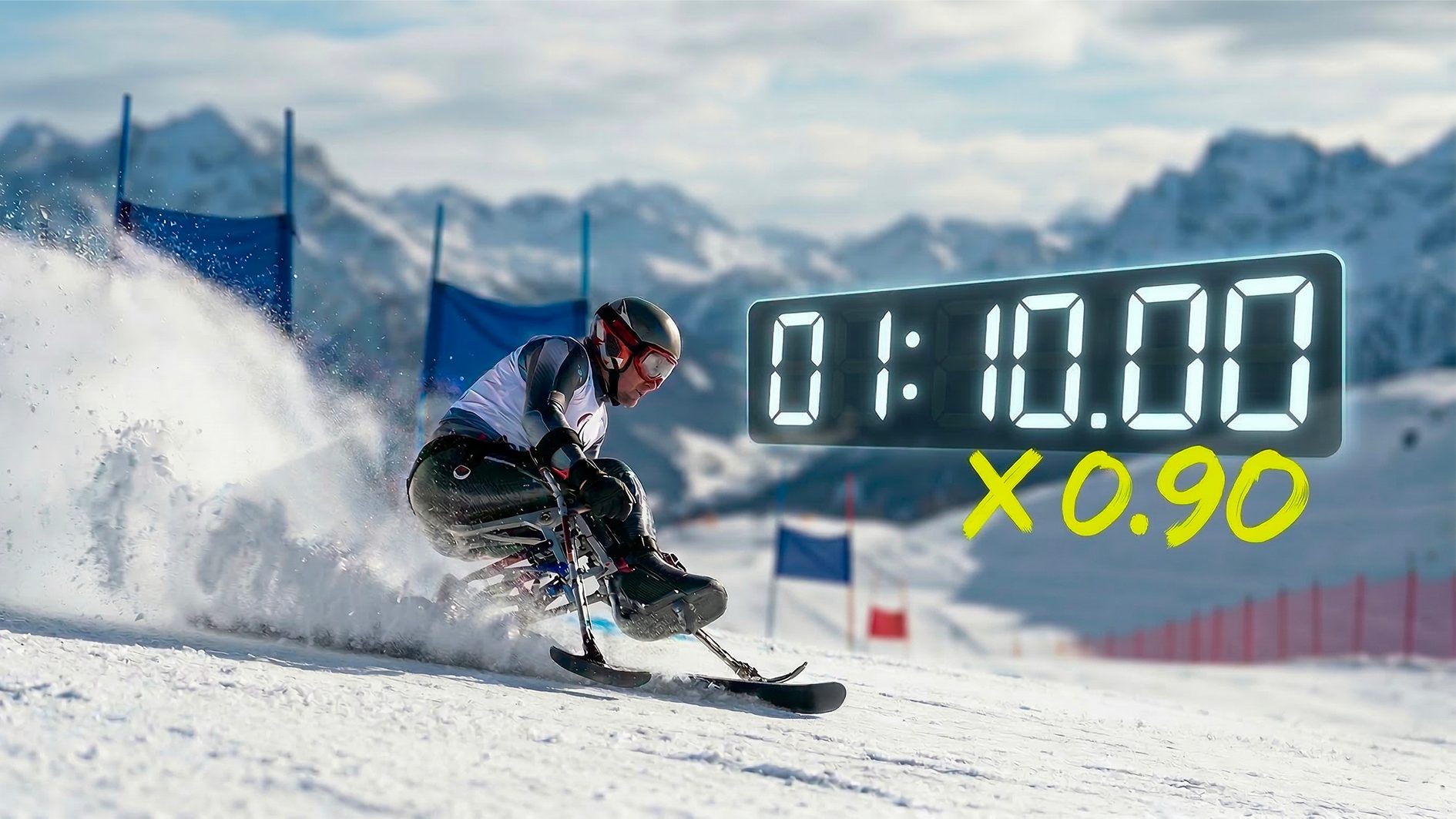
Watching some of the Winter Paralympic competitions in Milan Cortina 2026 we might come across what seems like a chronometric error: in some races, in fact, the time flows more slowly for some of the competing athletes. It’s not a trick to try to put one of the 79 gold medals up for grabs in this edition of the Games around your neck, and it’s not even a mistake: it’s the effect of factored timea mathematical system used in several Paralympic sports to make competitions more balanced between athletes with different disabilities. To understand why it exists and how it works, we need to analyze one of the fundamental principles of Paralympic sport: functional classification.
How the categories work at the Paralympics
In most Paralympic disciplines, athletes are divided into different categories based on their level residual functionalitythat is, based on how much the disability affects sports performance. This process aims to allow athletes with functional abilities that are as similar as possible to compete with each other, regardless of the type of disability of each individual athlete.
For example, in Paralympic swimming, athletes with physical disabilities are divided into ten classes, from S1 to S10where S1 includes athletes with more significant motor limitations and S10 those with minor limitations. They can be found within the same class athletes with different disabilitiesfor example an arm amputee and a leg amputee, if their overall level of function is considered comparable. In a swimming race this mechanism works well, because the athletes compete against each other, and the time taken to complete the race becomes just a reference on which the medals do not depend.
But in sports where you race against the clock, such as alpine skiing, cross-country skiing or biathlon, the situation becomes much more complicated and is handled differently. If we created as many categories as there are levels of disability, we would risk having many races with very few participants per class. For this reason the athletes are grouped into macro-categorieswider.
In the example of the 3 Paralympic disciplines that involve the use of skis, there are three macro-categories: standingfor those who ski standing up, sittingfor those who ski sitting down, visually impaired for athletes with visual impairments. Within these macro-categories, however, there are different levels of residual functionality. Two skiers who both compete “standing” can have very different disabilities, which affect performance differently. It is precisely to compensate for these differences that the factored time.
What is factored time and how is it calculated
Factored time is a system that modifies the real race time by applying a coefficient linked to the class the athlete belongs to.
The formula is very simple: real time × class coefficient = final time.
In practice, this means that athletes with less impactful disabilities and high residual functionality will have a coefficient very close to 1while athletes with less residual functionality will have a lower coefficient. In practice it is as if, for some athletes, time passed more slowly.
A practical example from the Winter Paralympics
Let’s imagine a Paralympic ski race with two athletes belonging to different classes, in which for that specific discipline a coefficient of 0.95 to athlete A and of 0.80 to athlete B. So let’s assume that athlete A has a higher residual functionality compared to athlete B.
Athlete A completes the race in 60 secondsathlete B in 70 seconds. Applying the factored time we obtain:
- Athlete A: 60 seconds x 0.95 = 57 seconds
- Athlete B: 70 seconds x 0.80 = 56 seconds
So the winner in this case is theathlete Bdespite having taken 10 seconds more than athlete A to complete the race.
How the coefficients are established
The coefficients are not chosen arbitrarily, but are established by federations of each discipline analyzing the performances of athletes in international competitions. The results of many competitions are compared to understand how much, on average, a certain disability influences performance. Based on this data, the coefficients are calculated for each class, discipline and specialty. For example in alpine skiing we have different coefficients for slalom, giant slalom, super-G and downhill. These values come later updated periodically to reflect the evolution of sport and performance.
Factored time however it is not a perfect systembecause establishing a coefficient capable of truly putting athletes with very different disabilities on an equal footing is extremely complex. For this reason, the classification and assignment of coefficients is one of the most discussed and continuously revised aspects in Paralympic sport. Despite its limitations, however, this system allows multiple athletes to compete together, avoiding competitions with few participants and keeping the races spectacular and competitive.
