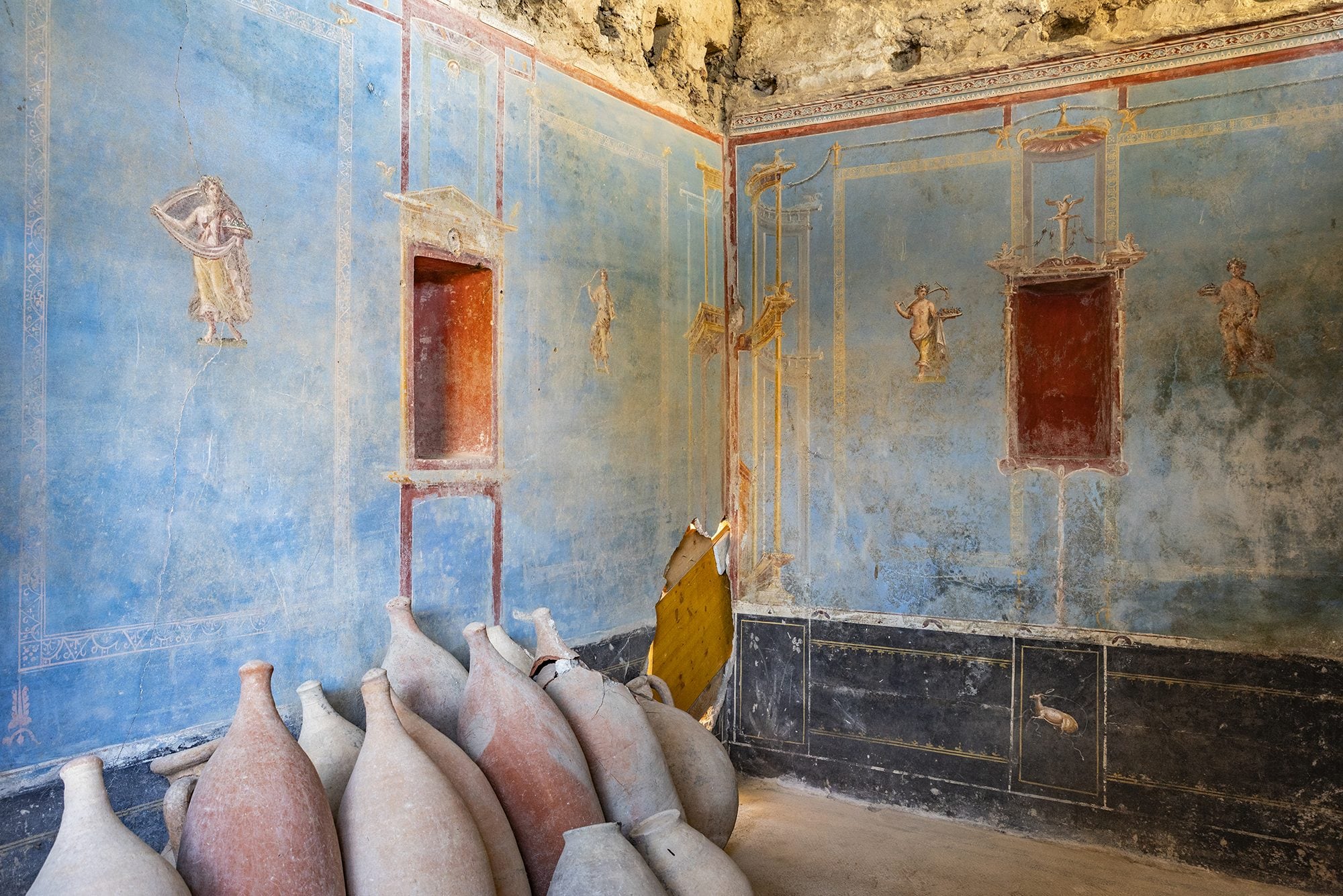
That the famous blue Egyptian was a prized pigment in ancient times, it is a long established fact: this vivid color was commonly associated with wealth, high social status, and even divine attributes. However, we are only now discovering how precious it is: painting a room in Egyptian blue it cost between 50% and 90% of a legionary’s salary. A study just published in the prestigious journal reveals the high costs of this precious pigment npj Heritage Sciencewithin the group Nature: a group of scholars from the MIT – Massachusetts Institute of Technology has in fact analysed, with the collaboration of the Archaeological Park of Pompeii and the University of Sannio, the blue pigment that covers the walls of the famous “Blue Shrine” of the Regio IX of Pompeii establishing the actual value of the color used in relation to the wages of the time.
What is Egyptian blue
This pigment, produced already between 3200 and 3300 BC in Egypt as an alternative to the more expensive semi-precious lapis lazuliwas obtained by cooking silica sand, calcium carbonate, copper-containing minerals and alkaline flux together at around 850-950 °C. The final product was a glassy paste interspersed with intense blue grains of calcium and copper tetrasilicate, which was transported in pellets and then crumbled to make pigment.
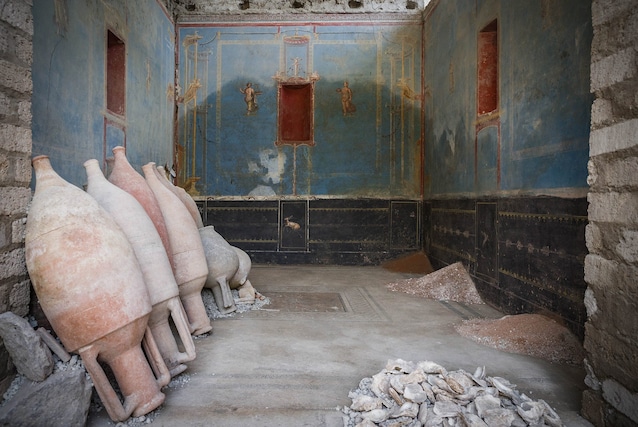
Egyptian blue soon became the most widely used blue pigment in the ancient Mediterranean and Asia Minor for over three millennia, despite the relative rarity of blue pigments compared to other colors. Also for this reason quantifying its actual value is not easy: but what better place to understand it than the “Blue Shrine” of Pompeii, that is, that sanctuary which is completely covered by it?
Studies on Egyptian blue in Pompeii
Samples were collected from the Shrine, in addition to those from the official collection of the Pompeii Archaeological Park (from previous excavations of the House of Painters at Work), and an initial chemical investigation of the main pigments present on the walls was carried out.
Using a combination of visible light-induced luminescence (white light), SEM-EDS and Raman spectroscopy, the scientists were able to spatially map the large-scale distribution of color in spaceidentifying the application method and calculating the exact quantities of color employed in the fresco. By estimating the quantity of color it was possible to estimate the costs of the pigments used for the decoration.
The quantity is important: they were applied between 2.7 and 4.9 kg of color. But the cost?
To estimate it, scientists recovered a source from the time, a passage from Pliny which discusses the different types of blue pigments available at the time: armenium (Armenian), indicum (indigo), caeruleum (cerulean), lomentum (light blue) e cylon (another name for the Pozzuoli cerulean). For the caeruluemthe color that interests us, there are further distinctions that refer to the origin, from Egypt, from Pozzuoli or from Cyprus and so on. The one at the Blue Shrine, the Caeruleum Vestarianumof Egyptian origin it cost 11 denarii per pound (one pound is approximately 453 grams): to put it into context, the highest quality ocher was 2 denier per pound, orpiment up to 4 denier per pound, chrysocolla 3-7 denier per pound.
To estimate the economic investment required for the decoration, the scholars multiplied the 11 denarii per pound by the total weight of the pigment between 2767 and 4984 grams: a cost ranging from 93 to 168 denarii.
To understand how much money it is, just look how much Roman daily life cost: a loaf of bread during the 1st and 2nd centuries AD cost approximately 0.0625 to 0.125 denarii (1/16 to 1/8 of a denarii), with an increase in the city of up to 0.125 denarii. Even looking at the higher city price, therefore, the cost of the pigment in this room was equivalent to something like 744-1344 loaves of bread.
And how much did a normal infantryman in the Roman army get? At the time of the eruption of Vesuvius, he would have received approximately 187 denarii per year: here the cost of the pigment fluctuates between 50% and 90% of your annual income.
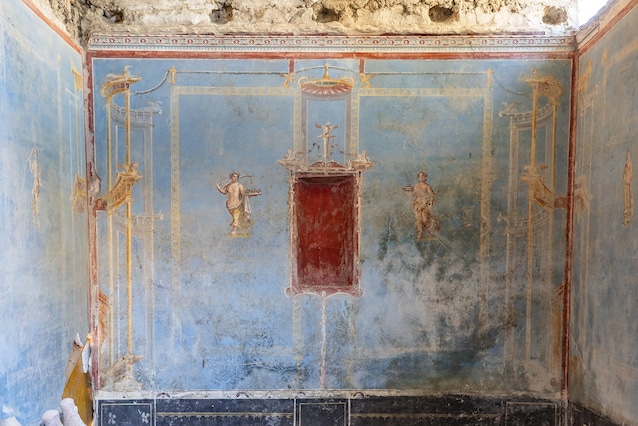
And think about this one of the smallest rooms of the entire domus and was used as a deposit before the eruption!
The owners of this villa could therefore afford an incredible investment: a wealth also confirmed by the type of decorations on the walls of the room, which refer to an idealized agricultural life and the prosperity of the land. The expense that these families could afford makes it very clear the detachment of the aristocracy from other social classes.
