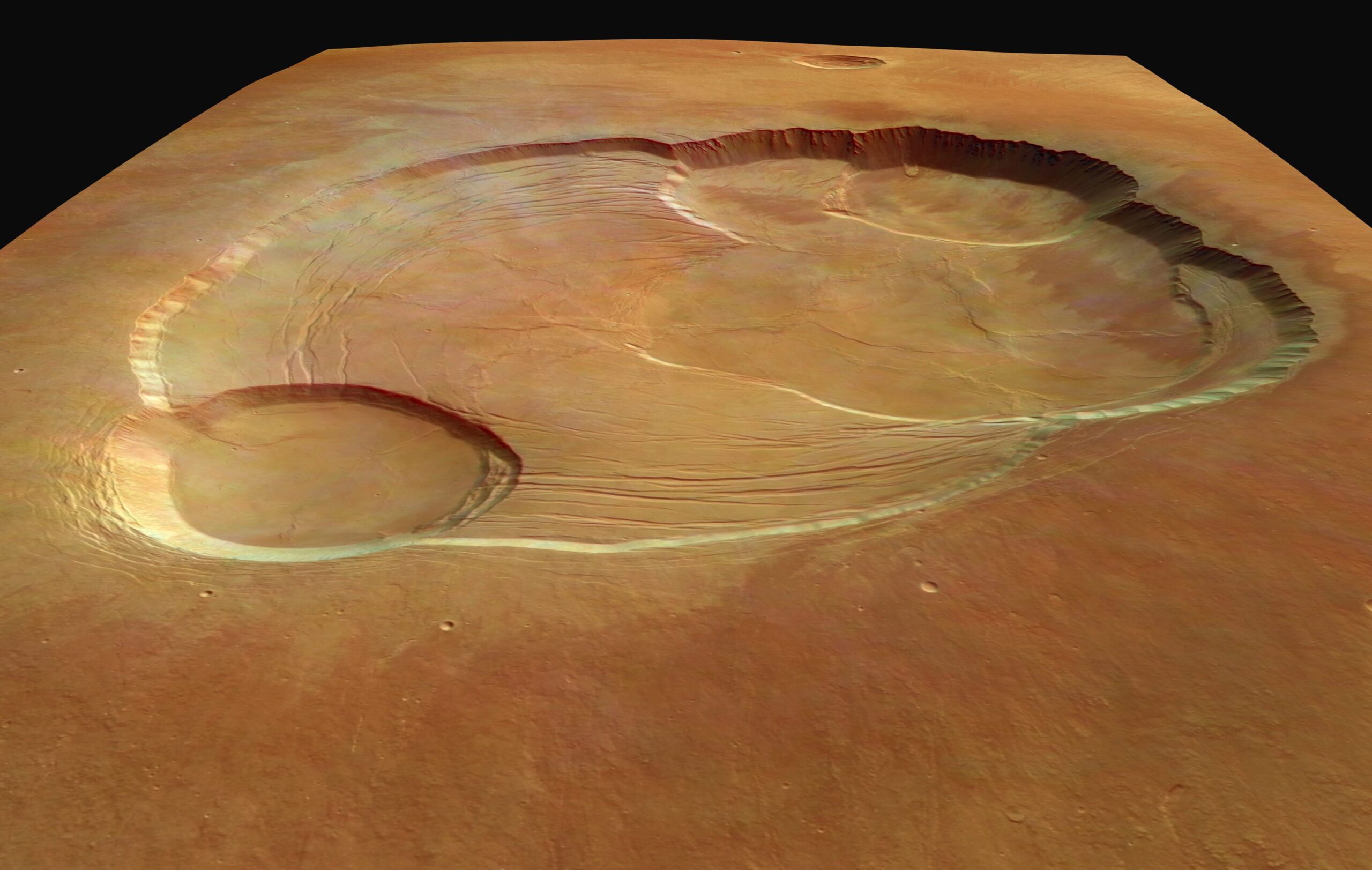
The Mauna Loain Hawaii, is the largest active volcano on Planet Earth with approximately 70,000-80,000 km3 in volume: if, however, we were to look at the entire Solar System, this record would belong to another volcanic giant, with significantly larger dimensions. It is about theOlympus Mons (“Mount Olympus” in Latin), a shield volcano located on Mars which, as such, has the typical “flattened” shapewhere the height (in ratio) is much smaller than the width of the base.
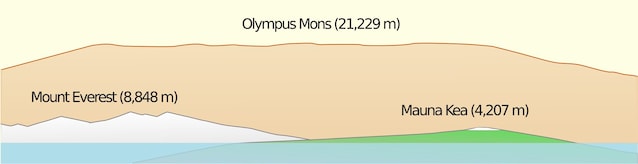
This Martian colossus is approximately 24 km high – almost 3 times as much as Mount Everest, which stands out on Earth with its 8,849 m of height – has a diameter of over 550 km (compared to the 120 km of Mauna Loa) and occupies an area of approximately 300,000 km². To be clear, Italy has a total surface area of 302,073 km²: as an extension, therefore, Olympus Mons could be compared to our country!
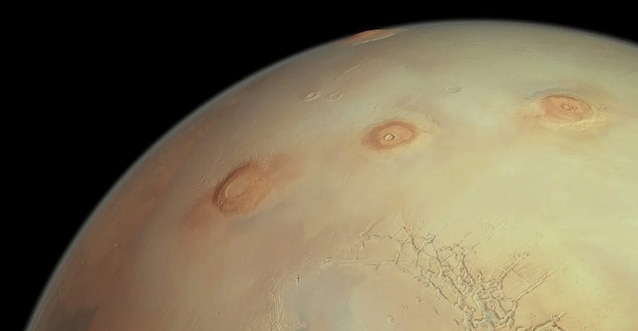
Going into more specifics, the Olympus Mons – which can also be considered the greatest prominence of the entire Solar System – is found in the region Of Tharsisnear the Martian equator, characterized by the presence of others volcanoes of enormous dimensions, clearly visible in the photo below: it is theArsia Mons (the first to be formed), the Pavonis Mgr el’Ascraeus Mons.
But how is it possible that such large volcanoes exist on Mars? As highlighted by the USGS (United States Geological Surveythe United States Geological Survey), there are two explanations of this phenomenon.
The first concerns the fact that Mars, unlike Earth, shows no evidence of active plate tectonics: this means that the surface of the red planet is rather static and, consequently, i lava hot spots under the crust they remain in the same position for long periods of time, allowing the volcano to grow larger and larger.
The second reason has to do with gravity, which is what it is on Mars about a third of that on Earth (about 0.38 times compared to that of the Earth): this means that Martian volcanoes can reach larger dimensions than terrestrial ones which, with dimensions of this type, would instead risk collapsing under their own weight.
