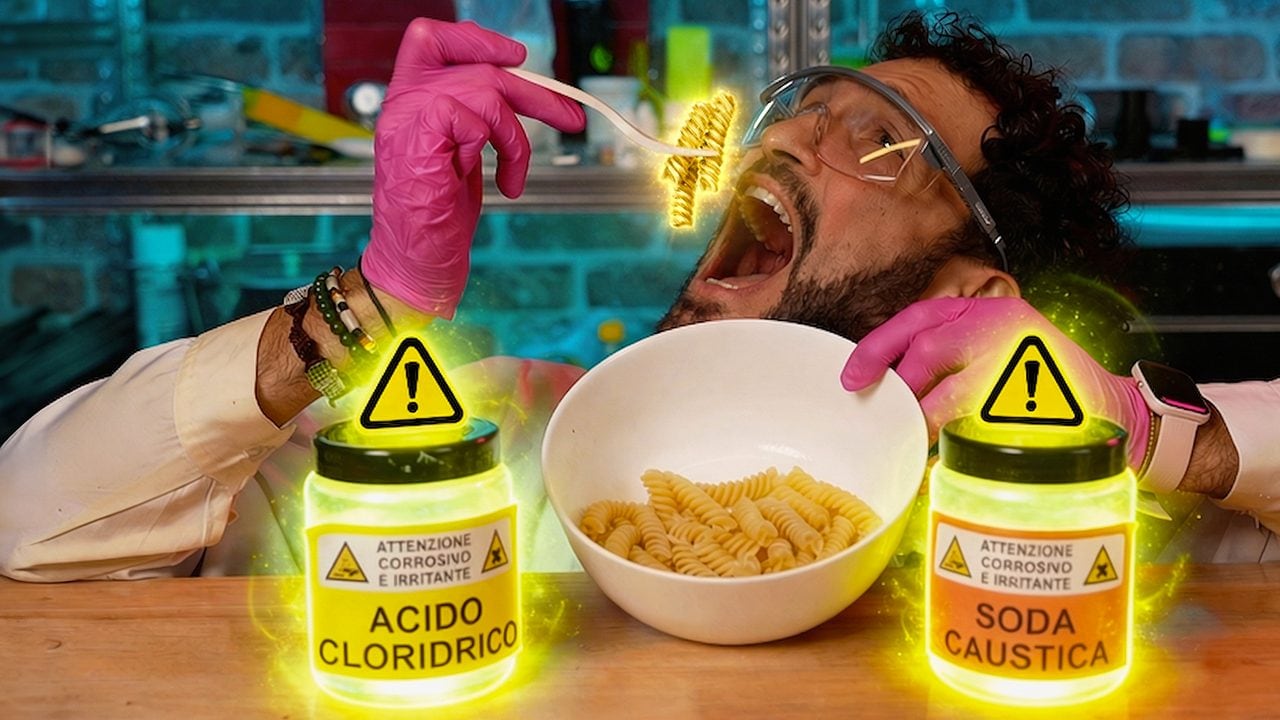
From a chemical point of view, the cooking salt (sodium chloride – NaCl) is nothing more than the neutralization product of a strong acid (hydrochloric acid – HCl) and one strong base (sodium hydroxide, commonly called caustic soda – NaOH). So the question came to me spontaneously: is it possible to boil pasta in a pan full of water where we have added HCl and NaOH in the right proportions to form salt? The answer is yes and in the video in this article we demonstrate everything.
⚠️ ATTENTION: SECURITY DISCLAIMER ⚠️
DO NOT REPLICATE THIS EXPERIMENT AT HOME. The video and the article are for purely educational and informative purposes. Hydrochloric acid and caustic soda are substances extremely corrosive which can cause severe chemical burns and permanent damage. The experiment shown was performed by professionals in a controlled environment, using PPE (Personal Protective Equipment) and precise stoichiometric calculations to ensure complete neutralization of the reagents. A dosage error would make the solution toxic and dangerous for ingestion.
Taken individually, hydrochloric acid and caustic soda are dangerous substances. However, if reacted in the right proportions (calculated to the milligram/milliliter to ensure that every single molecule reacts), the neutralization reaction occurs:
HCl + NaOH → NaCl + H2OR
What essentially happens is this: the hydrogens el’oxygen they come together to form waterfallwhile the sodium and the chlorine they form the sodium chlorideor common table salt. The result? A solution with pH 7 (neutral), perfectly safe and indistinguishable from the salt water we use every day.
But why do such an experiment?
The point of the experiment is not to suggest that you cook pasta with hydrochloric acid and soda in the absence of table salt, but to break down a common prejudice: “natural is better than synthetic“. It’s not like that.
If you think about it, with this experiment we obtained a synthetic salta salt”chemical” (adjective that can be given to any substance, even water is chemical). But from a scientific point of view, it is always NaCl. Therefore, regardless of the origin – whether synthetic or natural – what matters is the amount of that substance.
A molecules of Synthetic NaCl it’s perfectly identical to a molecule of Natural NaCl found on rocks, in a salt pan or in a mine. Consequently, preferring a natural substance to a synthetic substance does not make any kind of logical sense.
