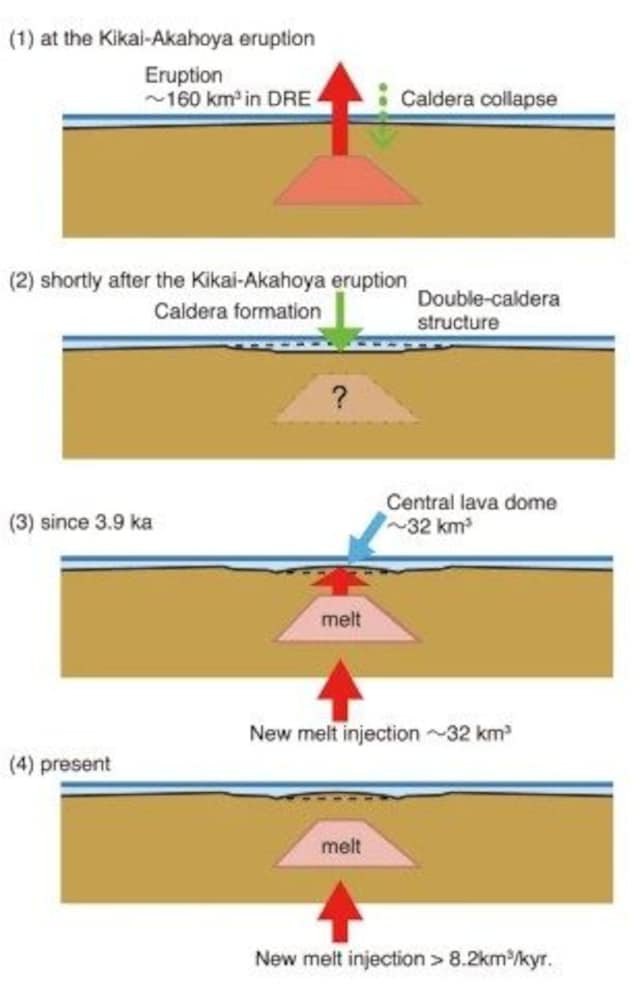
Under the caldera of Kikai underwater volcanooff the coast of southern Japan, the magma chamber is starting to fill again, 7300 years after what was themore violent eruption of the last 11,000 years. Researchers from Kobe University, Japan, detected a large quantity of magma under the caldera, who published the results of their analyzes in a study in the journal Communications Earth and Environment. The objective of the research is to better understand the mechanisms of magma accumulation under large-scale calderas and consequently to improve forecasts of this type of eruption.
The discovery of magma under the caldera of Kikai volcano
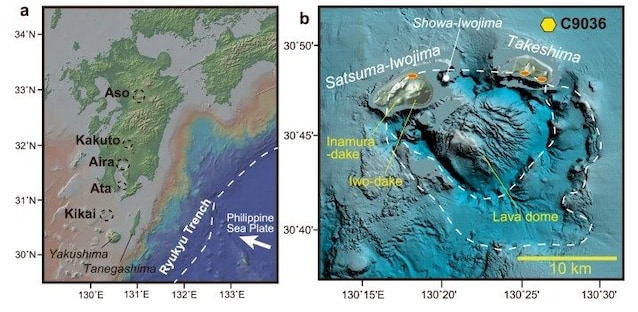
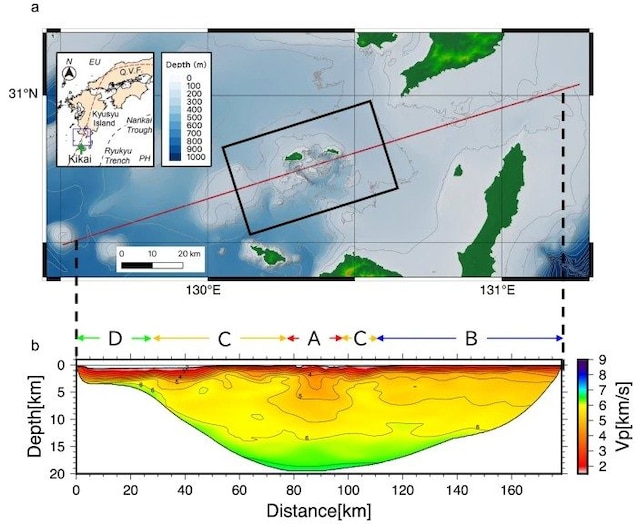
Located south of the Ryukyu Islands, Japan, the Kikai Caldera is largely submerged. Only part of its edge emerges from the ocean, in the form of three small islands. The caldera, which has a diameter of 19 kmis the result of violent eruptions which in the past emptied the magma chamber leading to the collapse of the volcano. The last great eruption, the most violent of the geological era in which we live, the Holocene, occurred 7300 years ago and it was VEI (Volcanic Explosivity Index) equal to 7 (for comparison, the 2022 eruption of the Hunga Tonga-Hunga Ha’apai volcano in the South Pacific reached a VEI 6). During this event the pyroclastic flows reached a distance of 100 km ei 150 km3 of ash issued have affected all of Japan. The fact that the volcano is located on the ocean floor offers ideal conditions to extensively investigate the structure of the crust through geophysical investigations. The researchers thus artificially generated seismic waves, and then intercepted them with a network of seismometers positioned on the seabed. Investigations revealed the presence of a vast area rich in magma under the volcanocorresponding to the same reservoir responsible for the last major eruption.
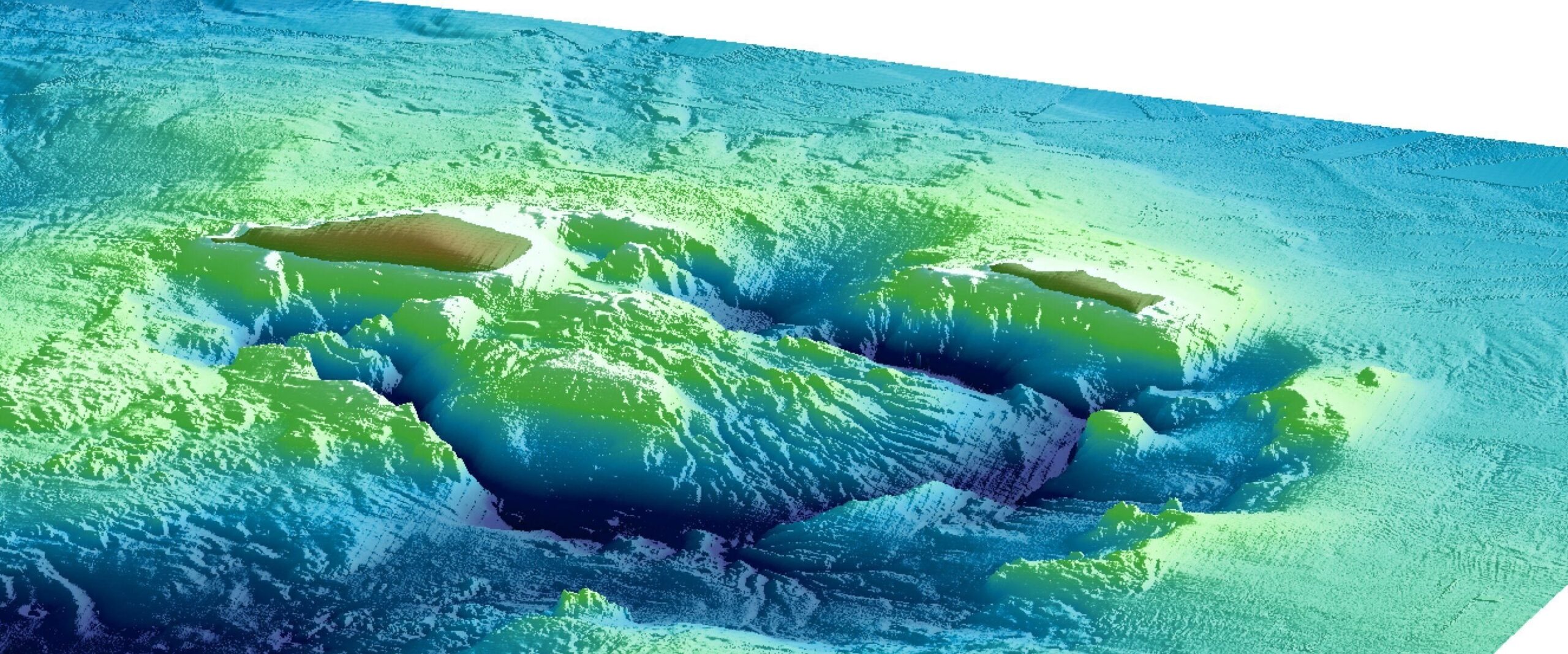
The lava dome of the volcano
Previously, researchers had discovered that a volcano was forming in the center of the caldera lava dome. By analyzing the materials they found that their composition is different from that of the products expelled during the eruption 7300 years ago. This means that the magma currently present in the magma chamber under the lava dome it is probably recent. The goal is to better understand the mechanism by which the magma chambers under large calderas fill over time after large eruptions, knowledge of which is still limited. Being able to do this is essential to monitor the precursor phenomena of possible eruptions. In this way in the future we might even be able to improve forecasts for caldera eruptions such as those of Yellowstone, in the United States, or Toba, in Indonesia.