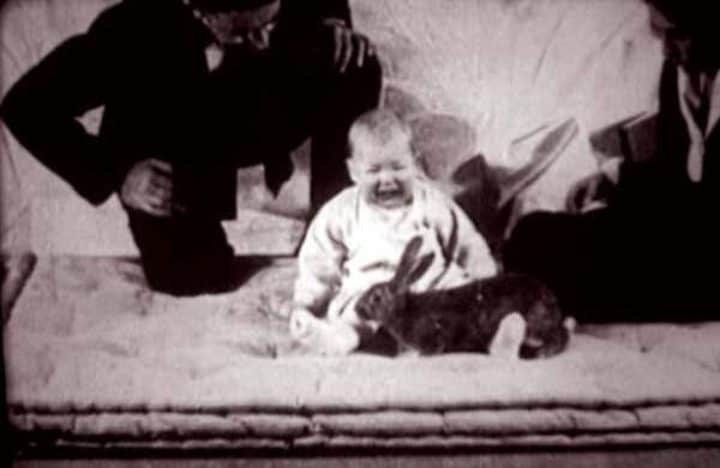
In 1920 the greatest exponent of behaviorism John Watson he was so convinced that behaviors and emotions could be shaped and shaped by the external environment that he decided to carry out an experiment at Johns Hopkins University on a child, known as the little Albertto demonstrate how also the fear can be learned.
At the beginning of the 20th century, psychology was faced with a fundamental question: how do we really study human behavior? Until then, attention had been paid primarily to inner thoughts and emotions. With the birth of behaviorismthe objective changes: psychology aims to become a science capable of provide directly observable and measurable data. At the center of the investigation, therefore, there are no longer the contents of the mind but the actionsreactions and how the environment shapes behavior.
The mind is like a black box
Watson considered the human mind like one Black Box (Black Box), whose internal functions were not directly observable and, precisely for this reason, could not be the subject of rigorous scientific analysis. Watson therefore proposes to treat the mind as a black box: it doesn’t matter what happens inside it, what matters is the relationship between stimuli coming from the environment and observable behavioral responses.
In this view, understanding behavior means study how certain stimuli produce certain reactionswithout referring to internal mental states. To understand how convinced he was of his theory, remember the famous quote:
Give me a dozen healthy, robust children and a specific environment in which to educate them and I assure you that I could take one at random and train him into any kind of specialist I decide, doctor, lawyer, artist, merchant and, yes, even beggar and thief, regardless of his talents, inclinations, tendencies, abilities, vocations and the race of his ancestors
Fear is not innate: the psychological experiment
Strongly convinced of his hypothesis, Watson wanted to prove that too fear is not innate, but it can be learned through experience. To verify this, he chose to apply the principles of classical conditioning processed by Ivan Pavlovuntil then studied mainly on animals. His collaborator was there to help him Rosalie Raynerwho later became his wife.
Watson and Rayner undertook this study to answer 3 fundamental questions:
- Can a child be conditioned to be afraid of an animal if it appears at the same time as a frightening stimulus?
- Could this fear be generalized towards other animals or inanimate objects?
- How long would such fears persist?
The involuntary protagonist of the experiment which took place in 1920 is a baby of about 11 months, known as little Albertraised from birth in a hospital environment (his mother was a nurse in the Harriet Lane Home). Watson describes Albert as a healthy, emotionally stable and unreactive child; according to the psychologist, the participation of the young participant would have caused “minimal damage”.
From the age of 9 months he was initially subjected to emotional testswhich became a real routine. The child was then exposed to various stimuli: a white mouse, a rabbit, a dog, a monkey, masks with and without hair, cotton wool and even burning newspapers. In none of these situations did Albert show any signs of fear. On the contrary, he reacted with strong fear when a was produced metallic noise suddenly, hitting a steel bar with a hammer: in these cases he jumped, trembled and cried. Having identified the stimulus capable of arousing fear, Watson decided to use it to influence an emotional response.
In a first phase, at the sight of the white mouse, the child tried to grab it without any hesitation. This is where the real conditioning begins: just as Albert touched the mouse, the steel bar was struckcausing an immediate reaction of fear and crying. Instead, when some toy bricks were exposed (neutral stimulus), Albert went back to playing peacefully. This procedure was repeated several times, until the The mere presence of the mouse was enough to trigger clear signs of fear. That is, the child had associated the sight of the mouse with the metallic noise: the mouse was no longer a neutral stimulus, but a signal that announced the arrival of the frightening sound. In other words, Albert had learned to anticipate the negative eventand this expectation was enough to trigger the fear response even in the absence of the noise.
But not only that, gradually he reacted with fear to all objects with fur: a blanket, the dog, the rabbit and even a furry mask worn by Watson himself. This is the phenomenon of generalizationso a learned fear tends to extend to stimuli similar to the original one.
After thirty-one days, some sessions were conducted to verify the persistence of the fear: Albert showed strong adverse reactions in the presence of the rat, the mask, the dog and an ambivalent behavior (approach and fear) towards a fur coat and a rabbit. This proved that that type of association could last for a long timecrystallizing the learned response.
Afterwards, the child left the hospital before Watson could “repair” the emotional damage and it is not known for certain if and how little Albert’s fear was overcome. Watson stated that if he had the opportunity he would try several methods to test:
- if over time the child could establish a sort of habituation;
- try to recondition the subject (counter-conditioning) by showing sweets or food;
- developing constructive activities and positive associations around the originally conditioned object.
Academic criticism and ethical problems
Today little Albert’s experiment is heavily criticized on a scientific level. Scholars underline the poor methodological rigor: a single subject, poorly standardized measurements and incomplete documentation. Furthermore, not a single one was carried out follow up to evaluate its progress.
Furthermore, although this experiment paved the way for subsequent studies on understanding and treating phobias And of learned emotionsfrom the point of view ethical the experiment is considered today unacceptable. A child was intentionally induced to feel fear, without informed consent and without intervention to eliminate the emotional distress created. This is precisely why modern psychology has developed rigid ethical rules to protect all participantsespecially minors.
And yes, fear can be taught.
Little Albert’s experiment
